Portuguese
  Spanish


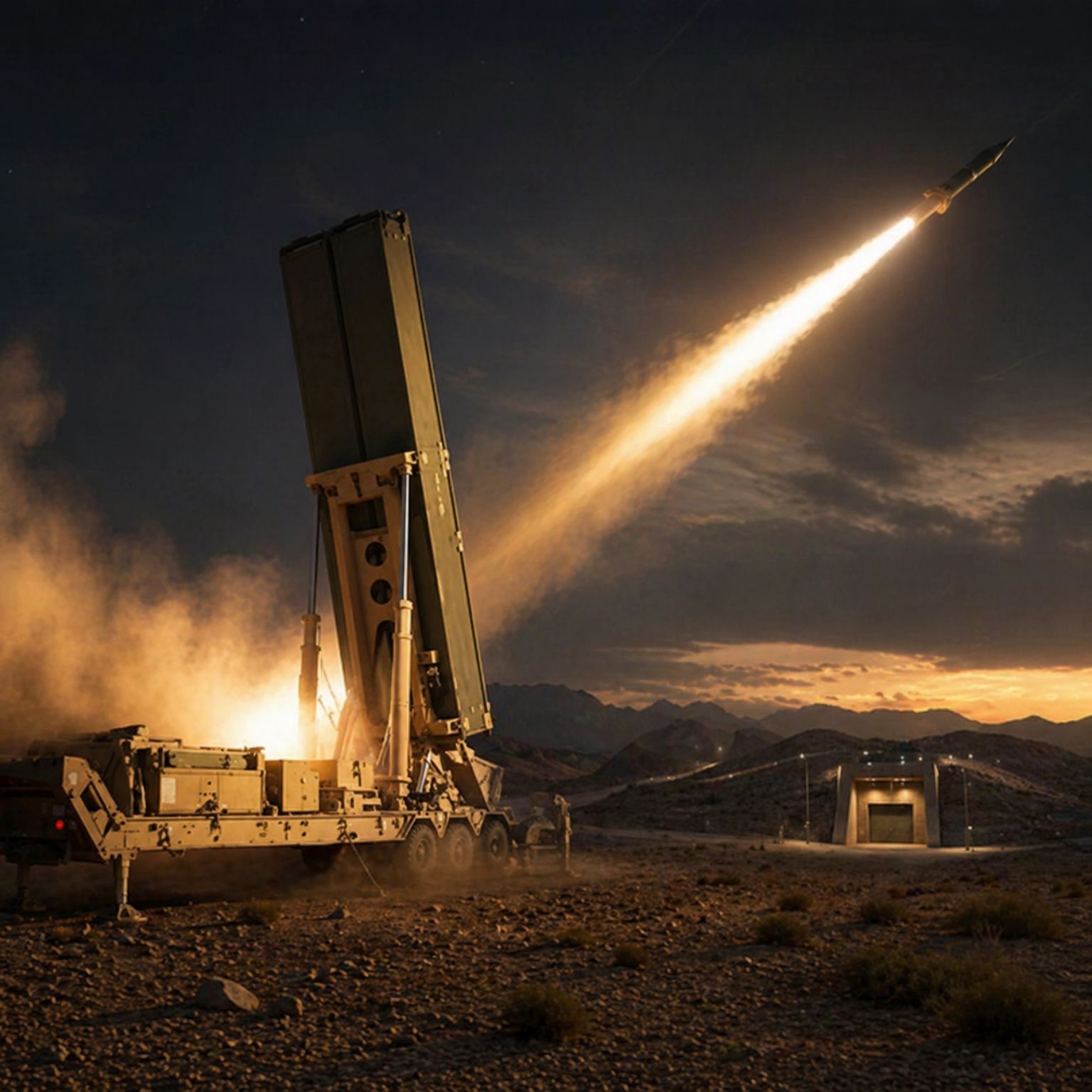


Hypersonic missile Dark Eagle may mark the first United States combat against Iran and officially open the American hypersonic era.
The hypersonic missile Dark Eagle may be used by the United States against Iran for the first time, according to the presented base, in a move that would have military, technological, and geopolitical weight simultaneously. Valued at around $15 million per unit, the system is described as the most sophisticated option available to hit deep, mobile, and underground targets that are currently out of reach for most precision weapons used by the U.S. and Israel.
The potential debut of the hypersonic missile draws attention because the Dark Eagle has never been employed in combat and appears linked to a scenario of regional escalation, repositioning of Iranian launchers to deeper areas of the territory, and partial depletion of part of the American conventional arsenal. If the request for use is approved, the launch would have practical value on the battlefield and would also serve as a symbolic milestone for the official entry of the United States into the hypersonic era.
What is the hypersonic missile Dark Eagle

The Dark Eagle is the military name given to the Long Range Hypersonic Weapon system, or LHW, officially named by the United States Army in April 2025. It is a ground-to-ground system of intermediate range, classified in the classic category between 1,000 and 5,500 kilometers.
-
In Brazil’s backyard: Tesla, by Elon Musk, announces official operations in Uruguay, where electric vehicles already make up 20% of new cars but still leaves out the largest market in the region.

-
This Mars rover may finally reveal if life ever existed on Mars.
-
A nearly 70-year-old Chinese inventor has registered 90 patents and created a device that stores water in the roots, helping seedlings survive drought while trying to transform the arid slopes of the Loess Plateau into green areas without relying on heavy irrigation.

-
Researchers want to change the way of producing rare earth magnets, reducing purification steps and making better use of the elements found in Swedish deposits.



What differentiates the hypersonic missile Dark Eagle, however, is not just the distance it can travel. The central point lies in the flight architecture known as boost-glide. This format combines extreme acceleration, separation from the initial stage, and atmospheric flight with active maneuvers until the target, significantly complicating any interception attempts with the current technology described in the base.
How the Dark Eagle technology works
The system operates in two stages. In the first, a two-stage solid fuel booster accelerates the assembly to the upper atmosphere and brings the weapon to hypersonic speed. In the second, this booster separates and releases an unpowered glider vehicle, which continues the flight within the atmosphere, maneuvering in the upper layers until reaching the target.
In practice, the hypersonic missile uses extreme speed and trajectory change to complicate interception calculations. According to the base, the glider vehicle alters its route during the mid and terminal phases of the flight, making it almost impossible to accurately predict the meeting point when the object moves at such high speeds.
The numbers that explain why the Dark Eagle draws so much attention
The data attributed to the Dark Eagle help explain the extent of the buzz around the system. The weapon is presented with a unit cost of about $15 million and an official range exceeding 2,775 kilometers, with estimates that could take this number up to 3,500 kilometers.
The speed is also one of the most impressive points. The base states that the hypersonic missile operates with a cruising speed in the Mach 5 range, equivalent to about 6,100 km/h, but can reach peaks of up to Mach 17. Instead of relying primarily on a large explosive warhead, the system concentrates its destructive effect on kinetic impact, making it especially relevant against armored structures, bunkers, and underground installations.
Why Iran appears as a possible target for the first time
According to the base, the justification for the possible use of the Dark Eagle is linked to the displacement of Iranian ballistic missile platforms to deeper areas of the territory, including caves and buried silos. As a result, these targets would have been out of reach for most of the precision conventional munitions available today.
This repositioning would have changed the operational logic. Instead of using more common armaments, the United States could resort to the hypersonic missile precisely because of the combination of long range, extreme speed, and the ability to hit buried structures in a short time. The central point is that Iran, according to the base itself, was not the original target of the program but has become an option given the current conditions of the conflict.
What changes in practice if the hypersonic missile is used
If the Dark Eagle is actually employed, the practical change will be immediate on two fronts. The first is military, because its use would open a new phase of American operations with hypersonic weaponry in real combat. The second is political, because such a launch would send a direct message to strategic rivals like Russia and China that Washington has not only developed the weapon but decided to put it into operational use.
This symbolic effect is treated at the base as part of the strategic calculation. An eventual launch against Iran would not only be read as a tactical response to buried targets but also as a demonstration of capability, credibility, and political willingness to employ a technology that until now was seen more as a promise than as a tool effectively used in war.
How the program was built and who is behind it
The Dark Eagle is described as an industrial consortium coordinated by the Pentagon. Lockheed Martin appears as the prime contractor, with the two-stage booster developed in partnership with Northrop Grumman and solid propulsion from Aerojet Rocketdyne. The glide vehicle was designed by Sandia National Laboratories, of the Department of Energy, and manufactured by Dynetics.
The entire program would have cost over US$ 12 billion in development, which helps to gauge the financial and technological weight of the project. This reinforces the idea that the hypersonic missile is not a one-off weapon, but part of a long-term strategy by the United States to respond to the advancement of rivals in similar systems.
Why the Dark Eagle was created and against whom it was born
According to the base, the program was born in 2018 within a Pentagon directive that prioritized hypersonic development as a response to three movements. The first was the entry into service of the Chinese DF-17 in 2019. The second was the declaration of operationality of the Russian Avangard in the same year. The third was the maturation of anti-access and area denial networks built by China and Russia in recent decades.
The cited employment doctrine points to three main missions. The first would be to defeat A2/AD networks by neutralizing sensors, commands, and long-range platforms. The second would be to suppress adversary fire sources, especially mobile ballistic missile launchers. The third would be to hit high-value, time-critical targets that emerge for a short window and disappear quickly.
What American stockpiles have to do with this decision
The base also links the possible use of the Dark Eagle to the recent depletion of the American arsenal. According to the cited analysis, the United States would have consumed a significant portion of offensive and defensive stockpiles in recent months, including interceptors and conventional missiles.
Another highlighted point is the situation of the GBU-57 penetrating bombs, described as practically exhausted and out of production. In this context, the hypersonic missile would emerge as an alternative for missions against deeply buried targets and beyond the reach of more traditional munitions, which helps explain why the weapon began to be considered for a theater that was not originally its priority.
How an operational Dark Eagle battery is formed
The operational structure of the system also helps to show its scale. According to the base, a battery is composed of four TEL launcher vehicles mounted on M983 prime movers, with each unit carrying two missiles. This brings the total to eight missiles ready for launch per battery, in addition to a mobile operations center and support vehicles.
The first operational battery of the American Army cited in the base is Bravo, of the 5th Battalion, 3rd Field Artillery Regiment, 17th Field Artillery Brigade, headquartered at Joint Base Lewis-McChord, in Washington state. The cost of a complete battery is estimated at around US$ 2.5 billion.
Why this possible launch would be a historic moment


The eventual authorization for the use of the Dark Eagle would be historic because it would mark the first combat launch of an American hypersonic missile. Until now, the United States has been following the advancement of similar systems by Russia and China, but had not yet transformed this capability into real deployment on the battlefield.
Therefore, the system’s debut would have a value that transcends the immediate target. It would consolidate a new technological level for American military power and reposition the global debate on hypersonic weapons, range, deterrence, and response speed in high-intensity conflicts.
The next steps and what’s at stake now
According to the base, the request for use would have been forwarded by the American military command and would depend on higher approval. If authorization is granted, the first operational firing of the Dark Eagle could occur in the coming weeks or months, depending on the evolution of the ceasefire and the regional situation.
What’s at stake is more than the debut of a weapon. The possible entry of the hypersonic missile into combat mixes technology cutting-edge, strategic messaging, and escalating tension in a region already marked by deep conflicts. It is precisely this combination that makes the Dark Eagle one of the most observed weapons of the moment.
Do you think the first use of an American hypersonic missile in combat would permanently change the military and political balance on the international stage?