Portuguese
  Spanish


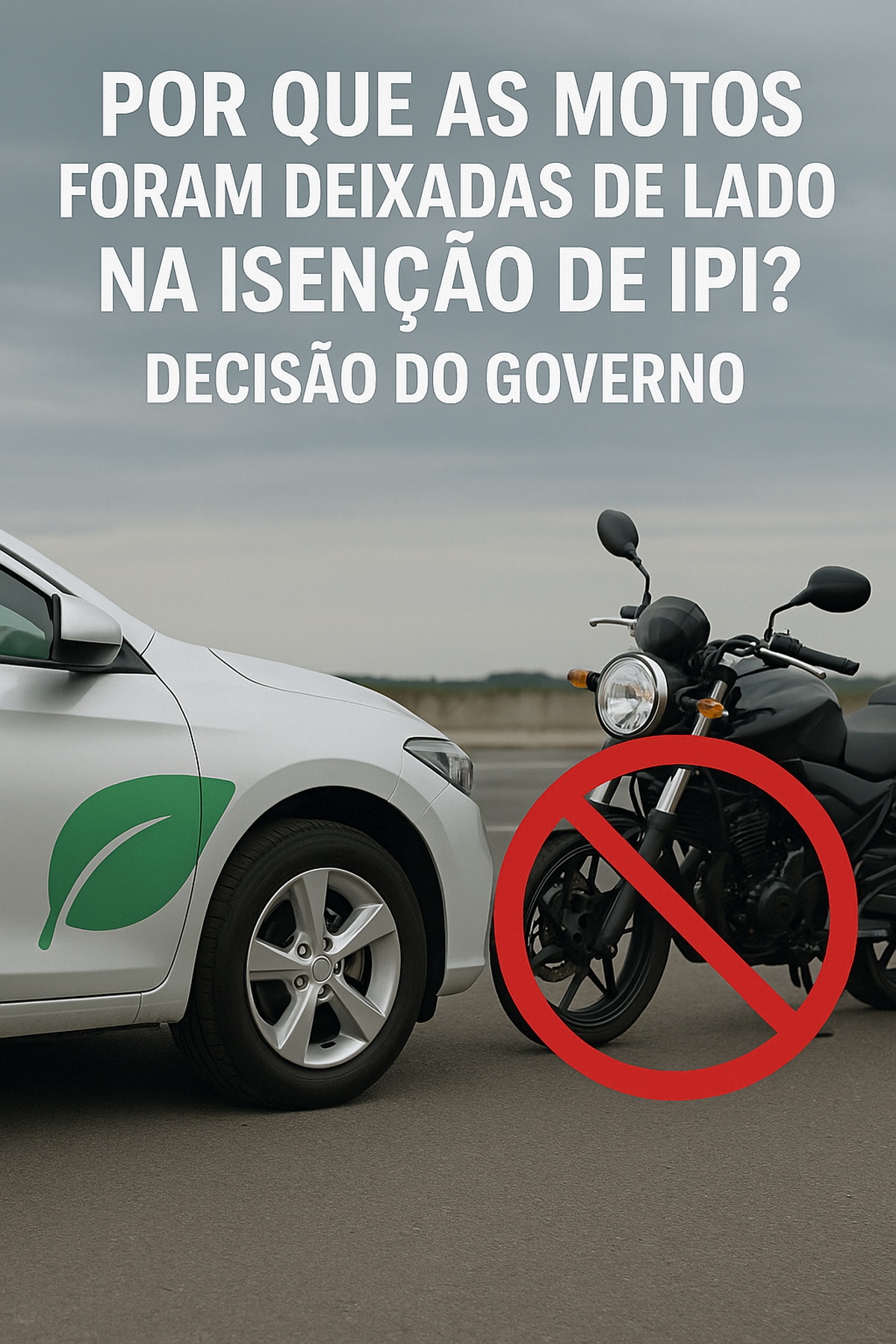

Government Eliminates IPI for Sustainable Cars, but Motorcycles Are Left Out. Discover the Technical, Environmental, and Fiscal Reasons Behind the Decision.
The federal government recently announced the exemption from IPI (Tax on Industrialized Products) for sustainable cars. The initiative is part of the Mover program, through the decree signed by President Lula. The program is aimed at vehicles with a lower environmental impact. However, one detail caught attention: motorcycles were left out of the new policy.
Car manufacturers operating in the country, such as Volkswagen, Renault, Hyundai, and Stellantis, have already started to announce price reductions for their more affordable models. But the tax benefit does not cover motorcycles.
So, why did the government decide to not include motorcycles in the benefits package? The answer involves technical, environmental, and even fiscal strategies
The main objective of the measure is to encourage the production and use of cleaner cars, especially electric, hybrid, and highly recyclable models. Since these vehicles are responsible for a large part of the greenhouse gas emissions, they were prioritized.
-
Owner of Havan Visits Paraguay to Discuss Lower Taxes, Local Suppliers, and International Expansion with President

-
Brazilian Construction Retail Chain Closes After 60 Years, Begins Liquidation Sale Across Five Cities

-
Brazil Approves Landmark Bill Requiring Workplace Adaptations for Autism Inclusion

-
Brazil’s Micro-Entrepreneur Program May See Major Changes: Income Cap Could Increase to R$ 130,000, Annual Inflation Adjustments, and Allow Hiring of an Additional Employee



On the other hand, motorcycles, although popular, have a different environmental impact — and account for a smaller share of total emissions. As a result, the government opted to focus efforts on cars.
Safety and Technology Criteria Exclude Motorcycles
Another important point: the criteria for the exemption involve technologies such as electronic stability control, automatic braking, and monitoring cameras — features common in cars but absent or unfeasible in most current motorcycles.
Additionally, the requirement for minimum recyclability levels and complete national manufacturing makes motorcycles less compatible with the current incentive model.
Despite the exclusion, the impact on the sector was smaller, as more than 90% of motorcycles produced in the country come from the Industrial Hub of Manaus and already enjoy specific tax benefits.
The Green IPI policy follows the principle of fiscal neutrality. This means that all tax reductions must be offset by increased revenue from other sources, without harming the federal budget.
The Mover Program Aims for Industrial Innovation — Mainly in Automobiles
The Mover program was designed to stimulate technological innovation in the Brazilian automotive industry, focusing on energy efficiency, decarbonization, and sustainable production chains.
The motorcycle sector, although relevant, is not at the center of this industrial policy at the moment.
Summary of Reasons:
- Motorcycles have a smaller environmental impact and are not a priority on the climate agenda.
- They do not meet the technical requirements set by the program.
- The government’s fiscal strategy focuses on sectors with higher financial and environmental returns.
- The policy seeks to foster innovation in more complex vehicles, such as electric and hybrid cars.
- Motorcycles already enjoy specific tax benefits.