Portuguese
  Spanish


Cheap franchises appear as an alternative for small towns, with home office, local services, and lower initial investment. List published on June 7, 2026, gathers 15 models starting from R$ 5 thousand, including education, credit, tourism, marketing, insurance, and solar energy for entrepreneurs in the current competitive Brazilian countryside.
Cheap franchises have entered the radar of those living in small towns who want to start a business with lower initial investment, home office operation, or local services. The list published by Exame on June 7, 2026, gathers 15 models starting from R$ 5 thousand and reaching up to R$ 15 thousand.
According to a report by Exame, the survey shows networks of education, healthy food, automotive services, credit, tourism, marketing, insurance, recruitment, solar energy, and digital solutions. The focus is on entrepreneurs in the countryside, where lower competition, reduced operational costs, and proximity to customers can influence the choice of model.
Small towns become target for low-investment models
Starting a business outside major centers may seem limited at first glance, but the survey shows that many networks have started operating with more flexible formats. Instead of requiring a physical store, several franchises operate in home office, digital service, local prospecting, or delivery model.
-
Owner of Havan Visits Paraguay to Discuss Lower Taxes, Local Suppliers, and International Expansion with President

-
Brazilian Construction Retail Chain Closes After 60 Years, Begins Liquidation Sale Across Five Cities

-
Brazil Approves Landmark Bill Requiring Workplace Adaptations for Autism Inclusion

-
Brazil’s Micro-Entrepreneur Program May See Major Changes: Income Cap Could Increase to R$ 130,000, Annual Inflation Adjustments, and Allow Hiring of an Additional Employee



This format aligns with the reality of smaller municipalities, where a commercial point may not be necessary to start. The logic is to reduce the entry cost and use local relationships as a competitive advantage, especially in services that rely on trust and referrals.
Cheap franchises also appear as an alternative for those with little capital who do not want to take on a heavy structure right at the start. However, the lower investment does not eliminate risks, as each operation depends on sales, service, commercial discipline, and adherence to the city’s market.
Therefore, the list works better as a starting point, not as an automatic promise of income. The investment data, average revenue, and return period were presented by the networks in the survey, but the actual result depends on the franchisee’s execution and local demand.
List starts with literacy, healthy eating, and automotive services
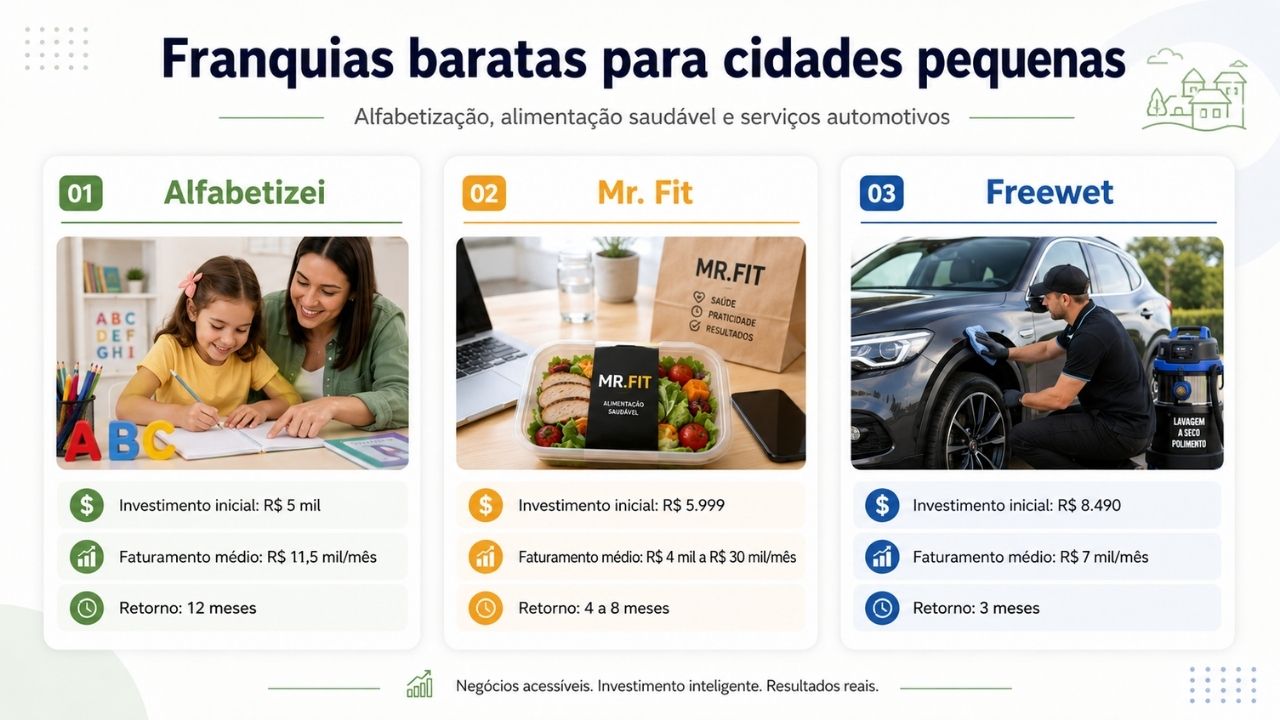
The option with the lowest investment is Alfabetizei, created in 2020 and aimed at literacy for children with pedagogical difficulties or health-related issues. The initial investment starts at R$ 5,000, with an average monthly revenue reported at R$ 11,500 and a return period of 12 months.
This type of franchise can find space in small towns due to the demand for educational reinforcement and specialized support. In the countryside, the lower presence of niche educational services can pave the way for closer family service.
Next is Mr. Fit, a healthy eating network that allows home office operation, managing deliveries from home. The initial investment starts at R$ 5,999, with an average monthly revenue reported between R$ 4,000 and R$ 30,000 and an estimated return between 4 and 8 months.
Among the affordable franchises on the list, Freewet enters through the automotive sector, with dry cleaning and vehicle aesthetics in a delivery model. The initial investment starts at R$ 8,490, the average monthly revenue reported is R$ 7,000, and the estimated return period is 3 months.
Credit, tourism, and local advertising appear among digital models
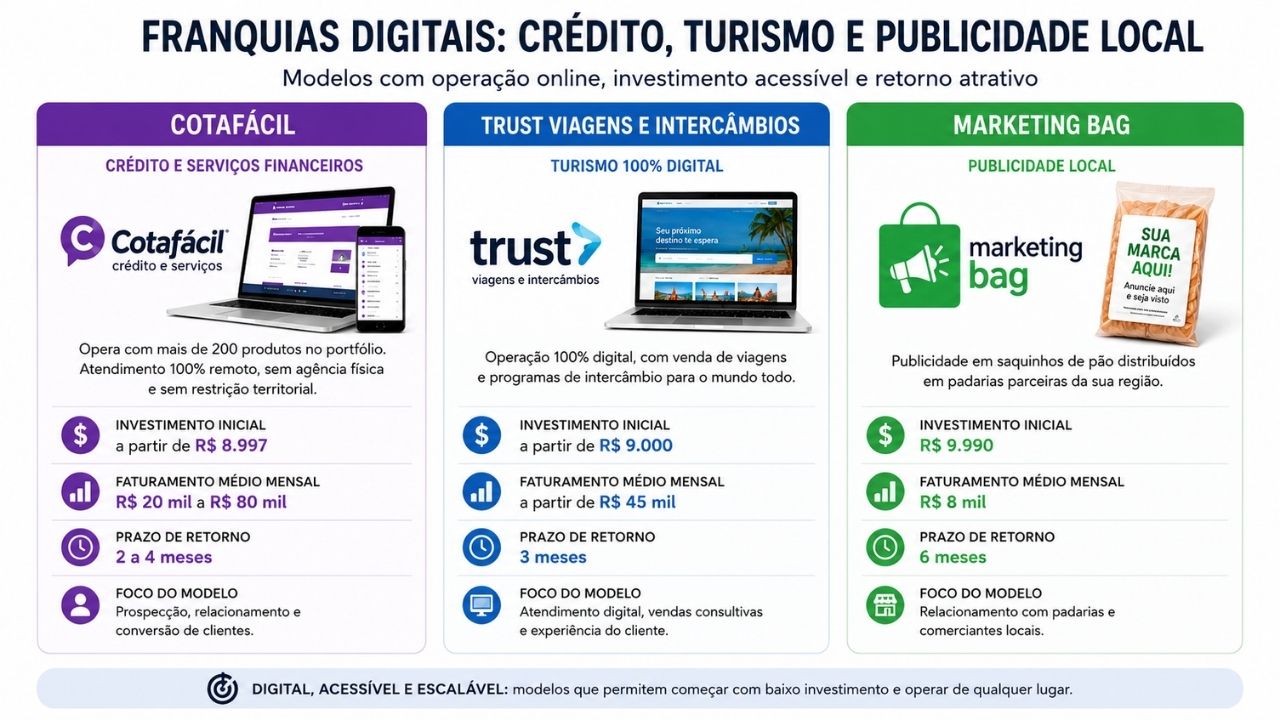
Cotafácil operates with credit and financial services, gathering over 200 products in its portfolio. As the operation is remote, the franchisee can serve clients without a physical agency and without territorial restriction, with an initial investment starting at R$ 8,997.
The average monthly revenue reported by the network varies from R$ 20,000 to R$ 80,000, with an estimated return between 2 and 4 months. It is a model that heavily depends on prospecting, relationship building, and the ability to convert clients into financial services.
In tourism, Trust Viagens e Intercâmbios appears with a 100% digital operation and an initial investment starting from R$ 9,000. The network reports an average monthly revenue starting from R$ 45,000 and a return period of 3 months.
Meanwhile, Marketing Bag works with advertising on bread bags distributed in partner bakeries. The initial investment is R$ 9,990, with an average monthly revenue reported at R$ 8,000 and an estimated return in 6 months, in a format that can greatly depend on the relationship with local merchants.
Home office expands the reach of franchises related to travel, visas, and events
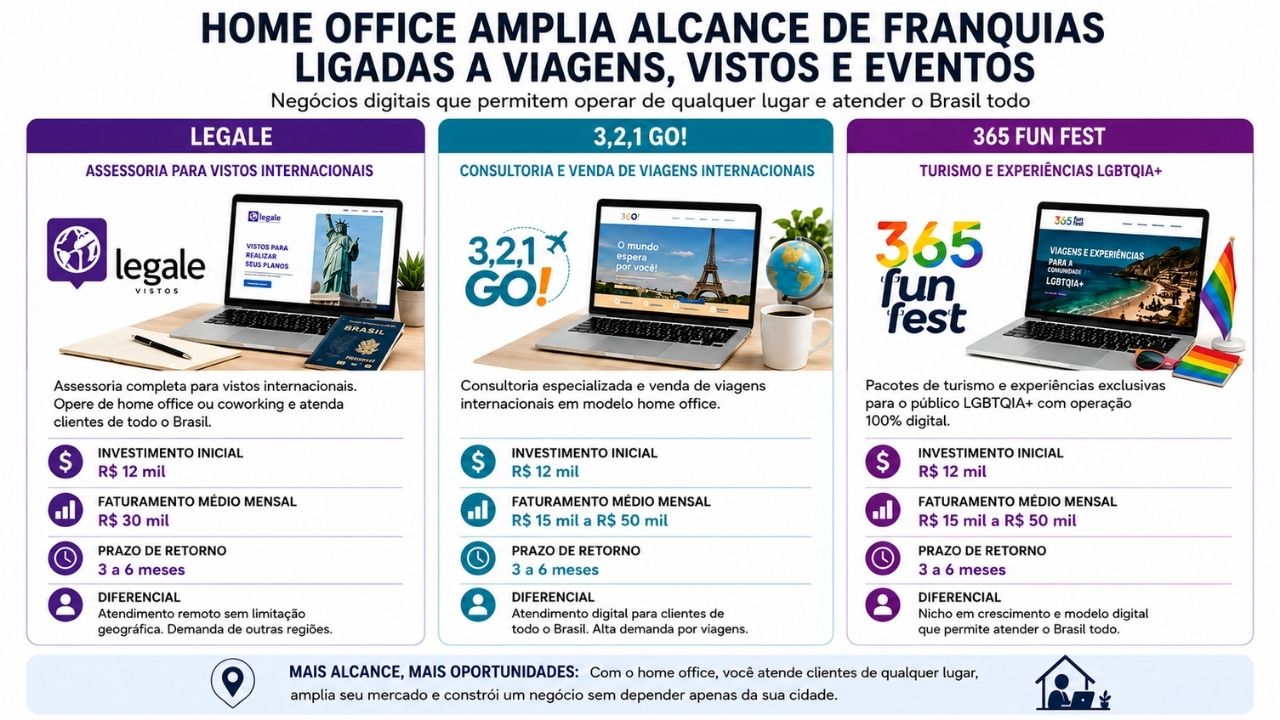
Legale operates with international visa advisory and allows operation in a home office or coworking space. The initial investment is R$ 12,000, with an average monthly revenue reported at R$ 30,000 and a return period between 3 and 6 months.
This type of service can be operated in a small town without limiting service to the municipality, as demand can come from other regions. The remote operation changes the business logic: the franchisee lives in the interior but does not rely solely on the local city’s audience.
3,2,1 GO! works with consulting and selling international trips, also in a home office model. The initial investment is R$ 12,000, with an average monthly revenue reported between R$ 15,000 and R$ 50,000 and an estimated return between 3 and 6 months.
365 Fun Fest, focused on tourism packages and experiences for the LGBTQIA+ audience, also operates digitally. The network reports an initial investment of R$ 12,000, average monthly revenue between R$ 15,000 and R$ 50,000, and a return period of 3 to 6 months.
Artificial intelligence, WhatsApp, and media in totems enter the list
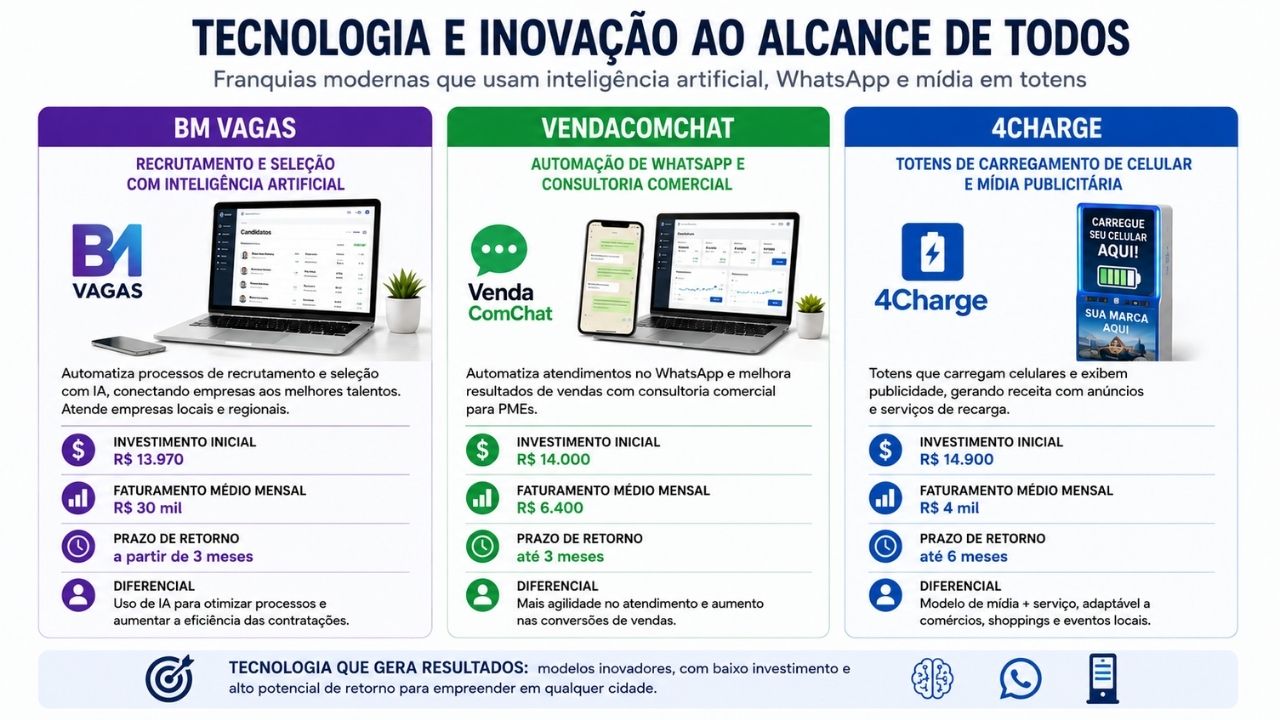
BM Vagas operates in recruitment and selection using artificial intelligence to automate processes. The initial investment starts at R$ 13,970, with an average monthly revenue reported at R$ 30,000 and a return period starting from 3 months.
In small towns, the model can target local and regional companies that need to hire but do not have their own selection structure. Technology serves as a tool, but commercial prospecting remains a decisive part of the operation.
VendaComChat offers WhatsApp automation and commercial consulting for small and medium-sized businesses. The initial investment is R$ 14,000, with an average monthly revenue reported at R$ 6,400 and an estimated return within 3 months.
4Charge works with cell phone charging kiosks that also function as advertising media. The initial investment is R$ 14,900, with an average monthly revenue reported at R$ 4,000 and an estimated return within 6 months, with possible adaptation to local businesses and events.
Insurance, solar energy, and marketing close the options up to R$ 15,000
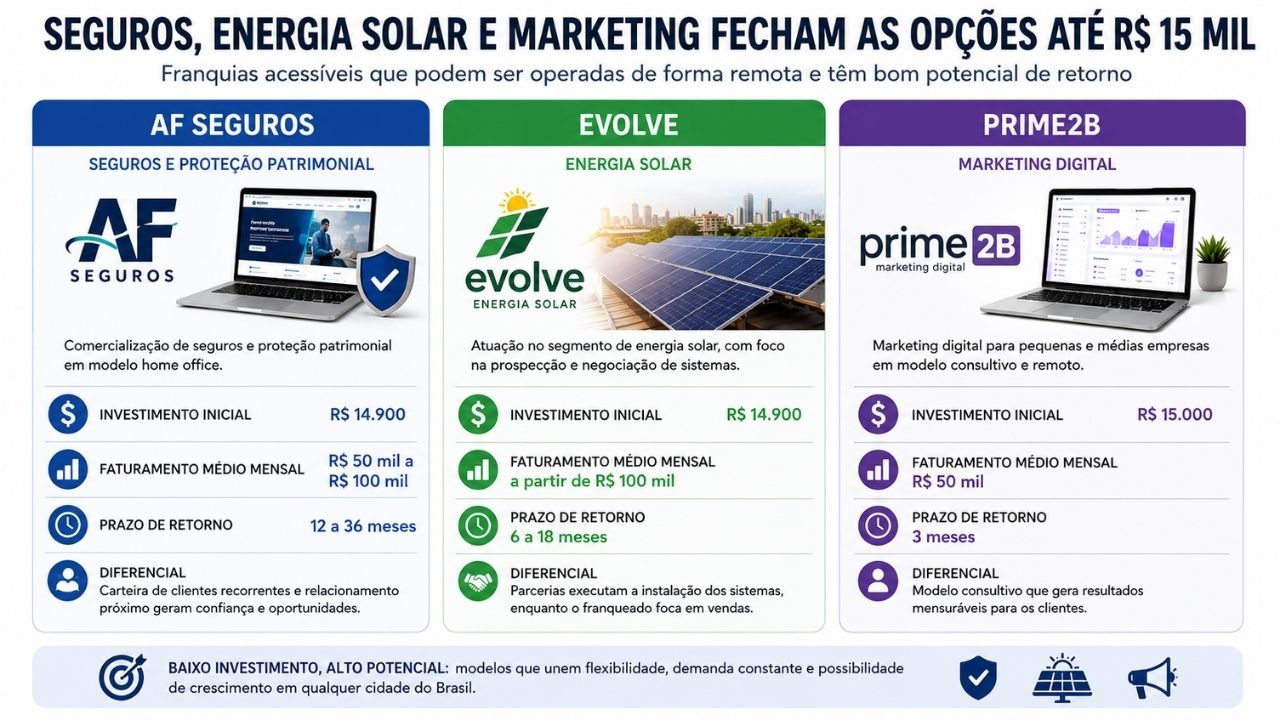
AF Seguros operates in the commercialization of insurance and asset protection in a home office model. The initial investment is R$ 14,900, with an average monthly revenue reported between R$ 50,000 and R$ 100,000 and a return period between 12 and 36 months.
Among the affordable franchises listed, this is a case where the portfolio of recurring clients can weigh heavily. In small towns, proximity to residents and businesses can help build trust, but sales require persistence and follow-up.
Evolve appears in the solar energy segment, with an initial investment of R$ 14,900, an average monthly revenue reported starting from R$ 100,000, and an estimated return between 6 and 18 months. The franchisee is involved in prospecting and negotiation, while partners execute the system installations.
Closing the list, Prime2B works with digital marketing for small and medium-sized businesses. The initial investment is R$ 15,000, with an average monthly revenue reported at R$ 50,000 and a return period of 3 months, in a consultative and remote model.
Low investment does not eliminate the need for planning
Although cheap franchises attract attention due to the reduced investment, the choice requires careful analysis. The entrepreneur needs to assess whether there is local demand, if the model fits their routine, if the franchisor offers consistent support, and if the estimated revenue makes sense for their reality.
It is also important to compare return periods, fees, contractual obligations, prospecting needs, and operational costs. A franchise with a lower investment may be more accessible to start, but it remains a business that requires sales, management, and consistency.
Another point is that small towns may offer less competition, but they also have smaller consumer markets. This makes the choice of segment even more important, especially in areas like tourism, digital marketing, credit, insurance, and solar energy.
In the end, the differentiator may lie less in the size of the town and more in the ability to identify a real pain point of the local audience. Those who understand the community’s routine can turn proximity into an advantage, as long as the chosen model has market adherence.
Cheap franchises can open doors, but they don’t replace strategy
The list shows that the interior has become part of the strategy for networks betting on digital formats, home office, and local services. For those who want to start a business with little capital, cheap franchises can represent a more accessible entry point than traditional businesses with a physical store.
Even so, the numbers should be read with caution. Initial investment, average revenue, and return period are not guarantees of results, but indicators to compare models before making a decision.
The scenario also reinforces a change in the market: living in a small town no longer prevents someone from operating businesses connected to clients from other regions. With the internet, standardization, and network support, some models can overcome geographical limitations.
And you, would you open a franchise in the interior or do you think the risk is still high even with a lower investment? Leave your opinion in the comments and tell us which of these models seems more viable for a small town.