Portuguese
  Spanish


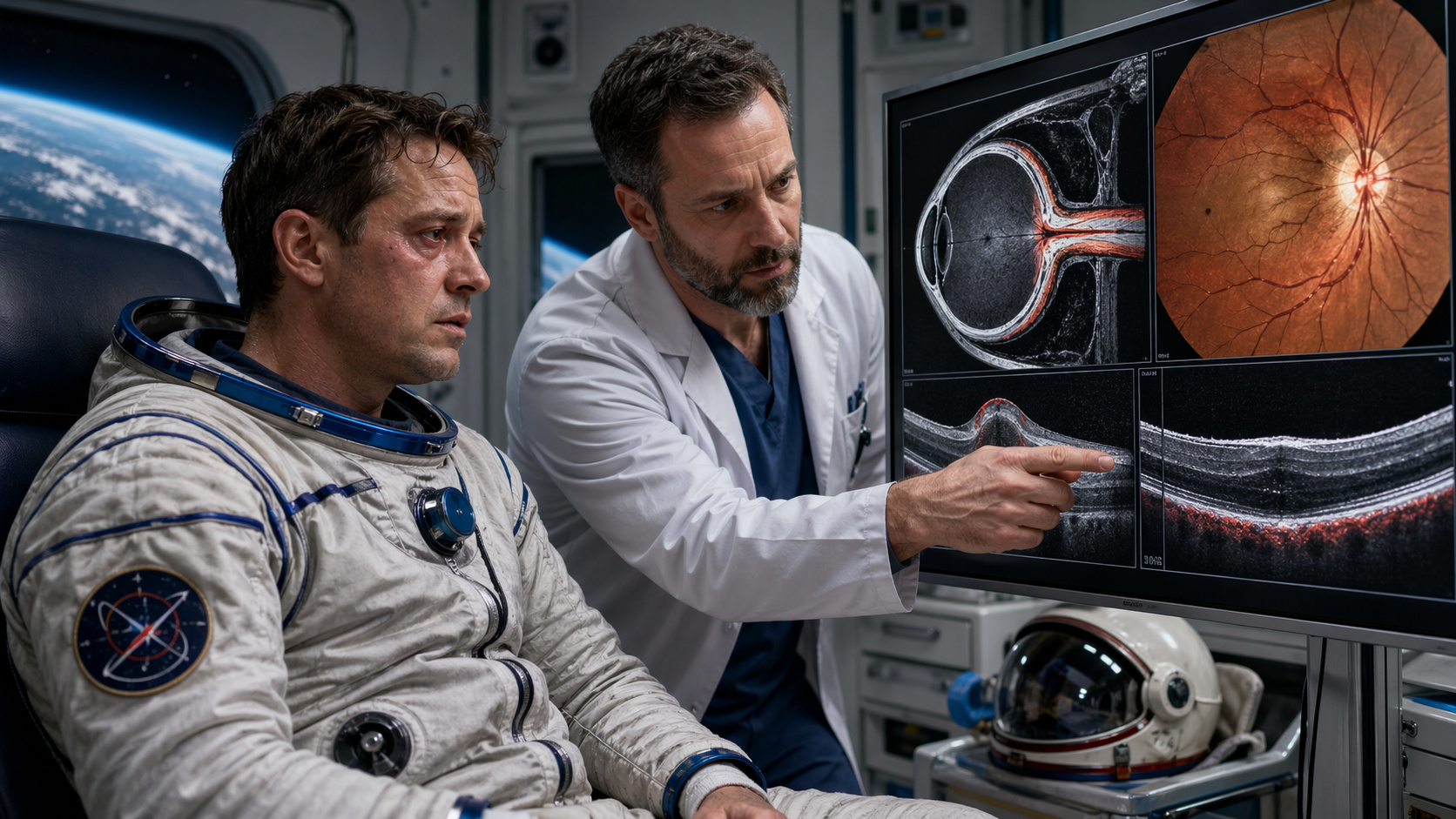


NASA alerts that up to 70% of astronauts experience ocular changes in space, with increasing risk for long missions like Mars.
According to NASA, approximately 70% of astronauts who spend months on the International Space Station show some degree of inflammation in the back of the eyes. The phenomenon has had an official name since 2011: Spaceflight Associated Neuro-Ocular Syndrome, known by the acronym SANS. The American space agency classifies SANS as the primary health risk in long-duration missions, surpassing well-known issues such as bone loss, muscle weakening, and exposure to cosmic radiation.
So far, the only proven remedy is the use of corrective glasses during flight. However, the internal structural changes remain without effective treatment.
Functioning of the human eye depends on balance between intraocular pressure and cerebrospinal fluid pressure
The human eye does not function in isolation. It is directly connected to the brain via the optic nerve, which is responsible for transmitting visual information.
-
China’s Solar Panel Installation in Desert Unintentionally Alters Soil, Moisture, and Vegetation Dynamics

-
China’s Plan to Prevent Giant Asteroids from Hitting Earth Involves Deep Nuclear Blasts and 20 Years of Preparation
-
Google Invests Billions in Italian Island’s Innovative Energy Storage Using Liquid CO2 Technology

-
LG Unveils 670-Liter Multidoor Refrigerator in Brazil with Transparent “InstaView” Panel, Independent Temperature Zones, and Smartphone Control, Starting at $15,100




This nerve is surrounded by a sheath that contains cerebrospinal fluid, the same fluid that circulates in the brain and spinal cord.
There is a delicate balance between the internal pressure of the eye and the pressure of this fluid around the nerve. This difference is called the translaminar gradient and is essential for maintaining the structural integrity of the visual system. On Earth, gravity naturally regulates this balance, distributing bodily fluids in a stable manner.
Microgravity alters distribution of body fluids and increases pressure inside the skull
In the space environment, the absence of gravity completely modifies the distribution of fluids in the human body.


Fluids migrate to the upper part of the body, causing facial swelling, thinning of the legs, and increased intracranial pressure.
This increase in pressure propagates through the cerebrospinal fluid to the region of the optic nerve, altering the balance necessary for the proper functioning of the visual system.
Studies with magnetic resonance show flattening of the ocular globe and swelling of the optic nerve
SANS was formally described in 2011 by ophthalmologist Thomas Mader and team, based on examinations conducted before and after long-duration space missions.
The results showed significant structural changes: swelling of the optic disc, flattening of the back of the ocular globe, and folds in the choroid.
Spots on the retina associated with reduced blood flow and worsening near vision, characterized as hypermetropic shift, were also observed.
Incidence of SANS can reach up to 70% of astronauts on prolonged missions
More recent analyses have expanded the understanding of the problem. While about 23% of astronauts on short missions reported visual changes, this number rises to approximately 48% on longer missions.

Consolidated data indicate that the incidence can reach up to 70% during prolonged stays on the International Space Station.
Genetic and nutritional factors influence risk of ocular changes in space
Studies indicate that elevated levels of homocysteine are associated with greater severity of ocular changes.
This compound is regulated by B-complex vitamins, especially folate and vitamin B12. Changes in these levels can compromise the integrity of vascular structures and increase vulnerability to SANS.
Research also points to possible genetic influences, suggesting that some astronauts may have a greater predisposition to developing the syndrome.
Physiological differences between individuals may explain variation in symptom severity
Not all astronauts are affected in the same way, even under identical conditions. One hypothesis involves anatomical differences that can influence venous drainage from the head, altering intracranial pressure.
Another factor is the still limited distribution of data between men and women, which prevents definitive conclusions about sex differences.
One of the most concerning characteristics of SANS is its persistence. Although optic nerve swelling may regress over time, changes such as globe flattening and retinal changes can remain for years.
In some cases, these changes were considered permanent.
SANS may increase future risk of diseases like glaucoma due to pressure on the optic nerve
Researchers assess that SANS may increase the long-term risk of developing diseases such as glaucoma.
The condition involves progressive damage to the optic nerve caused by pressure, a mechanism similar to that observed during prolonged exposure to microgravity. However, there is still not enough data to quantify this risk over decades.
Among the solutions under study is the use of negative pressure devices on the lower body, which help redistribute fluids.
Another approach involves creating artificial gravity through centrifugation, which could partially restore the natural behavior of fluids in the human body.
Despite advances, none of these solutions have shown proven effectiveness in real long-duration space missions.
Missions to Mars increase SANS risk and challenge the limits of space medicine
Crewed missions to Mars represent an even more complex scenario. The journey can last between six and nine months in each direction, exposing astronauts to microgravity for long periods.
Mars’ partial gravity may not be enough to reverse the damage accumulated during the journey.
Studies indicate that current countermeasures may not work adequately in reduced gravity environments.
Now we want to know: is the human body prepared to withstand long-duration space missions without permanent damage?
Spaceflight-Associated Neuro-ocular Syndrome raises questions about the physiological limits of space exploration.
In your view, will science be able to solve this problem before crewed missions to Mars, or could the human body itself be the biggest obstacle to this next stage of exploration?