Portuguese
  Spanish


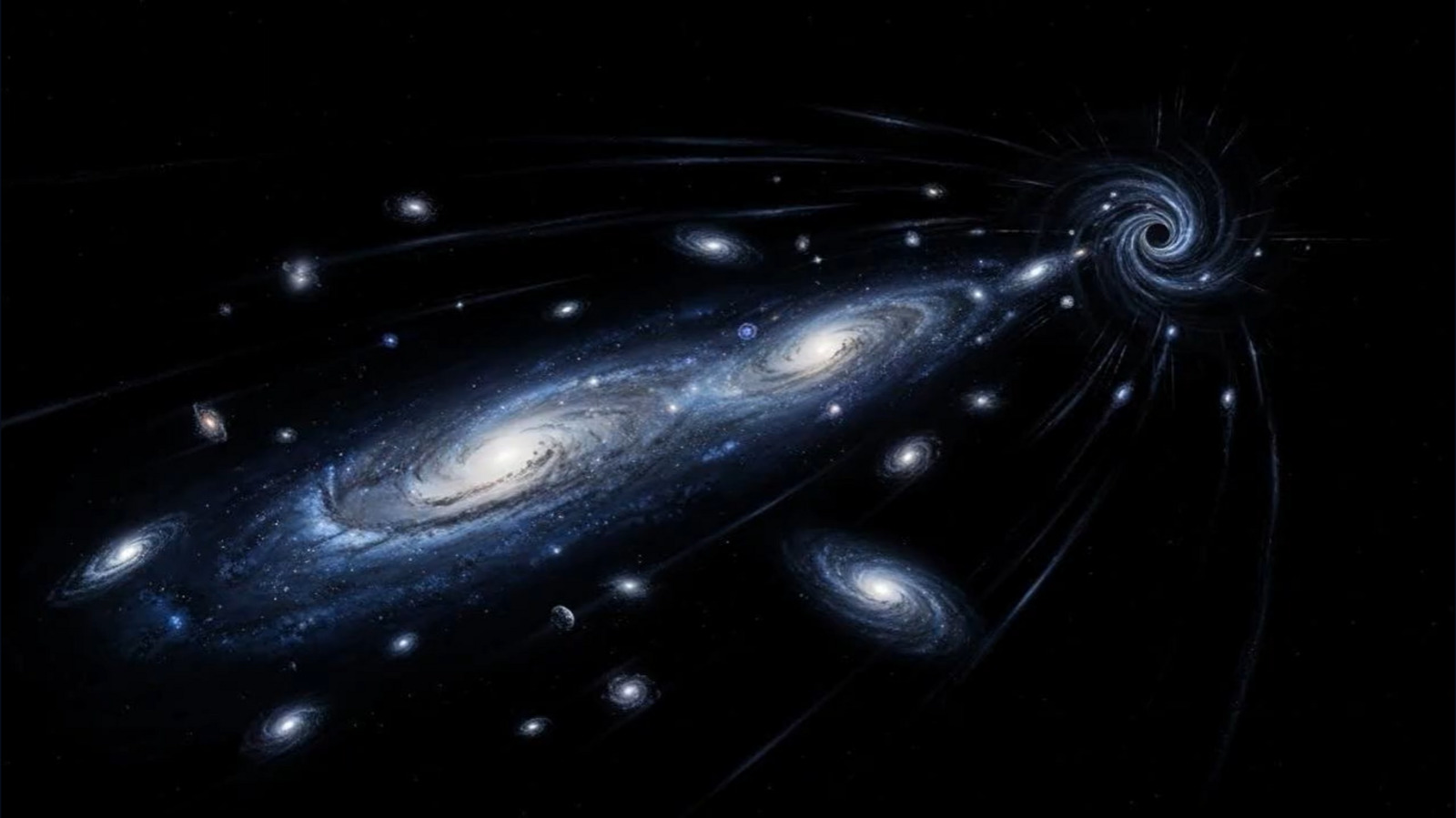


Mapped behind the Milky Way, Vela-Banzi gathers an estimated mass of 30 quadrillion suns, is 300 million light-years across, and helps astronomers understand hidden structures of the nearby universe with new data
With about 30 quadrillion suns, Vela-Banzi has been mapped behind the Milky Way and appears as one of the largest known structures in the nearby universe, hidden by dust, gas, and stars.
The discovery was detailed in a study published on arXiv, focusing on matter distribution and large-scale architecture.


Structure hidden by the galaxy itself
The supercluster, previously known as Vela, is approximately 800 million light-years from Earth.
-
Engineers Develop Fridge-Sized Machine to Produce 95-Octane Synthetic Fuel from Air and Water, Aiming to Sustain Combustion Engines Without Oil

-
Two-Armed Robot Uses AI to Reassemble Destroyed Pompeii Frescoes, Solving an “Impossible” Puzzle
-
New Law in Brazil Requires Breaks for Type 1 Diabetes Management at Work, School, and Public Exams

-
Scientists Confirm “Greening” of Antarctica: Ice on the World’s Coldest Continent Turns Green as Mosses Multiply Over Tenfold in Four Decades


It remained difficult to measure because it is behind the Zone of Avoidance, a region blocked by the dense disk of the Milky Way.
This area concentrates enough stars, gas, and dust to prevent direct observation. Even relatively close on a cosmic scale, the complex remained for years as only a partial presence in astronomical surveys.
The new analysis shows that Vela-Banzi extends for about 300 million light-years. This dimension makes it approximately 3,000 times larger than the Milky Way, expanding the perception of cosmic architecture.
Within this expanse, there are at least 20 galaxy clusters. Each cluster gathers hundreds or thousands of galaxies bound by gravity, forming a gigantic network of matter distributed on a large scale.
The estimated mass, about 30 quadrillion suns, places the structure among the most massive known in this region of the universe. The complex surpasses Laniākea, where the Milky Way is located, and rivals Shapley.
Two enormous nuclei approaching
One of the central points of the discovery is the concentration of a large part of the mass in two massive nuclei.
These nuclei are slowly moving towards each other, showing an ongoing interaction.
This movement indicates a large-scale evolution happening over cosmic time. The structure offers a rare glimpse into how enormous formations grow, connect, and undergo gravitational mergers.
The supercluster was named Vela-Banzi, derived from the Xhosa language. The meaning is “revealing widely,” a direct reference to the revelation of a structure that was hidden behind our own galaxy.
How scientists crossed the barrier
Observing beyond the Milky Way’s disk is difficult because millions or billions of stars occupy that band. The closer to the galactic plane, the thicker the dust layer becomes.
To circumvent the obstacle, scientists gathered approximately 65,000 galaxy distance measurements. To this set, nearly 8,000 new redshift observations were added.
Redshift allows measuring the speed at which galaxies move away. This information helps estimate position and movement in space, fundamental elements for outlining the formation’s boundaries.
The MeerKAT radio telescope in South Africa played a decisive role in this advance. The instrument captures radio emissions from hydrogen gas present in galaxies, signals capable of penetrating the dust that blocks visible light.
About 2,000 redshift measurements came directly from MeerKAT. This allowed galaxies never seen by optical telescopes to be included in the mapping of Vela-Banzi.
This combination allowed tracing boundaries and internal movements with much greater precision than before. The result is not yet a complete map, but it offers a robust basis for the structure’s scale and complexity.
Why the map matters for cosmology
The mapping of Vela-Banzi carries more weight than the identification of a single supercluster. Structures of this size help test cosmological models, an area dedicated to the origin and evolution of the universe.
Understanding the distribution of matter on such large scales allows us to verify if current theories accurately describe the observed reality.
Size, mass, and motion need to be analyzed together to complete this reading.
The discovery also shows that part of the universe remains hidden not by distance, but by observational barriers. Even in a cosmic neighborhood considered accessible, there are still partially explored regions.
Radio astronomy emerges as a central path to advance in these blind spots. By capturing signals that penetrate dust, it allows for the revelation of galaxies and structures invisible to optical instruments.
Next steps in the hidden universe
Despite the advancement, the map of the Vela Supercluster remains incomplete. Not all galaxies emit strong radio signals, which keeps some regions difficult to observe, even with advanced instruments.
Future telescopes with greater sensitivity will be able to refine the image of the formation. Still, parts of Vela-Banzi may remain obscured, setting limits for the complete reconstruction of its structure.
Current progress opens space for a deeper exploration of the Zone of Avoidance. With better techniques and more data, astronomers hope to find other hidden structures, perhaps comparable to or larger than this one.
Each new identification adds a piece to the map of the universe. Vela-Banzi shows that already observed areas can still hide immense formations, capable of changing the understanding of cosmic architecture.
With information from Daily Galaxy.