Portuguese
  Spanish


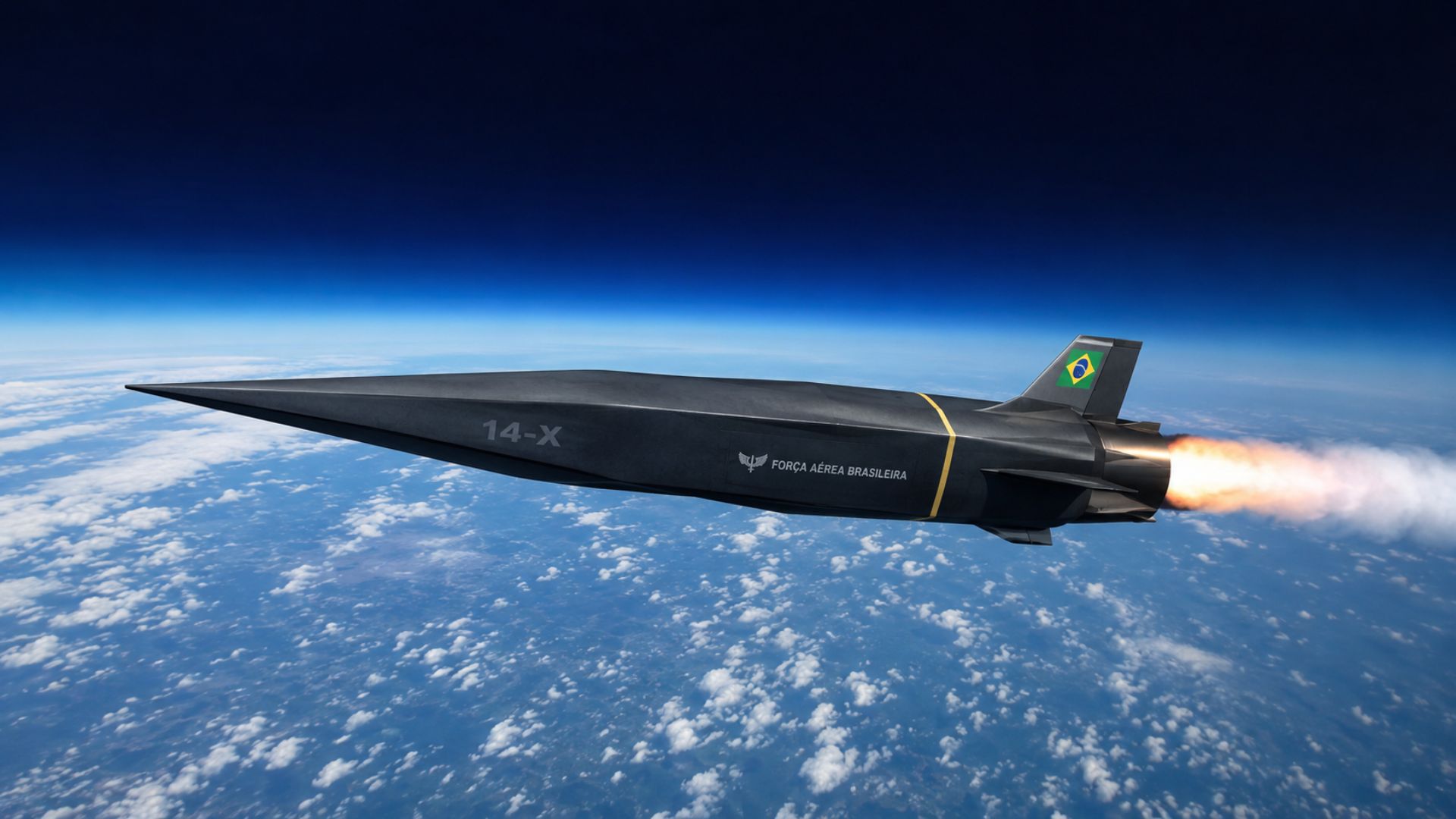


The flight took place in December 2021, in the so-called Operation Cruzeiro, and validated for the first time in Brazil the so-called aspirated hypersonic propulsion, capable of burning hydrogen in full supersonic flow. Now the Santa Catarina company Mac Jee is developing the accelerator rocket that should take the next generation of the project to flight, scheduled for 2027.
At 30 kilometers altitude and almost 7,000 kilometers per hour, the 14-X demonstrator of the Brazilian Air Force tested a scramjet engine without moving parts in Alcântara, in an experiment that marks the country’s entry into a select international group of nations with the capability to conduct flight tests of this technology. The program, conducted by the Institute of Advanced Studies, of the FAB itself, aims in the long term for the bold level of Mach 10 and has just received a historic investment of R$ 93 million from Finep.
The 2021 test was not a missile flight nor a military display ready for operation. It is a technological demonstrator, part of the so-called PropHiper Project, aimed at research in aspirated hypersonic propulsion, an area in which very few countries can test in a real environment. The name 14-X is a tribute to Santos Dumont’s 14-Bis, from 1906, with the letter X representing the goal of reaching 14 times the speed of sound in the more distant horizon of the program.
What was done in Operation Cruzeiro
On December 14, 2021, the Alcântara Launch Center, in Maranhão, hosted the first test flight of the Brazilian scramjet engine, dubbed Operation Cruzeiro. The 14-X S demonstrator was attached to the top of a Hypersonic Accelerator Vehicle based on the VSB-30 sounding rocket, from the Brazilian Space Agency, and taken to over 30 kilometers altitude for the experimental engine to reach operating conditions.
-
Scientific Breakthrough: Bacteria Found in a Rio de Janeiro Lagoon Guide Mars Research After Scientists Identify Similarities to Extreme Environments, Expanding Understanding of Extraterrestrial Life Possibilities

-
Brazilian Mechanic Wins Indian Presidential Award for Inventing Fuel-Efficient Agricultural Machine

-
Brazilian Polilaminin Reaches 100 Spinal Cord Injury Patients Through Compassionate Use, Shows Progress After 6 Months, Highlighting UFRJ’s Role in Experimental Regeneration Research

-
Electrolux Unveils New Stove with Integrated Airfryer, PerfectCook360, VaporBake, Grill, Glass Top, and Oil-Free Large Portion Cooking




In that flight, the set reached a speed close to Mach 6, equivalent to about 7,350 kilometers per hour, with a suborbital apogee of 160 kilometers and a trajectory of approximately 200 kilometers until it fell in a safe area in the Atlantic Ocean. It was the first time a Brazilian aircraft validated in a real environment the supersonic combustion of the scramjet, considered one of the most complex engineering challenges humanity attempts to solve.
Why the scramjet is so difficult
To understand the difficulty, it’s worth understanding how the engine works. In conventional rockets, it is necessary to carry both the fuel and the oxidizer on board, which means that more than half of the launched mass is not useful. The scramjet, an acronym for supersonic combustion ramjet, dispenses with the oxidizer: it uses the oxygen from the atmosphere itself, captured at supersonic speed, to burn the hydrogen injected into a chamber without moving parts.
The challenge is to maintain stable combustion in an airflow that enters the engine at a speed greater than that of sound. It’s something equivalent to trying to light and maintain a flame inside a hurricane at 7,000 kilometers per hour, with external temperatures exceeding 2,000 degrees Celsius, hotter than the lava of many volcanoes. Only a handful of countries have succeeded in making this technology work under real flight conditions.
Mach 6 already achieved, Mach 10 as a goal


It is important to carefully separate what has already been done from what is yet to come. The 2021 flight reached Mach 6, a historic milestone for Brazilian engineering. The final goal of the program, however, is more ambitious: to reach something between Mach 10 and Mach 14, that is, about 12,000 to 17,000 kilometers per hour, in successive phases of development. For this, it will be necessary to overcome thermal, structural, and material barriers that still require years of research.
The PropHiper program is divided into four phases, all detailed by the FAB itself. The first, of the 14-X S, was completed in 2021. The second, of the 14-X SP, foresees the demonstration of the real thrust of the scramjet, and not just the combustion. The third, of the 14-X W, targets glided and controlled flight in a hypersonic regime, with guidance systems. The fourth and final, of the 14-X WP, involves a fully autonomous vehicle in the so-called waverider pattern, in which the fuselage shape itself takes advantage of the shock wave as lift.
The accelerator rocket made by Mac Jee
Since the scramjet only works at high speed, an auxiliary rocket is needed to bring the vehicle to the right point of operation. This is precisely the role of the RATO-14X, an acronym for Rocket Assisted Take-Off. The development is in charge of the Brazilian company Mac Jee, in partnership with IEAv, with Orbital Engenharia and with the participation of the Instituto Tecnológico de Aeronáutica, ITA, in an agreement announced at the beginning of 2026.
The RATO-14X is expected to be about 14 meters long and approximately 15 tons in mass, capable of accelerating the demonstrator to speeds around Mach 8, up to the ideal starting conditions for the scramjet. The launcher can also, in the future, integrate larger rockets, eventually used to place satellites in orbit, which connects the program directly to Brazil’s broader space sovereignty agenda.
Historic Investment of R$ 93 Million
In 2024, the Financier of Studies and Projects, Finep, announced an investment considered historic for the defense area: R$ 93 million allocated to the development of the national hypersonic rocket, a figure cited by publications like Hora do Povo and Sociedade Militar. In the same period, the project was included as a critical technology in the New Industry Brazil program, with a goal of 50% national autonomy by 2033.
The institutional leap came in December 2025, with the signing, published in the Official Gazette of the Union, of a 36-month technical cooperation agreement between the Brazilian Air Force and Mac Jee, mobilizing more than 40 engineers, researchers, and specialized technicians. In February 2026, ITA also signed a partnership with the company, further expanding the scientific and industrial base involved in the project, with a perspective of involving around 500 professionals until the first flight of the launcher, scheduled for the end of 2027 in Alcântara.
A Select Group of Nations with Hypersonic Tests
With the success of Operation Cruzeiro, Brazil joined a restricted group of countries that managed to bring aspirated hypersonic propulsion to a real flight test. The United States, Russia, and China are clearly ahead, with more mature programs, and India, France, Australia, and Japan also conduct research in advanced stages. Each source combines these names slightly differently, depending on the criteria used, whether scramjet engine in flight, operational missiles, or experimental demonstrators.
What differentiates the Brazilian case is the eminently civil and strategic nature of the program, conducted around research and training of engineers, not around weapons in use. The FAB and IEAv speak of aspirated hypersonic propulsion as a technology capable of serving both future fast aircraft and space access systems at lower cost, benefiting the Brazilian space program as a whole.
Why This Topic Matters to the CPG Reader
For the oil, gas, and infrastructure audience, the 14-X is more than an aerospace curiosity. It symbolizes Brazil’s bet on critical technologies, with a national industrial chain, qualified jobs, and dual-use potential, in an area dominated by few world powers. The combination of hydrogen as fuel, advanced materials resistant to extreme temperatures, and precision manufacturing also aligns with current debates on energy transition and high-complexity industry.
Furthermore, the program strengthens the strategic position of the Alcântara Launch Center, a national asset that has been discussed in international agreements as Brazil’s gateway to the global space launch market. Each successful test in Alcântara increases the relevance of the base and the surrounding Maranhão economy, with impacts ranging from regional technical training to attracting investments in defense and aerospace companies in the country.
The 14-X is both a concrete scientific achievement and a long-term promise. The Mach 6 already reached in 2021 shows that Brazilian engineering is capable of operating in conditions that very few countries in the world can replicate. The R$ 93 million from Finep and the involvement of Mac Jee, ITA, and Orbital Engenharia in the project, combined with the RATO-14X schedule until 2027, provide the program with an unprecedented structure. It remains to be seen if the schedule is met and if the next phases deliver the expected leaps towards the Mach 10 level and beyond.
And you, did you know that Brazil has already tested a scramjet engine in flight at almost 7,000 kilometers per hour? Do you believe that the country has real conditions to reach Mach 10 with national technology in the next decade? Leave your comment, tell us how you see the PropHiper program, and share the article with those interested in defense, aerospace, science, and technology.