Portuguese
  Spanish


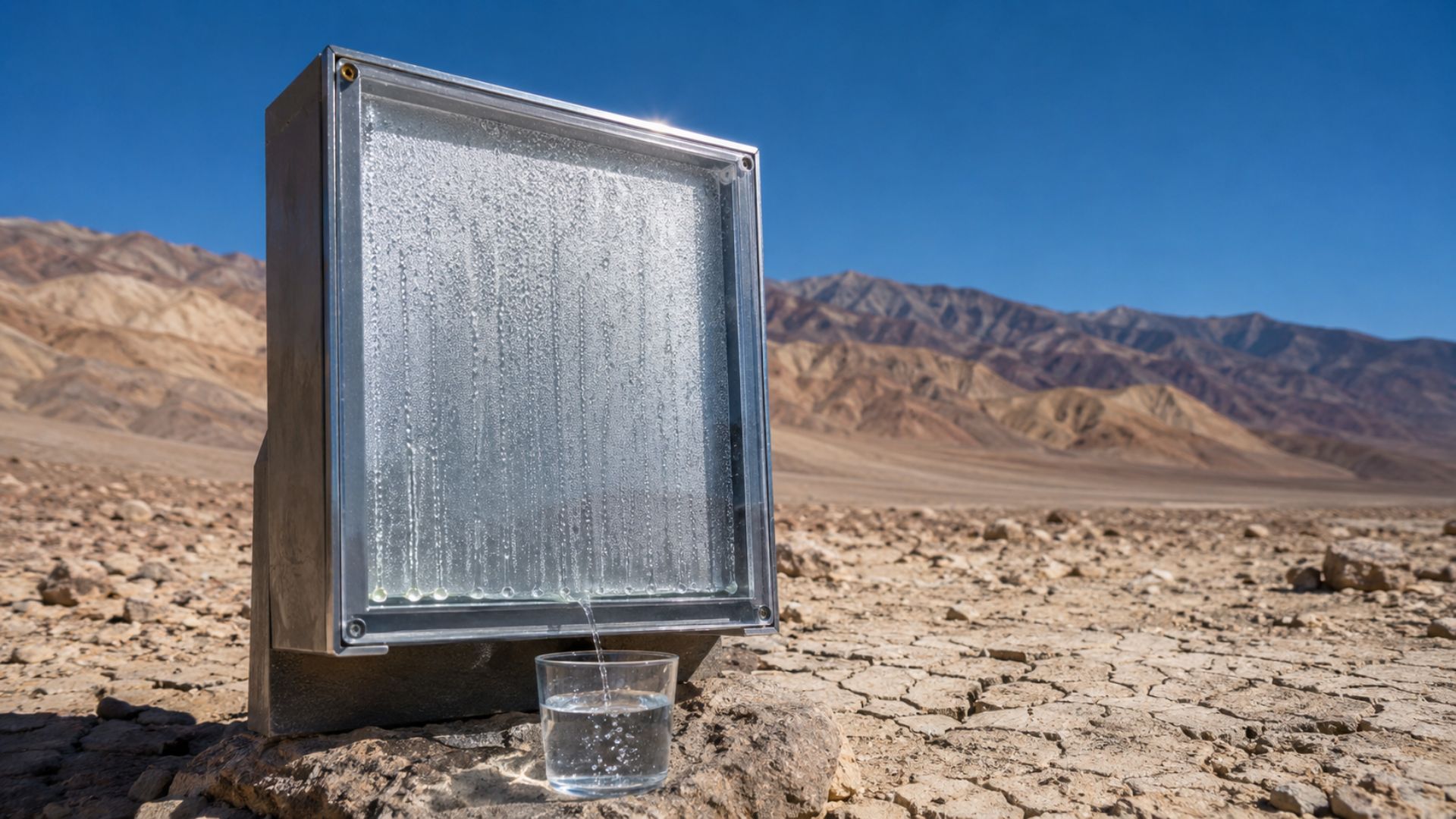


The equipment was installed in one of the driest places on the planet and operated for over a year, producing between 57 and 161 milliliters per day. Behind the idea is a family of ultraporous materials awarded in October, capable of capturing water molecules with air humidity below 10 percent.
A window-sized device, without electricity or filters, managed to extract potable water from the dry air of Death Valley, United States, using only sunlight. The result comes from a study by the Massachusetts Institute of Technology, MIT, published in June 2025 in the journal Nature Water, and gives new impetus to a family of technologies crowned a few months later with the 2025 Nobel Prize in Chemistry.
The experiment was led by Professor Xuanhe Zhao, from the Department of Mechanical Engineering at MIT. In an environment where the relative humidity of the air ranged between 21% and 88%, the device produced between 57 and 161 milliliters of water per day, in an amount compatible with the World Health Organization’s potability standards. For comparison purposes, commercial atmospheric water generators usually require compressors, high electrical consumption, and air humidity above 40% to operate efficiently.
How the MIT device works

This hydrogel is folded in an origami pattern to multiply its contact area with the air, mounted between glass plates that function as a kind of passive solar still, without any moving parts.
-
Brazilian Senate Approves Bill to Automate Child Support Payments Directly from Debtors’ Accounts

-
Brazilian Student in the U.S. Helps Provide Clean Water to 50 Families in São Paulo Slum, Launches Year-Long Volunteer Project with National Expansion Plans
-
Daughter of Farmers from Brazil Uses Social Media to Highlight Rural Life and Promote Agriculture
-
Free Willy’s Orca, Captured as a Calf, Became a Global Star in a Mexican Tank and Was Part of the Most Controversial Attempt to Return a Captive Whale to the Wild


The operation cycle is simple and repeats every 24 hours. During the night, the hydrogel absorbs water vapor from the air. During the day, the sun heats the assembly through the glass, causing the stored water to evaporate, condense on the internal surfaces, and drain into a collection container. There are no pumps, fans, or compressors involved, which reduces energy consumption to practically zero and paves the way for applications in remote regions or without an electrical grid.
The 2025 Nobel that entered the conversation
The MIT research gained additional echo on October 8, 2025, when the Royal Swedish Academy of Sciences announced that the Nobel Prize in Chemistry would be awarded to three scientists who paved the way for this type of application. The awardees were Susumu Kitagawa, from Kyoto University, Richard Robson, from the University of Melbourne, and Omar Yaghi, from the University of California, Berkeley, for the development of the so-called metal-organic frameworks, known by the acronym MOF, from the English metal-organic frameworks.
MOFs are ultra-porous crystalline materials, formed by the combination of metal ions and organic molecules, capable of storing gases, capturing carbon dioxide, separating pollutants from water, and, among other things, harvesting moisture directly from desert air. Yaghi, in particular, has been developing a version called MOF-303, capable of absorbing water vapor in humidity conditions below 10%, and founded the startup Atoco to try to bring the technology to commercial scale, with the goal of generating tens of thousands of liters per day.
An idea much older than it seems


Despite the recent spotlight, the principle of capturing water from the air is not new. There are records and attempts that span centuries. In 1900, in Crimea, the forestry engineer Friedrich Zibold found large piles of stones in the ruins of the ancient Greek colony of Theodosia and interpreted them as atmospheric condensers from Antiquity, with more than two millennia of history. Later studies indicated, however, that those structures were actually funerary tombs, and not condensation systems.
Even so, the idea inspired new attempts. In 1931, the Belgian engineer Achille Knapen built a bell-shaped condensation tower in Trans-en-Provence, in the south of France, about 14 meters high. The monumental structure produced in practice only a few liters per day, showing that material science was lacking to make the principle truly useful. It was only in the second half of the 20th century that fog collectors, then hydrogels, and finally MOFs began to transform the old idea into viable technology.
The path of fog collectors
An important milestone in this journey was the work of Canadian atmospheric scientist Robert Schemenauer, who, in 1987, installed the first modern fog collectors in El Tofo, Chile, on the edge of the Atacama Desert. The technique uses fine vertical nets that intercept droplets carried by the wind, which accumulate and flow into gutters. In 1992, the Chilean village of Chungungo began operating a station with about one hundred collectors that produced, on average, 15,000 liters of water per year for a decade.
In 2000, Schemenauer co-founded the organization FogQuest, which expanded the deployment of this technology in countries such as Chile, Peru, Morocco, and Ethiopia. In Morocco, a single 30-square-meter collector typically meets the basic needs of about 400 people, at an approximate cost of one thousand dollars per unit. The numbers show that, in places with regular fog, the technology is already a cheap and tested reality, although it depends heavily on the local climate regime.
Why we still don’t see these systems on a large scale
Despite the advances, it is important to separate enthusiasm from reality when it comes to harvesting water from the air. Devices based on hydrogels and MOFs are still in the field testing phase, with daily production measured in hundreds of milliliters or a few liters per kilogram of material. To supply cities, it would be necessary to scale these technologies into thousands of modules, with production, maintenance, and durability costs still under study.
It is also not correct to frame the topic as a “market-hidden” technology. Leading universities, governments like Saudi Arabia, and venture capital-funded startups are investing in these fronts. The 2025 Nobel Prize, by the way, helps consolidate these researches as a global priority, and Yaghi’s Atoco is a concrete example of a company trying to bring the technology to market. The main obstacle lies in science, engineering, and cost, not in some supposed conspiracy to keep people dependent on supply networks.
Why this topic matters to the CPG reader
For those following oil, gas, infrastructure, and the environment, this type of advancement has several layers. The first is water security, on a planet where about 2.2 billion people still do not have reliable access to drinking water according to the United Nations, in a scenario aggravated by extreme climate events. For Brazil, marked by historic floods in the South and prolonged droughts in the Northeast and other regions, any gain in alternative supply technologies is strategic.
The second layer is the link with the climate debate. MOFs, the same family of materials behind water harvesting, also appear in research on direct air carbon capture, hydrogen storage, and industrial gas separation, all central themes of the energy transition. Following the evolution of these materials is, therefore, following part of the future of the energy, mining, and oil and gas sectors, which will increasingly have to operate within decarbonization targets.
What to Expect in the Coming Years
The most likely scenario for the short term is the use of these systems in specific niches: isolated communities, military operations, outposts in desert areas, humanitarian missions, and even adventure tourism. Massive commercial scale, with panels on residential rooftops or treatment stations powered by the atmosphere, still depends on advances in material durability, large-scale production, and cost reduction.
There are also low-cost initiatives involving simple hydrogels or homemade fog collectors, discussed in popular science magazines and channels. It’s important to view these variants as an interesting proof of concept, not as an immediate domestic application recipe. Reproducing chemical mixtures at home without proper technical guidance can involve safety risks and does not guarantee the quality of the water obtained, which should always undergo laboratory analysis before consumption.
The MIT experiment in Death Valley and the 2025 Nobel Prize in Chemistry mark a moment when the old idea of capturing water from the air finally begins to have high-level scientific backing and real application potential. It is not a magical solution to the global water crisis, but a promising piece within a larger puzzle, alongside basic sanitation, aquifer management, desalination, and waste reduction. The next decade will tell if these technologies will leave the laboratory to actually reach the faucet of those who need it most.
And you, do you believe that passive devices like the one from MIT can really become a real alternative for regions with potable water scarcity? How many years do you see this type of technology reaching Brazil? Leave your comment, tell us if you had heard of metal-organic structures, and share the article with those interested in science, energy, and the future of water on the planet.