Portuguese
  Spanish


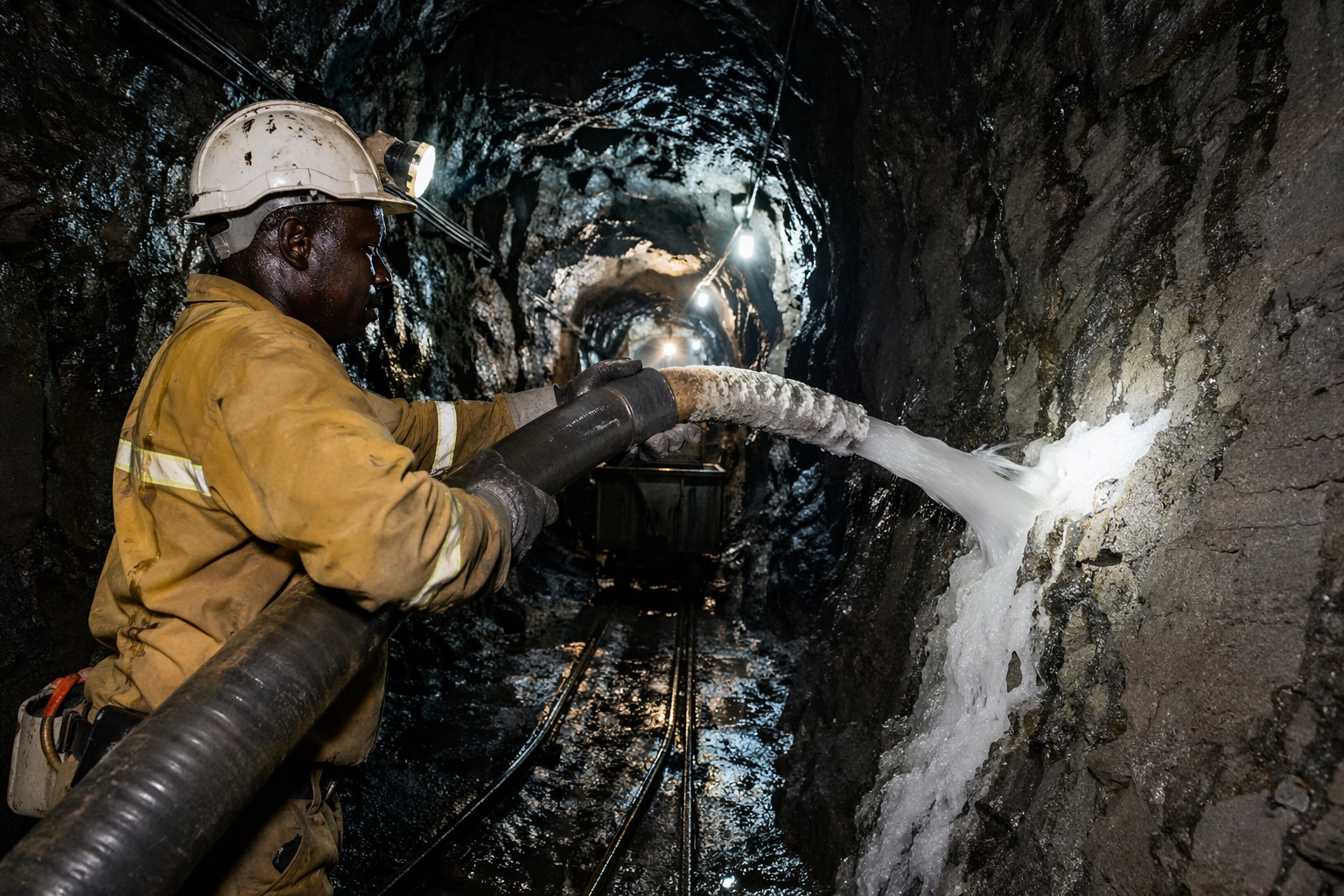

Underground environment reaches up to 60 °C and reveals the technical and human challenges of extreme depth mining
One of the most intense operations in global mining occurs at the Mponeng mine in South Africa, where the depth exceeds 4 kilometers.
Additionally, the internal environment records temperatures close to 60 °C on the rock walls, turning the site into a true underground geological oven.
In light of this extreme scenario, industrial systems continuously pump liquid ice to reduce heat and allow workers to stay underground.
-
Eni Acquires 25% Stake in Chilean Lithium Project, Plans to Invest Up to $225 Million in Eco-Friendly Extraction Method

-
Mexico’s Giant Crystal Cave: A Deadly 58°C Underground Palace with 11-Meter Crystals Formed Over Nearly a Million Years

-
China Dominates Over 90% of Rare Earth Refining, Prompting Global Concerns: Canada and Japan Launch Billion-Dollar Plan to Reduce Dependency and Safeguard Batteries, Semiconductors, and Defense
-
Ancient Mines in Spain Reveal Tools and Metals That May Explain Bronze Age Trade with Scandinavia


According to widely documented technical records since the 2010s, including compilations like Wikipedia, thermal control is essential to keep operations active.


Descent to the bottom requires time, precision, and endurance
To reach the deepest areas, workers face a long and demanding journey.
Firstly, the descent is made in vertical metal cages, which transport teams along a continuous and restricted route.
In this context, the journey can take about 90 minutes, marked by darkness, confinement, and constant tension.
Moreover, the process occurs in a fragmented and slow manner. This is because the supporting cables could suffer overload due to their own weight.
Thus, operational control is strict, while the descent imposes significant physical and psychological challenges on the workers.
Extreme heat does not come from the sun, but from the Earth’s interior
Contrary to popular belief, intense heat is not related to the surface or solar incidence.
In fact, the high temperature is a direct result of the geothermal gradient, a phenomenon linked to the natural heat of the Earth’s interior.
Thus, the deeper the depth reached, the greater the increase in ambient temperature.
According to technical data consolidated over the years, each meter excavated contributes to a constant and predictable increase in internal heat.
Moreover, the rocky walls continuously radiate heat, making the environment even more difficult to endure.
Internal environment requires constant thermal control
Given these conditions, thermal control becomes essential for operation.
Therefore, the pumping of liquid ice is used as the main cooling strategy, reducing the impact of heat in the deeper areas.
At the same time, the environment remains dense and feels constantly stuffy.
Thus, ventilation and thermal monitoring are crucial to maintain operational safety, even though conditions remain extremely challenging.
Depth, heat, and logistics make operation unique
Consequently, the Mponeng mine stands out as one of the most complex operations in the mineral sector.
This is because the combination of extreme depth, intense heat, and delicate logistics requires rigorous technical planning.
Moreover, each step of the process needs to be carefully controlled to avoid structural and operational risks.
In this way, mining at great depths reveals important physical and technological limits for the sector.
In light of this extreme and highly controlled scenario, how far can we advance in underground exploration without compromising human safety?