Portuguese
  Spanish


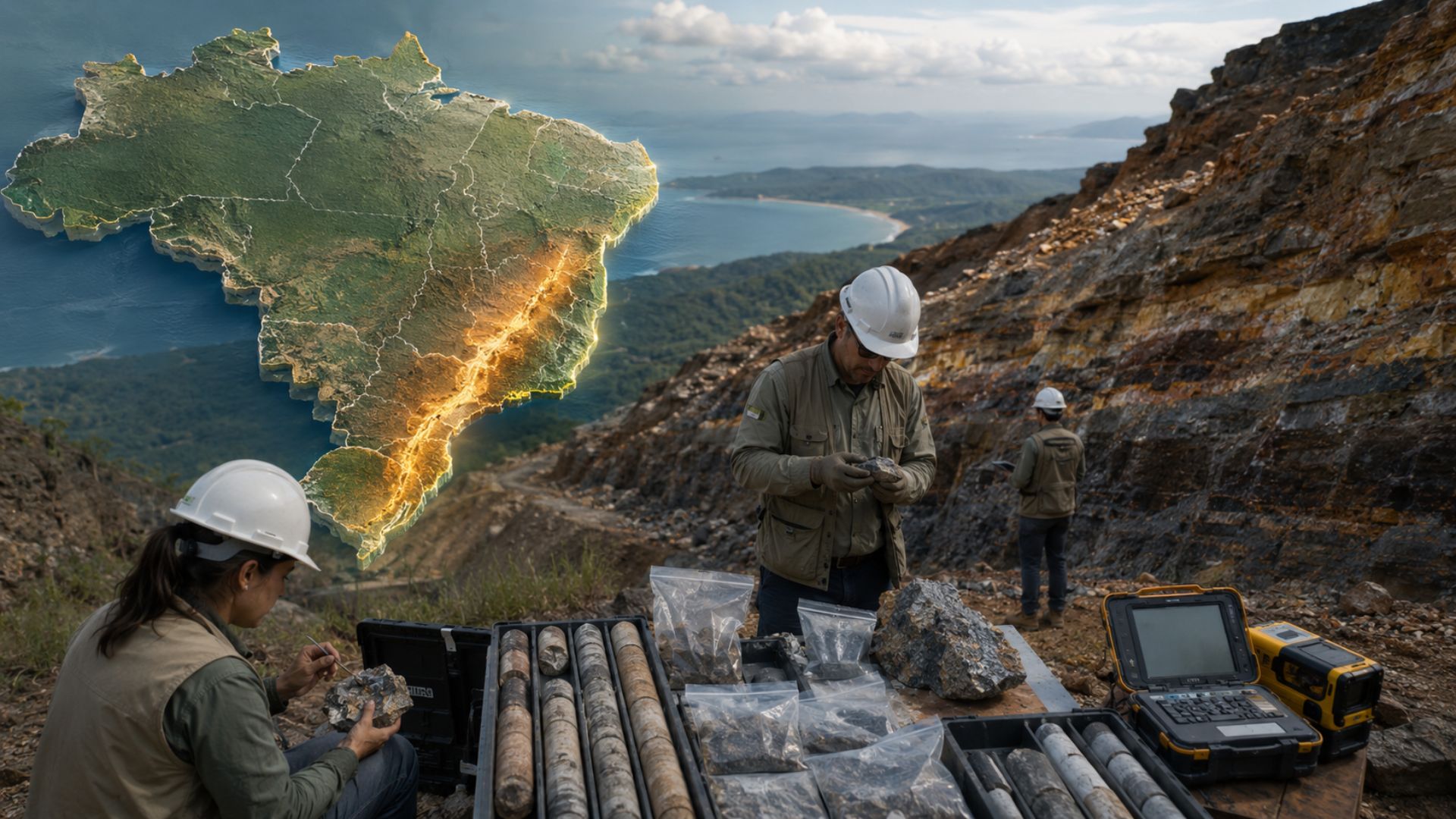


The Geological Service of Brazil identified high concentrations of rare earths in the Ribeira Belt, a geological province that extends through São Paulo, Paraná, and Santa Catarina. According to G1, samples collected in cities like Joinville, Garuva, Cajati, and Jacupiranga recorded levels exceeding 8,000 parts per million, a level considered significant for the energy transition in a market dominated by China.
Brazil has just taken a concrete step in one of the most contested agendas of the global economy. The Geological Service of Brazil identified high concentrations of rare earths in an extensive geological strip that crosses São Paulo, Paraná, and Santa Catarina, known as the Ribeira Belt. Some soil and rock samples recorded levels exceeding 8,000 parts per million of rare earth elements, meaning that, for every million particles analyzed, more than 8,000 corresponded to these strategic minerals. The result is considered significant for an initial research phase and reignites the discussion about the role the country can play in the energy transition and the global critical minerals chain.
The discovery does not appear in a geopolitical vacuum. Rare earths are essential for the manufacture of electric car batteries, wind turbines, smartphones, defense equipment, and artificial intelligence systems. China controls about 60% of global production and uses this dominance as a tool for commercial pressure. President Lula himself discussed the topic with Donald Trump at the May 7 meeting at the White House, advocating that Brazil wants to exploit its reserves without repeating the historical model of exporting raw materials without adding value.
What are rare earths and why are they so valuable

Despite the name, rare earths are neither earth nor rare. They are a group of 17 chemical elements, the 15 lanthanides plus scandium and yttrium, relatively abundant in the Earth’s crust but almost never appear in concentrations that enable economic extraction. What makes rare earths so valuable is the difficulty of separating each element from the minerals they are associated with, a complex and costly chemical process.
-
Canadian Investment Transforms Remote Brazilian Amazon Town into Copper Hub for Global Electric Vehicle and AI Data Center Markets

-
Brazilian Company in Minas Gerais Innovates by Using Electric Currents to Extract Critical Metals from Industrial Waste

-
U.S. Acquires Brazil’s Only Rare Earth Mine for $2.8 Billion, Diverting It from China

-
Indian Project Aims to Recover Zinc and Silver from Mining Waste, Targeting Over ₹3.8 Billion Revenue in 28 Months


These elements are indispensable for high-performance technologies. Neodymium, for example, is used in extremely powerful permanent magnets, essential for electric vehicle motors and wind turbine generators. Terbium is involved in efficient lighting systems and electronic devices. Without rare earths, the energy transition stops working — and that is why the race for new sources of these minerals has become a matter of national sovereignty for dozens of countries.
The Ribeira Belt and the survey results
The Ribeira Belt is an extensive geological province formed by ancient rocks that stretch from the south of São Paulo to the north of Santa Catarina. The region was already known for the presence of alkaline-carbonatite complexes and granitic rocks associated with rare earths, but updated and systematized field data were lacking.
The Geological Survey of Brazil completed in April the third field stage of the Rare Earth Potential Assessment Project in Brazil, with sample collection in 16 municipalities across three states. The activities covered Itupeva, Alumínio, Morungaba, Capão Bonito, Juquiá, Jacupiranga, Cajati, Itapirapuã Paulista, and Cananéia in São Paulo; Cerro Azul, Castro, Carambeí, and Tijucas do Sul in Paraná; as well as Joinville and Garuva in Santa Catarina.
What the numbers really mean
Concentrations exceeding 8,000 parts per million caught the researchers’ attention, but it is necessary to contextualize the data. In mining, the viability of a deposit depends not only on the concentration but also on the volume, depth, accessibility, and specific composition of the elements present. The project coordinator, Lucy Takehara, emphasized that a positive identification does not mean there is already a deposit ready for exploitation.
Another relevant result came from specific elements. Researcher William Guerra reported that some areas recorded concentrations exceeding 3,000 parts per million of magnetic rare earths, such as neodymium and terbium. These are precisely the most valued elements in the market due to their use in manufacturing high-performance magnets for electric motors and renewable energy generation. Their presence in significant concentrations increases the economic interest in the identified areas.
The next stage of rare earth research
The project continues throughout 2026 and 2027, with new field campaigns planned for municipalities in São Paulo such as Sete Barras, Tapiraí, Piedade, and Natividade da Serra. The goal is to deepen sampling in areas that showed the most significant results and produce more detailed scale mineral favorability maps.
Takehara explained that the first phase was a regional study and that now the work will focus on more systematic sampling to confirm anomalous concentrations. The production of new technical reports is scheduled between 2026 and 2027. The project is part of the Strategic Minerals for Energy Transition line of the federal government’s Growth Acceleration Program, indicating that there is budget and political priority behind the research conducted by the Geological Survey.
Brazil in the Global Race for Rare Earths
The country has the second-largest known reserve of rare earths in the world, second only to China, with potential identified by the Geological Service in 12 states. The only officially recognized and producing reserve is in Araxá, Minas Gerais. But the gap between having reserves underground and having the capacity to extract, process, and industrialize these minerals is still enormous.
The discovery in the Ribeira Belt reinforces the geological potential, but does not solve the industrial bottleneck. Mastering the rare earth value chain requires investment in processing technology, training specialized labor, and clear environmental regulation. Lula told Trump that Brazil is open to partnerships, but does not want to be merely a raw material exporter. Turning promising grades into real wealth is the challenge that will define whether the country will be a protagonist or just a supporting player in the global energy transition.
Did you know that rare earths were found between São Paulo and Santa Catarina? Do you think Brazil will be able to industrialize these minerals or will it repeat the pattern of exporting raw materials without adding value? Tell us in the comments.