Portuguese
  Spanish


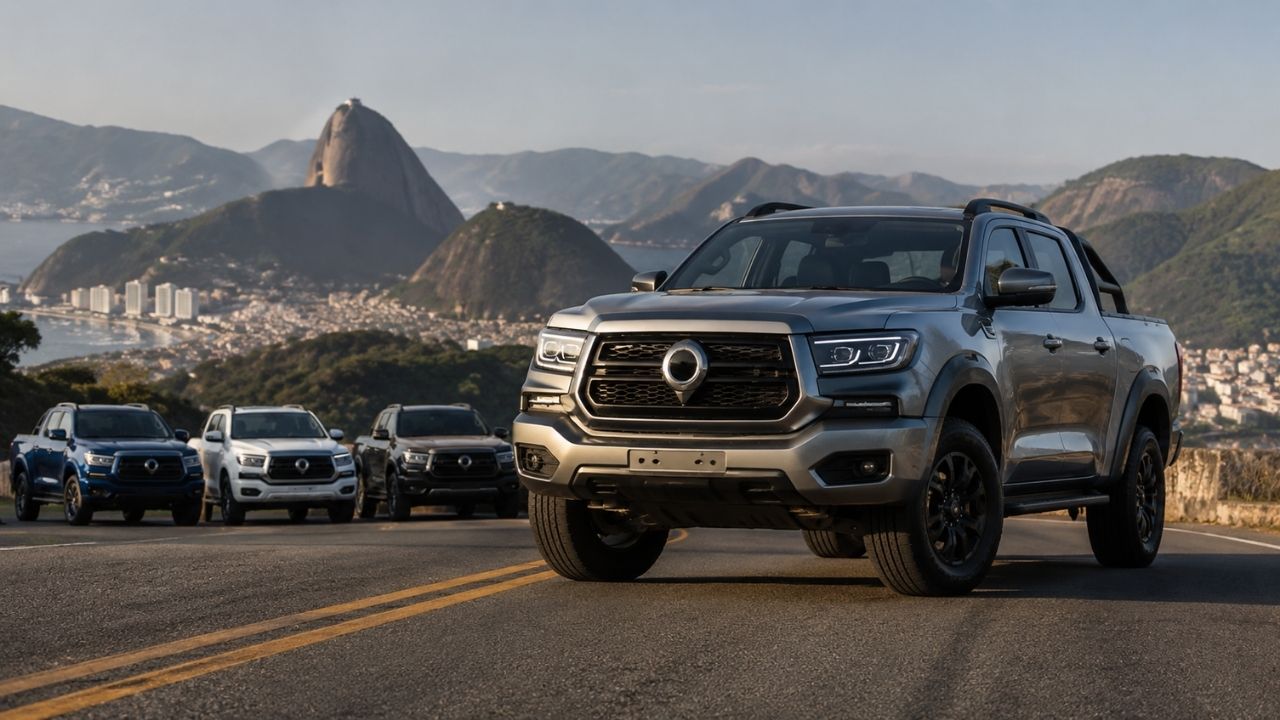

The GWM Power Trail debuted in Brazil, going against the logic of Chinese hybrids, by betting on a diesel pickup truck without electrification, an aggressive price, and a competitive package to compete with Ranger, S10, and Rampage in one of the market’s most conservative segments.
The GWM Power Trail arrived in Brazil at the end of 2025 with a proposal that immediately caught attention: to set aside electrification, bet on a diesel engine, and enter the mid-size pickup segment with a price of R$ 220 thousand. With this, the brand placed the cheapest mid-size diesel pickup in the country on the market and brought its name to the center of a dispute dominated by already consolidated models, such as Ranger, S10, and Rampage.
According to the Quatro Rodas channel, the move became even bigger precisely because it went against what was expected from a Chinese manufacturer. Instead of starting with the discourse of hybrids and electric vehicles, GWM chose a more traditional configuration, with mechanical 4×4 traction, body-on-frame construction, and a proposal more aligned with the profile of an audience that still values robustness, capability, and known mechanics. It is this turnaround that transforms the arrival of the Power Trail into something greater than just another launch.
GWM entered a conservative territory with a strategy opposite to that of its Chinese rivals

The arrival of the Power Trail shook up the most recent logic of Chinese brands in Brazil. In recent years, most of these debuts have been accompanied by discourses focused on electrification, energy efficiency, and hybrid proposals. GWM did the opposite by launching a mid-size diesel pickup, without electrification, targeting an audience that still pays more attention to durability, strength, and real-world daily use.
-
End of an era in Brazil: beloved sedan by Brazilians is discontinued despite having a 2.0 engine with 151 hp, CVT transmission, 466-liter trunk, and up to 650 km of range.

-
New Law Proposal in Brazil Could Heavily Penalize Drivers: Dangerous Overtaking May Become a Serious Offense with Fines Increased Tenfold and a 12-Month License Suspension; Update on 2026 Progress

-
Electric Revolution: Watts W125 Motorcycle Offers 160 km Range, 90 km/h Speed, and Affordable Price Starting at $3,000
-
General Motors Replaces Over a Thousand Workers with 50 Cobots at Electric Vehicle Plant, UAW Union Criticizes Move Amid Industry’s Automation Push



This choice carries weight because the mid-size pickup segment continues to be one of the most competitive and traditional in the Brazilian market. It’s not enough to appear with a flashy look or cabin technology. In this territory, buyers usually compare structure, traction, bed, engine, road behavior, and the ability to handle work and mixed use. By entering this scenario with the Trail version, GWM signaled that it truly wanted to compete, and not just make an appearance.
The R$ 220 thousand price put the Power Trail at the center of the conversation

It was the price that turned the novelty into a big topic. The Power Trail arrived for R$ 220 thousand, a value that positioned it as the cheapest mid-size diesel pickup in the Brazilian market. In a segment where a few thousand reais can change a purchase decision, this commercial positioning became one of the model’s main arguments.
The calculation becomes even more relevant when observing the competitive environment. GWM’s proposal was not to appear as a niche option, but as an alternative that tries to unbalance the comparison with names that already have tradition in the country. This gives the Power Trail a rare condition for a newcomer: it enters not just as a novelty, but as a product capable of attracting consumers through their wallets without seeming like an overly simplified version.
The curious twist is that the “entry-level” pickup doesn’t look basic
The most interesting detail about the Power Trail is that it occupies the base of the lineup without giving the impression of an stripped-down model. Visually, the differences from the superior version are minor, and the overall proposal continues to convey stature, presence, and a level of finish that goes beyond the idea of a merely lean entry-level pickup.
This aspect helps broaden the news’ impact. Instead of overly reducing the product to reach the R$ 220 thousand price, GWM preserved a list of elements that sustain the perception of value. The Power Trail maintains a strong visual package, a modern cabin, a good offering of embedded technology, and a mechanical configuration aligned with what this market expects. This is precisely where the strategy gains strength: charging less without dismantling the narrative of robustness.
The technical package shows that the dispute won’t be just about price

The Power Trail features a 2.4 turbo diesel engine with 184 horsepower and 48.9 kgfm of torque, always combined with a nine-speed automatic transmission, 4×4 traction with low range, and a rear differential lock. It’s a configuration designed to speak directly to the world of traditional mid-size pickups, without resorting to electrified solutions to position itself.
In practice, this package reinforces the proposal of a pickup truck made to be taken seriously by those who value mechanics, mixed use, and work capacity. The recipe includes a body-on-frame chassis, elevated stance, and ample dimensions, in addition to a generous bed and competitive load capacity. More than trying to surprise with futuristic discourse, GWM chose to argue with classic segment attributes.
Even large, the Power Trail tries to sell itself as a usable pickup in the city and on the road
Another point that helps explain the model’s repercussion is the attempt to reconcile size with drivability. The Power Trail is larger than several direct rivals, but the package aims to convey enough agility for urban use and stability on highways. This combination is important because it expands the potential audience: it speaks not only to those who want a pickup for heavy work but also to those who intend to use the vehicle in everyday life.
There is also a clear effort to reinforce the sense of cost-benefit. The model appears as a large pickup, with generous interior space, a good equipment package, a well-regarded 360-degree camera system, and mechanics that align with the segment’s more conservative taste. This helps explain why the Trail becomes a central piece of the lineup: it is the version that delivers the impactful price without sacrificing most of the product’s proposition.
What this arrival changes in the dispute with Ranger, S10, and Rampage

When a new diesel mid-size pickup enters the market costing less than traditional rivals, the effect goes beyond the price list. The Power Trail pressures direct comparison with models that have dominated the segment’s imagination and forces consumers to look at a Chinese brand with a different filter. Instead of associating it only with electrification, they begin to see it also as a competitor in a territory of mechanical tradition.
This matters because the Brazilian market still treats mid-size pickups as both a rational and symbolic purchase. It’s not just a vehicle. It’s also an image of robustness, reliability, and versatility. By placing the Power Trail in this arena, GWM tries to show that it can compete for a space historically controlled by older manufacturers in the segment.
The debut reveals a larger movement by Chinese automakers in Brazil


The Power Trail also serves as a sign of strategic maturation. Instead of insisting solely on the path of hybrids and electric vehicles, GWM read the consumption profile of a specific segment and decided to enter with a configuration more aligned with local taste. This adaptation shows that the dispute among Chinese automakers in Brazil could become broader, less predictable, and more aggressive in the coming years.
If this movement gains traction, the effect could be felt in other market categories. The case of the Power Trail suggests that Chinese brands no longer want to be seen only as technological alternatives or energy transition bets. In some segments, they also want to directly compete on volume, price, and tradition, even in areas where consumers tend to be more resistant to change.
Why the Power Trail deserves attention going forward
The GWM Power Trail doesn’t just attract attention for arriving with a low price. It becomes a topic of discussion because it brings together three difficult-to-combine elements: a traditional proposition, Chinese origin, and competitive value in one of the country’s most demanding segments. When this happens, the launch ceases to be merely a commercial novelty and begins to represent a change in logic.
What lies ahead will depend on market reaction, public acceptance, and GWM’s ability to sustain this proposition with its network, after-sales service, and reputation. But one thing is already clear: by arriving in Brazil as the cheapest diesel mid-size pickup truck on the market, the Power Trail achieved something few launches accomplish right from the start: forcing competitors and consumers to pay attention.