






 Portuguese
  Spanish
  4 min of reading
  0 comments


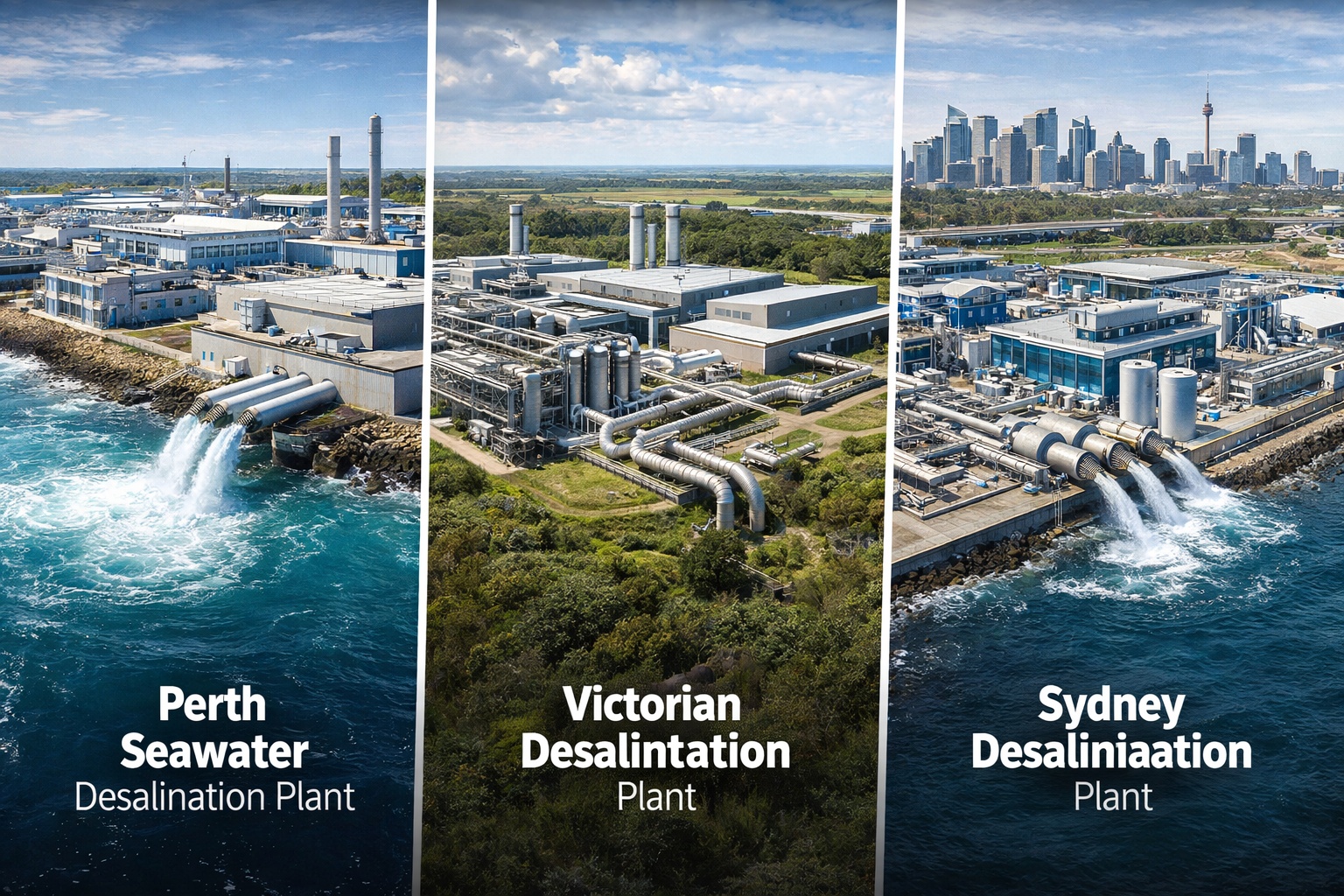
After The Millennium Drought, Australia Built Megadesalination Plants That Produce Up To 410 Million Liters Per Day And Supply Up To 33% Of The Water For Major Cities.
Between 1997 and 2009, southeastern Australia faced what became known as the Millennium Drought, one of the most severe drought periods ever recorded in the country. According to the Bureau of Meteorology, reservoir levels in cities like Melbourne and Sydney reached critical levels, forcing severe consumption restrictions. In 2007, Melbourne’s reservoirs dropped to around 33% of capacity. In Perth, the situation was even more dire: the historic reliance on winter rains had become unsustainable after decades of declining precipitation.
The Australian government’s response was structural and costly.
Megadesalination Plants Begin Operation
The chosen solution was the large-scale construction of reverse osmosis desalination plants, capable of producing hundreds of millions of liters of potable water per day from the sea.
-
Palm tree residue turns into a new type of concrete in the Middle East: previously discarded agricultural fibers strengthen structures in deserts, replace conventional materials, and pave the way for more affordable engineering.

-
Santos prepares a R$ 200 million plan to tackle sea level rise, flooding, and even realign leaning buildings on the waterfront; project with BNDES support targets drainage, coastal protection, and climate works for over 200,000 people.

-
Without bricks, concrete, or waste: company transforms straw and wood into ready-made panels with high thermal efficiency and accelerates the construction of sustainable walls in just a few days.
-
How much does a bricklayer charge to build a covered garage in 2026? See the average labor costs per square meter and the factors that most influence the final price.



Perth – Western Australia
The Perth Seawater Desalination Plant began operation in 2006, with an initial capacity of approximately 45 billion liters per year. Subsequently, a second plant — Southern Seawater Desalination Plant, increased the total production.

Today, according to Water Corporation, about 50% of the water consumed in Perth comes from desalination, making the city one of the most reliant on this technology in the world.
Melbourne – Victoria
The Victorian Desalination Plant, located in Wonthaggi, began operation in 2012.
- Maximum capacity: 410 million liters per day (ML/day)
- Possible annual production: about 150 billion liters
- Can supply up to 33% of Melbourne’s demand
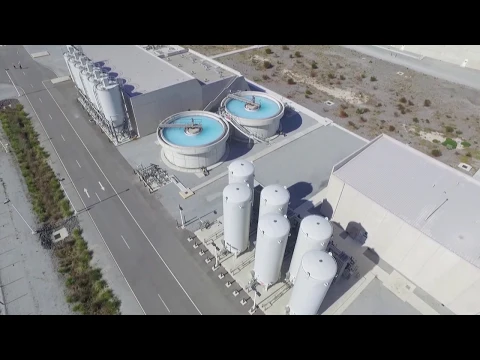

The project cost approximately AUD 3.5 billion and was one of the largest investments in water infrastructure in the state’s history.
Sydney – New South Wales
The Sydney Desalination Plant was completed in 2010, with a capacity of up to 250 million liters per day, equivalent to approximately 15% of the city’s supply.

The plant was initially deactivated after the drought ended, but resumed operations in 2017 when reservoir levels fell again.
Energy: The Invisible Cost Of Seawater
Desalinating water is energy-intensive.
Reverse osmosis requires high pressures to force seawater through membranes that remove salt. This means high electricity consumption.
To mitigate environmental impact, some plants were designed with renewable energy contracts:

- The Perth plant operates with integrated wind energy.
- The Melbourne plant has renewable energy contracts for emissions offset.
Still, experts highlight that desalination remains a high-energy cost solution when compared to conventional sources.
Demand Production: Plants That Can Turn On And Off
Unlike traditional reservoirs, Australian megadesalination plants operate in an adjustable regime.
They can be activated or increase production when reservoir levels drop below certain limits.
This creates a hybrid supply system:
- Natural reservoirs
- Aquifer recharge
- Desalination as water security
This model has been adopted as a climate resilience strategy.
Economic Cost And Public Debate
The projects faced criticism due to their high cost. In Melbourne, even when the plant operated below maximum capacity, fixed contract costs were paid by consumers through the water tariff.
Parliamentary debates occurred between 2012 and 2016 about the need to maintain active contracts even in normal rainfall years.
However, advocates argue that the investment represents insurance against future water collapse.
Environmental Impacts
Desalination involves two main environmental impacts:
- High energy consumption
- Discharge of concentrated brine into the ocean
The Australian plants use underwater dispersion systems to dilute the brine before returning it to the sea, following state environmental regulations.
Environmental monitoring is conducted to assess the impact on marine ecosystems.
Climate Change And Future Forecasts
Studies by the CSIRO (Commonwealth Scientific and Industrial Research Organisation) indicate that southwestern Australia may continue to experience reduced winter rainfall due to climate change.
This makes desalination not just an emergency response, but a structural part of the national water system. Perth no longer primarily relies on surface reservoirs.
Desalination As Permanent Policy
Unlike what happened in some countries where plants were underutilized, in Australia, desalination has consolidated as a strategic pillar.
Today, major Australian cities have a multi-source system:
- Surface water
- Groundwater
- Treated reuse
- Desalination
This diversification is considered essential to face increasingly frequent extreme events.
What Does This Mean For The Urban Future
The Australian model has been studied internationally as a case of climate adaptation. Although energy-intensive, desalination ensures predictability in a scenario of irregular rainfall.
In a country where much of the population lives near the coast, the ocean has come to be treated as a strategic reserve. After the Millennium Drought, Australia decided not to rely solely on rain.
Today, megadesalination plants pump hundreds of millions of liters of seawater daily to cities such as Perth, Melbourne, and Sydney.
Some even guarantee up to a third of urban supply. Water no longer relies solely on the sky — it also depends on membranes, turbines, and energy.
And in a world of extreme climate events, Australia has transformed the ocean into a permanent part of its water security.









-

1 person reacted to this.