Portuguese
  Spanish


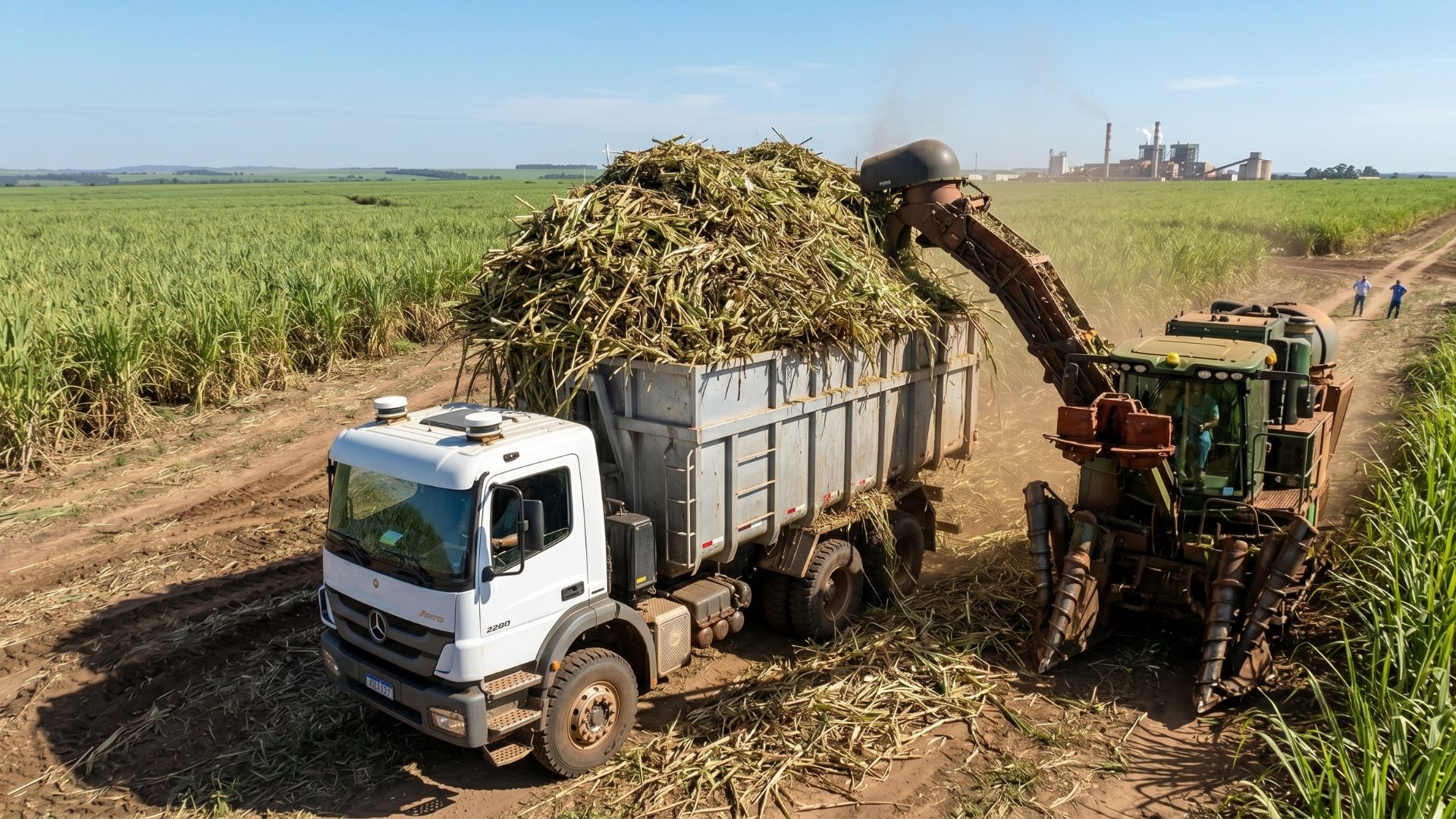


Autonomous Axor by Mercedes-Benz can transport up to 20 tons of cane per cycle and shows how automation is already transforming transshipment in the sugar-energy sector.
The mechanization of sugarcane harvesting has profoundly changed Brazilian agribusiness, but one of the heaviest and most decisive stages of the operation continues to happen away from the highways: the transport of freshly harvested cane within the cane field. It is precisely at this point that one of the most striking solutions of the new phase of agricultural automation has emerged. According to CanaOnline, the autonomous Mercedes-Benz Axor for cane transshipment was developed to operate within farms and replace traditional sets formed by tractors and trailers.
With the capacity to transport up to 20 tons of chopped cane per cycle, the model has become one of the strongest examples of how technology is already advancing over the internal logistics of the sugar-energy sector.
Autonomous Axor was created for one of the heaviest stages of cane harvesting
When the harvester cuts the cane, the work is far from over. The raw material needs to be quickly removed from the field and taken to loading points, where it will then proceed to vehicles responsible for transporting it to the mill.
-
18-Year-Old Student Designs Modular Microhouse from Fiberglass and PET to Combat Homelessness in Brazil, Plans to Live in Prototype for a Year to Demonstrate Quick Assembly

-
The Frenchman Who Brought the World Cup to Life: Overcoming Resistance and Crossing the Atlantic with the Trophy to Create Football’s Biggest Tournament

-
Archaeologists Reexamine 4,500-Year-Old Tombs in Ancient Mesopotamia, Suggesting Some Early Kings May Have Been Powerful Women
-
The North Face Co-Founder Donates Vast South American Lands to Create National Parks in Patagonia, Turning Private Wealth into Environmental Legacy





For a long time, this function was performed by tractors with transshipment trailers. This model remains present in many operations, but the expansion of cultivated areas and the pressure for more efficiency have opened up space for more robust, more productive, and more automated alternatives.
It was in this context that the concept of the autonomous truck for cane transshipment emerged, designed to operate directly within the cane field and increase the operational capacity of this critical stage of the harvest.
Capacity of 20 tons places the autonomous truck among the heaviest solutions in the sector
The most striking feature of the project is its load capacity. According to CanaOnline, the autonomous Axor was developed to transport up to 20 tons of chopped cane per trip, a level that places the equipment among the most robust solutions applied to transshipment in the sugar-energy sector.
In practice, this means reducing the number of trips needed to move the same volume of raw material. In a harvest operation, where thousands of tons need to leave the field quickly, any gain in capacity has a direct effect on productivity, harvest pace, and fleet usage.
This point is strategic because transshipment is not a secondary activity. If it fails or loses speed, the entire operational logic of the harvest begins to suffer, including the performance of the harvester itself.
Autonomous system was designed to operate without a driver in the cane field
The most impressive aspect of the project lies in its operational autonomy. The truck was designed to work without a driver controlling each movement in the field, using navigation and autonomous driving systems to maintain the correct positioning during the loading routine.
According to CanaOnline, the system allows the vehicle to accompany the harvester and follow programmed routes within the plantation, maintaining operational alignment with more precision and less dependence on continuous human corrections.
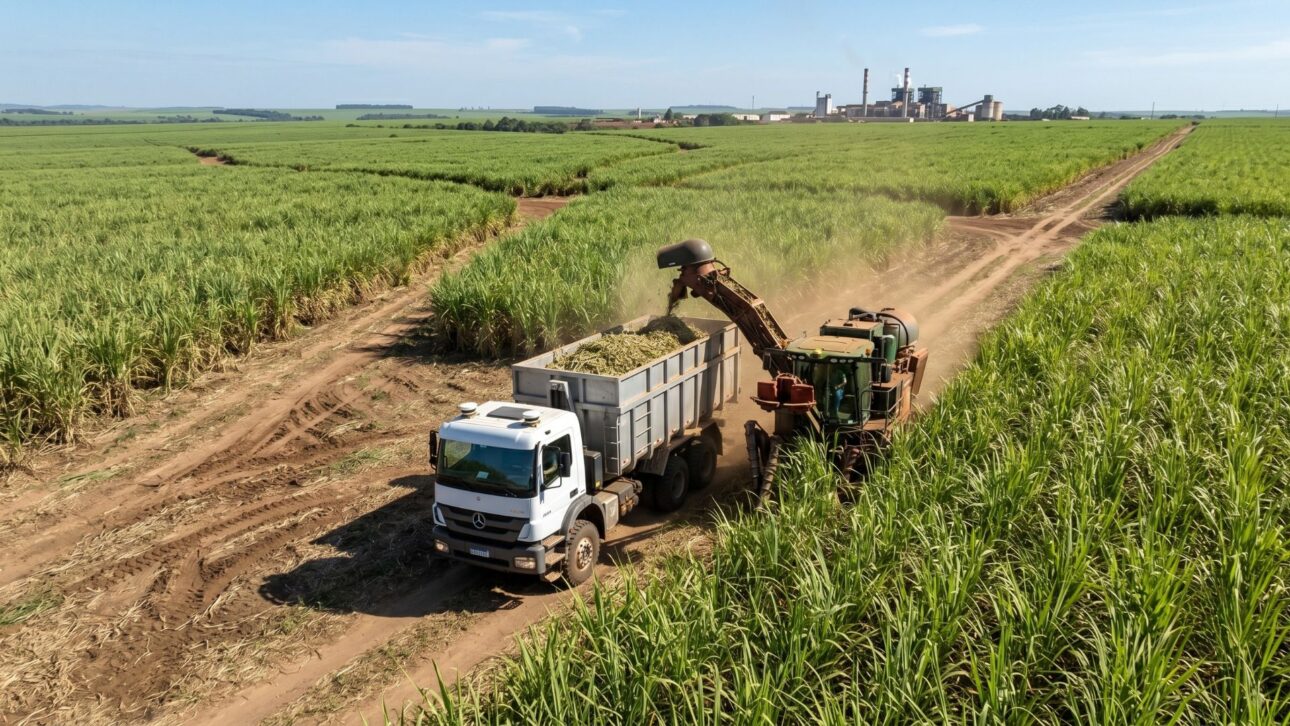
This represents an important change in the profile of agricultural mechanization. Instead of just putting a larger or more powerful machine in the field, the goal becomes to create equipment capable of executing part of the operational logic on its own, with high-level predictability and repetition.
Cane field imposes very different challenges from those faced by autonomous road vehicles
Although based on a truck, the autonomous Axor was not developed for the traditional road environment. It operates in a much more variable reality, with dust, mud, uneven terrain, soil irregularities, constant changes in traction, and circulation between crop rows.
This environment requires a different automation than that applied in urban autonomous cars or road trucks. In the sugarcane field, the vehicle needs to deal with a more unstable terrain, with natural interferences, and with the need to maneuver in productive areas where operational precision is decisive.
It is precisely this complexity that makes the project more relevant. Automating equipment in a heavy, dynamic rural environment subject to constant variations is a high-level technical challenge, especially in operations related to mechanized sugarcane harvesting.
Labor shortage also helps push automation in the sugar-energy sector
The expansion of this type of solution is not only linked to productivity gains. It also addresses a growing problem in agribusiness: the difficulty in finding available and prepared professionals for demanding, repetitive operational roles performed in long shifts.

In the case of sugarcane, transshipment requires constant attention, coordination with other machines, and high operational discipline. Autonomous systems emerge as an alternative to reduce direct dependence on tasks that need to be repeated precisely for many consecutive hours.
This does not just mean replacing people with machines. It means reorganizing the operation to make it more predictable, more synchronized, and less vulnerable to human bottlenecks in critical stages of the harvest.
Brazilian sugar-energy sector requires large-scale technology to maintain efficiency
The importance of a solution like this only makes sense when observing the weight of the sugar-energy sector in Brazil. The sugarcane chain moves enormous volumes of raw material and depends on extremely efficient internal logistics for the harvest to progress at the expected pace.
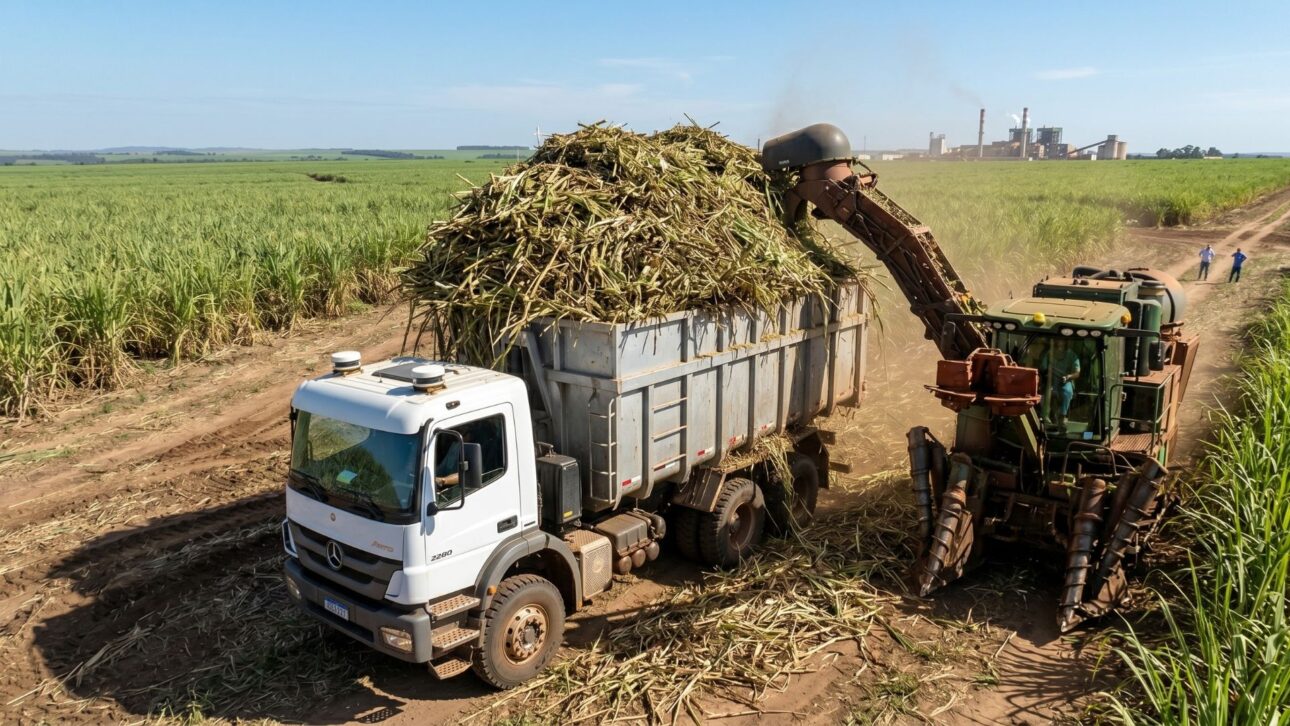
In this environment, seemingly modest efficiency gains can have a significant impact when multiplied across extensive areas and an intense operational calendar. That’s why equipment like the autonomous transfer truck is starting to be treated as strategic assets, not just technological curiosities.
The logic is simple: when an operation moves millions of tons throughout the harvest, every improvement in time, capacity, and synchronization between machines gains real economic weight.
Autonomous Axor shows that the field revolution has moved beyond the harvester and reached logistics
For many years, agricultural modernization was mainly concentrated on harvesters, tractors, and sprayers. Now, automation is also beginning to advance in the farm’s internal logistics, and the transfer of sugarcane is one of the clearest examples of this change.
The autonomous Axor shows that the focus of innovation is no longer just on mechanizing a task. The goal now is to integrate smarter machines capable of working in a coordinated, precise manner with minimal human intervention in stages that previously depended on operators all the time.
In the end, this autonomous truck represents more than just a new piece of agricultural equipment. It shows that the technological transformation of the field has already reached one of the heaviest and most decisive stages of the harvest, indicating that the future of the sugarcane field may involve increasingly connected, automated operations guided by systems capable of making decisions on the move.