Portuguese
  Spanish


The operation will gather 342 concrete mixer trucks to apply 2,730 m³ of concrete in a structural block in Jardim Aquarius, in São José dos Campos, with 165 piles, 18 hours of continuous work, use of ice, temperature control, and closure of Avenida Tubarão to reduce impacts on local traffic in the region.
The closure of Avenida Tubarão, in Jardim Aquarius, in São José dos Campos, was announced to enable the circulation of 342 concrete mixer trucks during the largest concrete pouring ever recorded in the RM Vale do Paraíba. The operation is scheduled for Friday, February 13, 2026, towards Avenida Cassiano Ricardo.
The information was published by Life Informa on February 9, 2026, at 3:23 PM, in a report by Esrom Vellenich. According to the publication, the work is related to the foundation of a large residential tower and will be executed by Construtora Esdras, with concrete supplied by four Polimix plants.
Avenida Tubarão will be closed all day

The São José dos Campos City Hall informed the closure of Avenida Tubarão, in Jardim Aquarius, to allow the execution of a high-complexity operation in civil construction. The blockage will occur towards Avenida Cassiano Ricardo and is expected to last throughout the day.
-
Family buys abandoned 110-acre ranch in Nevada, finds restaurant, store, apartments, houses, butcher shop, and sheds, removes tons of trash, faces daily leaks, and transforms weed-infested fields into the foundation for a rebuilt rural family complex with irrigation, vegetable garden, and rental income.

-
A woman bought a century-old house from 1926 without a large renovation budget, tore out the carpet, began restoring old details with thrift store pieces, Marketplace, and free materials, and showed that restoring the charm of a century-old property can cost much less than a traditional renovation.
-
Developed over nearly two decades in a laboratory, the “living” concrete with bacteria that produce limestone and self-heal their own cracks has already been applied in areas of Schiphol Airport and a 12,000 m² parking lot in the Netherlands.

-
It seems too narrow to stand, but this 229-meter building houses 54 floors on a 12-meter base and controls the sway with water tanks.



The measure was announced by a banner installed on the avenue itself on the morning of Monday, February 9. The goal is to create logistical space for trucks, concrete pumps, technical teams, and materials to circulate without interrupting the concreting sequence.
Operation will have 342 concrete mixer trucks in continuous flow
The logistics plan foresees the mobilization of 342 concrete mixer trucks in uninterrupted flow, according to Construtora Esdras. The volume will be necessary to pour 2,730 cubic meters of concrete in a single structural stage.
This type of concreting requires a constant pace. If there is an interruption in the pouring of the concrete, technical problems may arise in the formation of the block, affecting the uniformity of the structure. Therefore, the operation depends on synchronized supply, transport, and pouring over several hours.
Foundation will have a large structural block
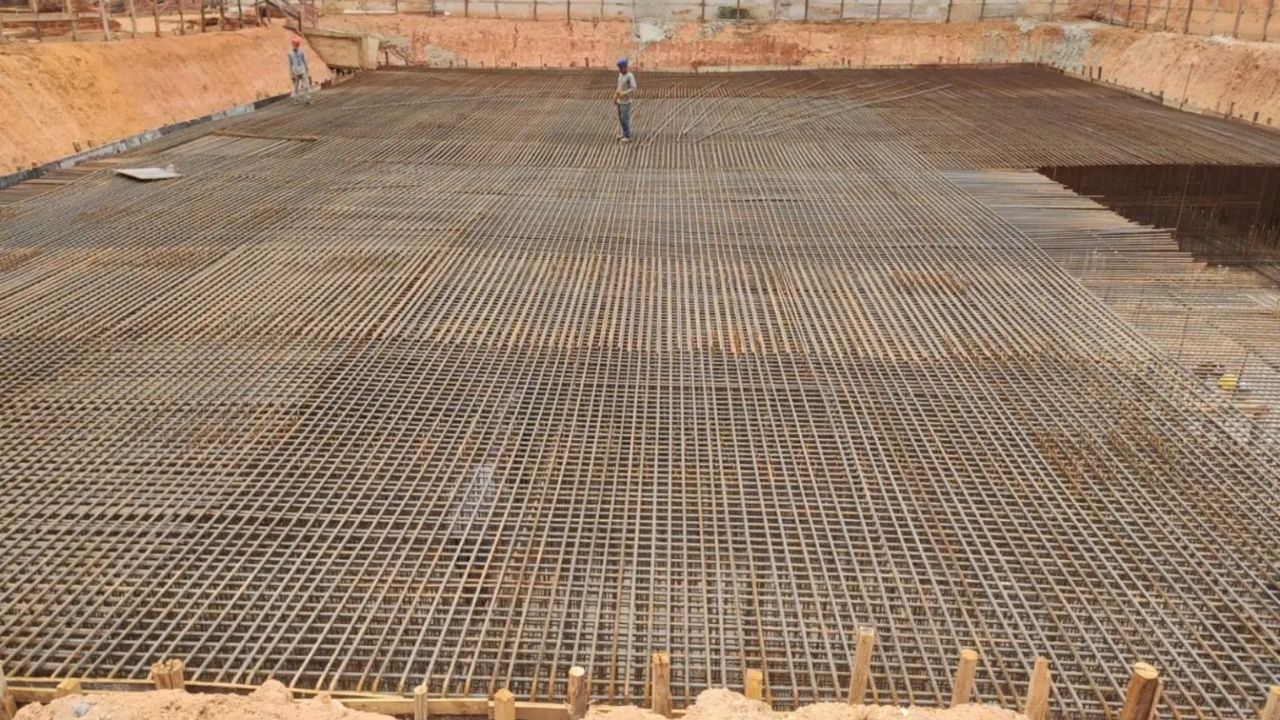
The concreting will form a structural block responsible for connecting 165 piles. Each pile is 90 centimeters in diameter and about 26 meters deep, forming the base of a large residential tower.
The function of this block is to distribute loads and ensure stability to the construction. In vertical works, especially buildings with heavy loads, the foundation needs to support concentrated efforts and transfer them to the ground safely. It is an invisible stage to the public but decisive for the performance of the structure.
Work should continue for about 18 hours
The operation is scheduled to occur continuously for approximately 18 hours. This interval includes the arrival of trucks, pouring of the concrete, use of pumps, technical checks, and control of the conditions of the material received on-site.
During this period, Avenida Tubarão will play a strategic role in logistics. The circulation of concrete mixer trucks needs to maintain regularity to avoid delays, bottlenecks, and waiting periods that could compromise the pace of concreting.
Four Polimix plants will supply concrete
The concrete supply will be carried out simultaneously by four Polimix plants. The strategy reduces the risk of shortages and helps maintain the necessary flow for an operation that cannot rely on a single source of material.
This planning also requires route control, transport time, and arrival on-site. Each load needs to arrive within suitable technical parameters, because concrete is not just volume: temperature, consistency, and application time directly affect the final quality.
Ice and additives are part of technical control
To ensure the quality of the foundation, the concrete will be produced using ice and special additives. The operation will also have permanent temperature control, a common resource in large-volume concreting to reduce risks associated with the heat generated during curing.
This care is important because large masses of concrete can suffer internal thermal variations. If the heat is not controlled, tensions may arise that can cause cracks or compromise durability. The use of ice helps keep the material within the range provided by the project.
Tests will be conducted with each new load
The report states that technological tests will be conducted with each new load received at the site. These tests verify if the delivered concrete meets the technical requirements before being applied to the foundation.
In practice, each truck undergoes checks that help control quality, consistency, and expected performance. With 342 concrete mixer trucks expected, this monitoring needs to be continuous and organized to avoid halting the operation or reducing technical control.
Team will have 66 professionals mobilized
The operation is expected to directly involve 66 professionals, including drivers, engineers, laboratory technicians, and concrete pump operators. Each role is necessary for the launch to occur without interruptions and within defined parameters.
The drivers maintain the flow of loads, the operators control the pumping, the technicians conduct tests, and the engineers oversee the execution. Concreting depends less on improvisation and more on coordination between teams, equipment, and suppliers.
Jardim Aquarius receives high-standard construction project
According to Victor Simão, operational director of Construtora Esdras, the foundation was designed to support a high-standard construction tower and a large vertical load. He compared the operation to large concrete pours carried out in capitals like São Paulo and Balneário Camboriú.
His statement helps to gauge the scale of the project in the regional context. Jardim Aquarius, known for residential and commercial buildings, is now hosting an unusual operation for the RM Vale, both for the volume of concrete and the logistical complexity.
Closure aims to reduce traffic impacts
The City Hall advised drivers to avoid the area during the closure period and use alternative routes. The guidance aims to reduce congestion and conflicts between regular traffic and the movement of trucks related to the project.
Since the closure occurs on an important avenue in the neighborhood, the local impact is likely to be felt by residents, workers, and drivers traveling through the west zone of São José dos Campos. The private operation requires public organization in traffic to avoid major disruptions.
Concrete Pouring Becomes a Milestone for Regional Construction
According to Construtora Esdras, the operation will be the largest concrete pouring ever recorded in the RM Vale do Paraíba. The volume of 2,730 cubic meters, the participation of four plants, the use of 165 piles, and the flow of 342 concrete mixer trucks make the project a rare scale for the region.
Besides the immediate impact on Jardim Aquarius, the concrete pouring shows how large-scale vertical developments require planning comparable to that of projects in major urban centers. The foundation stage concentrates engineering, mobility, logistics, and technological control in a single operation.
Giant Block Puts Engineering in the Spotlight
The concrete pouring on Avenida Tubarão draws attention because it transforms a normally hidden stage of construction into a visible urban event. While the final structure has yet to appear, the base already requires road closures, hundreds of trips, and intense technical control.
The case also raises a debate about how densely populated neighborhoods coexist with large private projects. Do you think operations of this scale show the advancement of civil construction in the region or bring too much disruption for residents and drivers? Share your opinion.