






 Portuguese
  Spanish
  2 min of reading
  2 comments


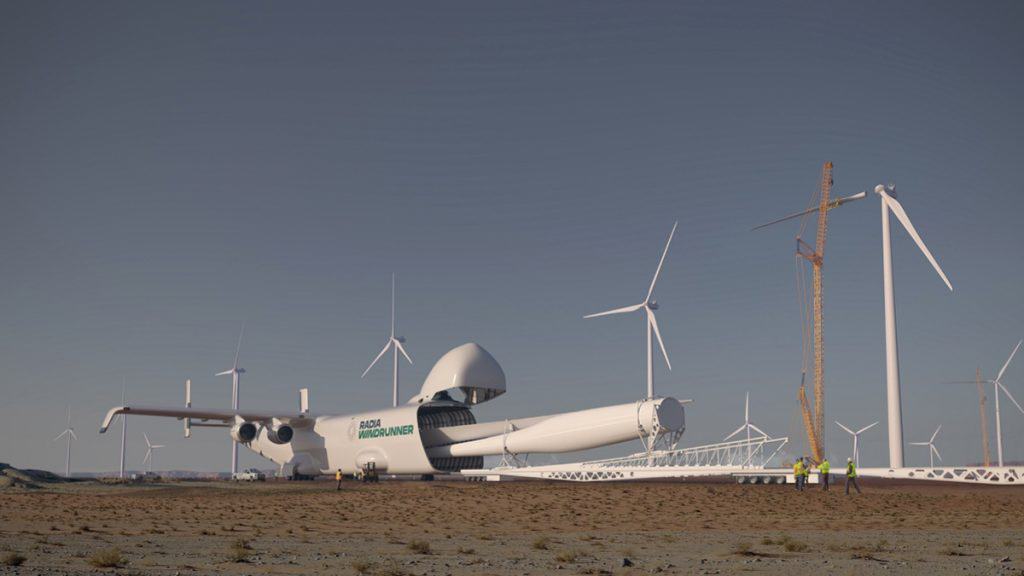

A “Giant” Airplane Could End Up Altering Everything Known Today About the Structure of Components Responsible for Wind Energy Generation. Read the Article and Check Out New Information About the Project.
We are talking about the Windrunner, which is Radia’s cargo plane project measuring 108 meters long, considerably longer than the Antonov An-225 Mriya, which, at 84 meters, established itself as the largest cargo aircraft in operation for a long time.
Recently, Click Petróleo e Gás addressed the subject. According to updated information from Radia, the company responsible for Windrunner, the idea is to make the airplane capable of transporting large components.
Some of these components are turbine blades for wind energy generation, which are considered hard-to-transport items by land or road. According to Radia, the project arises at a time when there is growing demand for large wind turbines, whose blades can exceed 140 meters in length.
-
Helicopter Drops 180 Tons of Sand and Gravel on Swedish River to Revive Ecosystem Damaged by Decades of Exploitation

-
Brazilian Company Launches Retro Smartphone with 48 MP Camera, T9 Keyboard, and Privacy Features for Social Media-Free Use

-
Self-Taught Chinese Farmer Builds 5-Ton Submarine from Scrap, Launches It in Anhui River
-
Invisible Induction Technology Enables Wireless Power for Blenders, Coffee Makers, and Air Fryers, Reducing Countertop Cables




Today, the size of wind turbine blades is a crucial factor in energy production. This is because larger blades allow for a greater area sweep, and consequently, generate more energy.
Currently, land transport limits the size of these blades. This restricts the energy efficiency that could be achieved with larger turbines, especially in onshore installations.
Project Coming to Life
According to Radia, in information provided to the Wall Street Journal, the company has already raised US$ 104 million, approximately R$ 530 million, to develop the aircraft.
Furthermore, the company states that the airplane could reduce onshore wind energy costs by up to 35%. Not only that, the giant may also expand the feasibility of wind farms in various locations, with plans for construction and certification of the airplane in four years.
Airplane Designed for Efficiency and Practicality
According to Radia, the construction of Windrunner aims for efficiency and practicality. In this sense, the idea is for the vehicle to transport the blades directly from the factory to the location where the wind farm will be built.
This eliminates the need for a complex land transport setup, thus allowing for the almost direct installation of the turbine blades.
Specifications of the Giant
Finally, there is information about the dimensional specifications of Windrunner. According to Radia, the giant will have a wingspan of 80 meters and the capacity to carry loads of up to 105 meters in length.
Due to this structure, it will be possible to carry up to 72,575 kg, with a spacious cargo compartment, allowing for significant transport operations.




O transporte dos componentes eólicos por meio aéreo é bem mais rápido se for comparar por navios, porém, o destino desse tipo de carga de componentes eólicos tem um destino até o local onde estão sendo construído esses parques eólicos e é óbvio que esse transporte aéreo não traz até o destino final e assim terá um trajeto dos aeroportos pelas rodovias que termina inviabilizando o trânsito de veículos quando se transportam esses componentes até os parques eólicos.
Certamente esse módulo de transporte irá também transportar equipamentos menores em maior quantidade em menor tempo reduzindo custos de transporte e reduzindo também congestionamentos nas malhas viárias