Portuguese
  Spanish


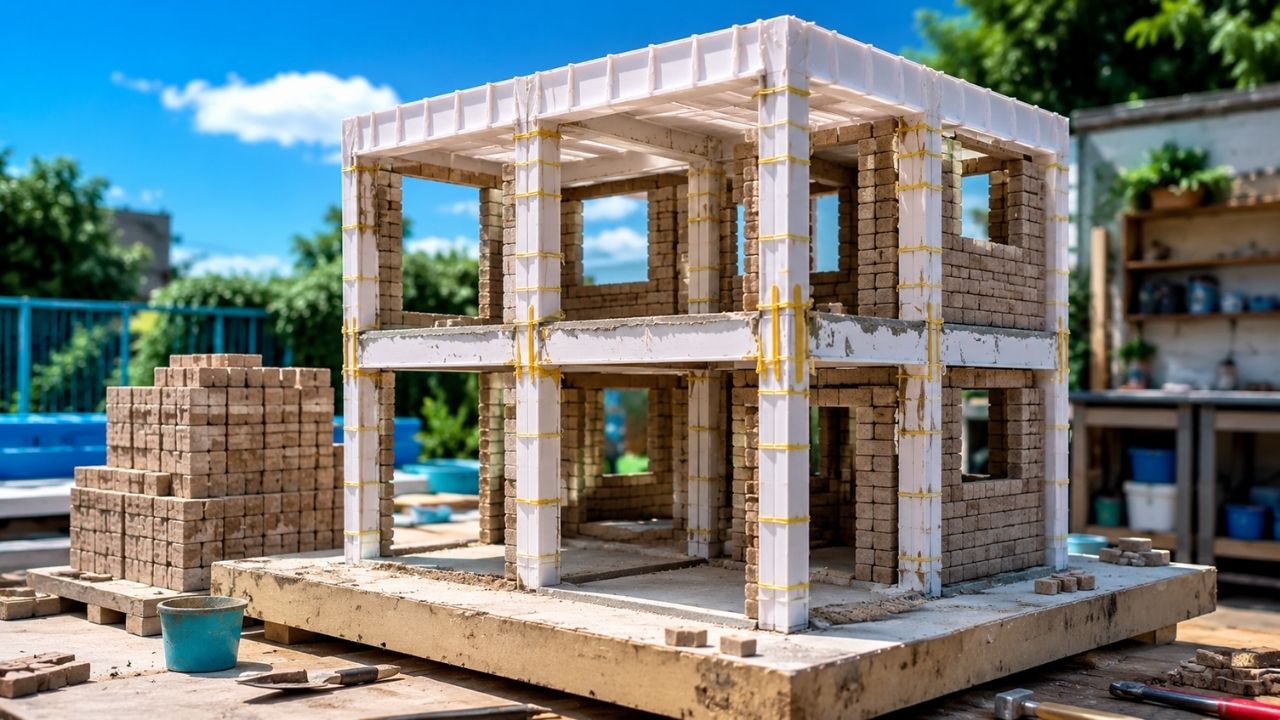

Reproducing in miniature each stage of a masonry construction, from compacted soil to the spiral staircase, a mini house showed that walls only enclose the space. What supports the building are beams, pillars, and reinforced concrete slabs, the skeleton that keeps any house standing without relying on the walls.
One of the most surprising pieces of information for those who have never set foot on a construction site is also one of the simplest: a house is not supported by the walls. This is exactly what a mini house, built to scale to reproduce each stage of a real masonry work, made visible, from the compacted ground to the second floor with a spiral staircase.
The project, highlighted in a report by the site O Antagonista, functions as a visual guide of how the skeleton of a construction is assembled piece by piece. More than just a beautiful model, the miniature reveals technical decisions that usually remain hidden within the walls and that determine whether the structure will stand safely.
Why the terrain is the first major decision of the construction
Before any brick or rebar, the soil needs to be prepared. In the mini house, the terrain was leveled and compacted within a wooden form filled with earth, recreating what in a real construction is done with graders, loaders, and compaction equipment. Building on loose or poorly leveled ground compromises everything that comes after.
-
While the World Opens New Airports and High-Speed Trains, Brazil Rushes to Complete Projects Stalled for 40 Years

-
Brazil Invests in Massive Waterway to Transport Soybeans by Barge, Reducing Costly Truck Reliance
-
Bridge Rebuilt in Just One Year Reconnects Two Brazilian States
-
Custom Furniture Costs in Brazil Expected to Range from $350 to Over $1,450 per Square Meter by 2026, with Kitchens, Closets, and Laundries Highlighting the Impact of Premium Features


The next step was to transfer the house plan to the ground, precisely marking where foundations, walls, and pillars would be. At this moment, 90-degree angles are crucial: a crooked marking results in a permanently misaligned construction, and no subsequent phase can correct this error. This is why the miniature treats leveling and marking as non-negotiable steps.
How the foundation distributes the weight to the ground
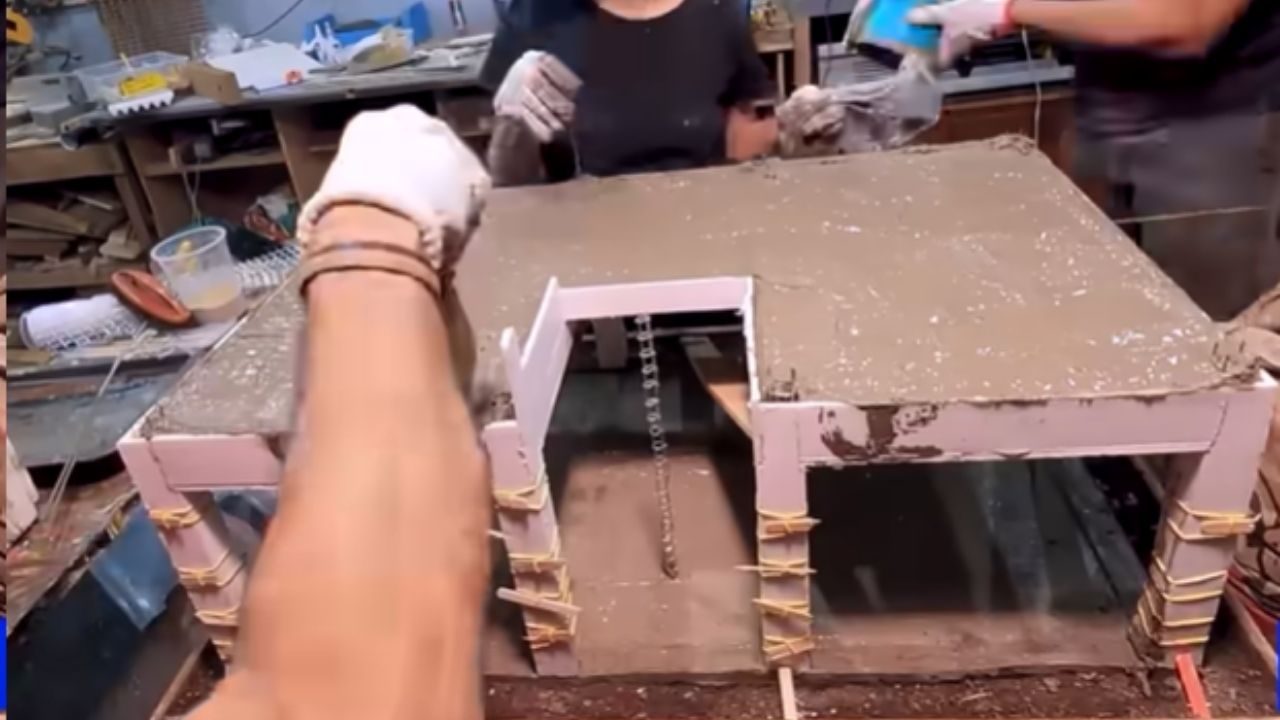
The foundation is the first structural part of the construction and acts as the interface between the building’s weight and the ground. In the mini house project, isolated footings and ground beams were used. The footings act as the “feet” of the pillars, positioned at points of greatest load to spread the weight across the ground, while the ground beams are beams below floor level that tie the base and support the walls.
The execution provided a valuable lesson about error and correction. The first attempt used the ground beam against the bank technique, where the hole in the ground itself serves as a mold for the concrete. Since the soil of the miniature was not compacted like in a real construction, the beam came out crooked. The solution was to use side forms to contain the concrete, ensuring more precise alignment and finish, and making it clear why compaction and correct use of forms are not optional steps.
Reinforced concrete: why steel and cement work together
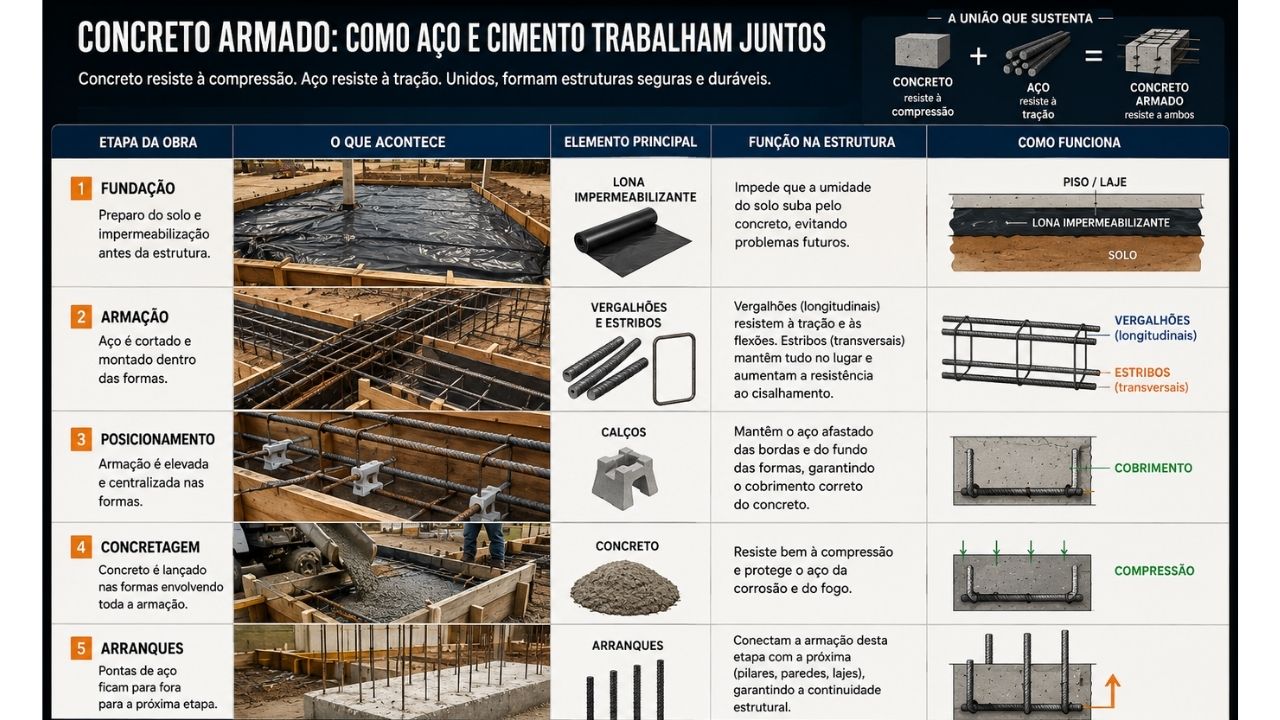
One of the central concepts of civil construction appears very clearly in the project: reinforced concrete. Concrete resists compression well, that is, forces that try to crush it, while steel is efficient against tension, when the structure is pulled or flexed. Alone, each material has limitations; combined, they form the basis of practically all modern construction.
In practice, the mini house showed the steps involved in this principle. The steel reinforcements are positioned inside the forms before concreting, with spacers that keep the metal centered and away from the edges. The rebars run longitudinally along the piece, accompanied by transverse stirrups that organize and reinforce the reinforcement, and the starters, steel tips left out of the concrete, serve to connect the reinforcement of the next stage. A waterproofing tarp under the floor slab prevents moisture from the ground from rising through the concrete over time. The report itself suggests a video from the Manual do Mundo channel on YouTube for those who want to see how the foundation of a house works.
Beams, pillars, and slabs: the skeleton that holds everything


With two floors and eight pillars, the mini house had the forms of beams and pillars assembled and connected before concreting, with the reinforcements tied with wire. To ensure the pillars were perfectly vertical on the second floor, a miniature plumb line was used. Triangular structures called braces prevented the beam forms from opening with the pressure of the concrete during filling.
After curing and removing the forms, a stage known as stripping, the skeleton was exposed: horizontal beams, vertical pillars, and flat slabs. And here is the big revelation of the project: in this construction, the walls do not serve a structural function, they only enclose the space. This means it is possible to open doors, move windows, or integrate spaces without compromising safety, as long as beams and pillars are preserved.
1,500 blocks, spiral staircase, and the final details
To close the walls, about 1,500 miniature concrete blocks were produced, a meticulous task that demonstrates the effort behind such a faithful mini house. The chosen staircase was a spiral type, with steps fitted into a central pillar that was only concreted after the structure was assembled.
The windows also brought an important technical detail: they received lintels, small beams that support the masonry above the openings. Where the structural beam already fulfilled this role, no additional lintel was needed. Each choice reproduced, in scale, a real decision of a conventional construction, with no shortcuts.
What this project teaches that no theoretical class can
The difference of this type of reproduction is making visible what is usually buried or hidden. The project was developed with the support of an engineer and an architect, and this detail is not secondary: building, even in miniature, requires logical sequence, structural safety, and technical knowledge that cannot be improvised.
For those who truly want to understand how a house stands, watching a mini house being built layer by layer is worth more than pages of written explanation. Each stage, from the ground to the roof, gains meaning when seen in sequence, and the result functions as a practical engineering lesson within reach of the eyes.
Now it’s your turn to give your opinion. Did you already imagine that it was possible to knock down a wall without putting the house at risk, or did you also think that they supported everything? Have you ever thought about doing a renovation and were afraid to mess with the structure? Tell us in the comments about your doubts or experiences with construction and share this article with that friend who is building or renovating now.