






 Portuguese
  Spanish




Dubai Invests Billions in a Project to Build Artificial Islands. Meet The World, an Archipelago of Artificial Islands in Dubai That Was Abandoned Due to Its Unfeasibility.
With the mission of reducing its dependence on oil as the main source of resources, Dubai invested in various grand real estate projects. One of the most notable was The World, an archipelago of 300 artificial islands designed to form the silhouette of the world map. Aimed at millionaires, these islands symbolized Dubai’s innovative and bold vision. However, the project faced numerous challenges and ultimately was abandoned due to its unfeasibility.
Abandoned Artificial Islands in Dubai Received Billion-Dollar Investments
The visual appeal and possibilities of Dubai’s abandoned artificial islands emerged in 2003 and attracted various interests, as those who acquired one of the islands could build their own mansion and be the only resident on the island of Spain, for example. It is no wonder that more than half of these artificial islands were sold even before they were launched.

With an initial investment of £12 billion, approximately BRL 68.5 billion at the current exchange rate, The World would consist of small artificial islands in Dubai, each ranging in size from 1.4 to 4.2 hectares. To construct this venture, 321 million m³ of sand and 386 million tons of stone were used, covering an area of approximately 54 km².
-
U.S. City Builds Tiny Home Village on Water Company Land to House 136 Homeless People: Inside the Social Housing Units

-
Woman Turns Shipping Container into Home, Embraces Rural Life to Cut Monthly Expenses to Just Over $330
-
France Revamps 530 Social Housing Units with Large Balconies and Glass Facades Without Demolishing Existing Buildings

-
Facing high rent, couple transforms parents’ garage into a fully functional apartment, creating a complete home at a fraction of the market cost.




However, despite 60% of its complex having actually been sold, the project has been stalled for years, given that people do not plan to move to live on the sinking and abandoned artificial islands of Dubai. Only four islands were developed, and one of them is even the site of the pilot project delivered to soccer player Cristiano Ronaldo.
Sinking Artificial Islands in Dubai: Understand the Unfeasibility of the Project
One of the factors that may have influenced the abandonment of the project is its isolation. This is because travel between the artificial islands of Dubai and the mainland must be done by sea, hindering mobility.
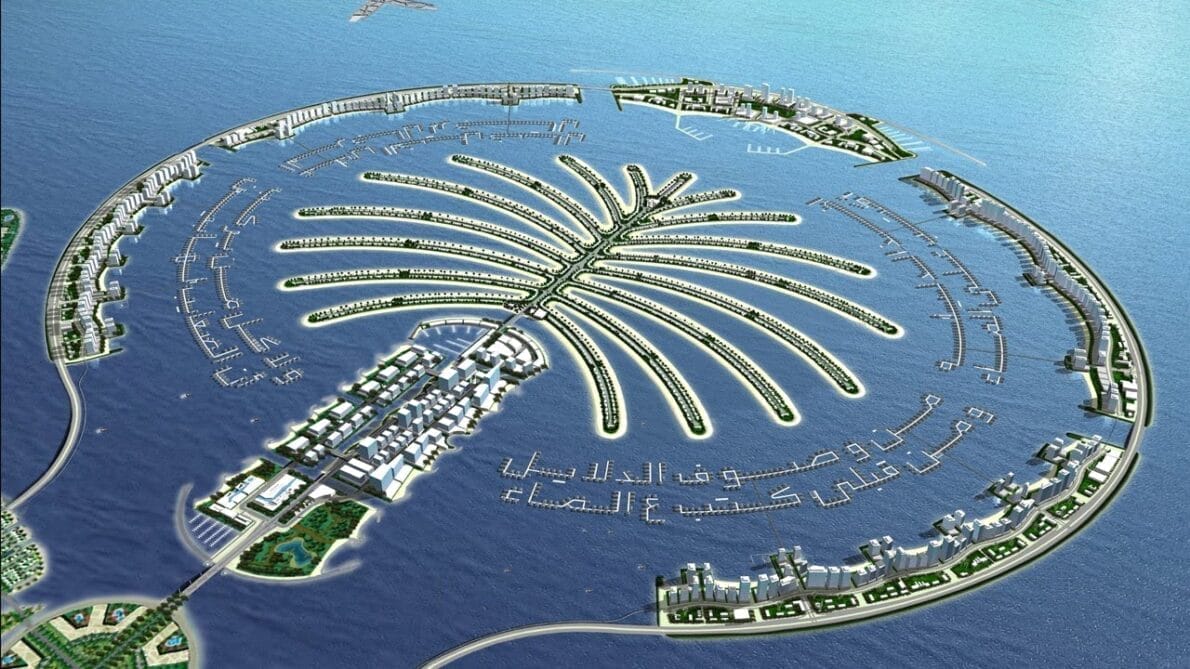
The famous Palm Jumeirah in Dubai, for instance, is connected to the mainland via a bridge. Taking commercial exploration to another level, this project, also based on artificial islands, consists of a complex made up of marinas, holiday resorts, 4,000 housing units, large hotels, and shopping centers.
The major problem is that the sinking and abandoned artificial islands of Dubai from The World are accelerating the emergence of the first signs of erosion in the channels surrounding the islands and their silhouette, transforming them into desolate sandy terraces. In light of the growing climate crisis, these types of initiatives are being put to the test. According to information from Greenpeace, the artificial islands of Dubai are sinking at a rate of 5 mm per year. What remains is the question of how Dubai will deal with this issue.
Artificial Islands in Dubai Would Be Used to Avoid Oil
The goal of the country in undertaking this project resonates again with each presentation of NEOM: to dissociate the country’s future from fossil fuels and ensure long-term viability as the demand for oil and gas decreases.
The vision of the United Arab Emirates was to find a way to replace its dependence on oil as the main source of resources. The chosen path was real estate business, according to Professor Alastair Bonnett, a geographer at the University of Newcastle.
It is important to mention that in addition to the abandoned artificial islands of Dubai, the country will have a new megaproject. It involves the inauguration of a new artificial island off its coast. Named The Island, the island will cover an area of 10.5 hectares and is expected to cost around 4.4 billion dirhams, which is more than BRL 5.8 billion.










Pff…Tinham que ter me chamado pra essa obra. Uma levantada de braço e as ilhas ficam sequinhas de novo.