Portuguese
  Spanish





Embraer’s Flying Cars Will Have a Range of 100 km and Initial Production of 120 Units Per Year Starting in 2027
The National Bank for Economic and Social Development (BNDES) officially announced on Thursday (14) a direct investment of US$ 74.9 million — equivalent to R$ 405 million — in Eve Air Mobility, a subsidiary of Embraer dedicated to the development of electric vertical takeoff and landing aircraft, known as eVTOLs or “flying cars.” Production will take place in Taubaté (SP), where the company is already preparing its industrial line.
The investment occurs through the purchase of BDRs (Brazilian Depositary Receipts), backed by papers issued by Eve in the United States. After the completion of the private operation, it is expected that the securities will also be traded on the Brazilian Stock Exchange, increasing the company’s exposure to the local market.
State Bank Strategy
The resource allocation is part of the resumption of the equity participation policy of BNDESPar, the bank’s investment arm, announced in June after nearly ten years on hold. According to the plan, up to R$ 10 billion will be allocated to companies focused on innovation, decarbonization, and energy transition.
-
Brazil Welcomes Spanish Wamos Air and Nigerian Air Peace, Potentially Transforming International Routes and Increasing Competition

-
Offshore air transport soars in Brazil, surpasses 2.5 million passengers, and reveals how oil has transformed Rio’s airports into key pieces of national logistics.

-
Latin America becomes the “global champion” of aviation taxes, tickets may become more expensive in Brazil, and IATA’s warning exposes risk for flights, tourism, and passengers.
-
Brazil has lost 85 air routes since 2019 and is still flying less than before the pandemic, leaving passengers with fewer destinations, fewer frequencies, and a more limited air network.




“BNDES’s support is a strategic step to position Brazil at the forefront of sustainable air mobility,” highlighted the bank’s president, Aloizio Mercadante, in a statement. The institution reported that the operation aims to strengthen Eve’s capital structure and support research and development projects that are essential for the advancement of the program.
Funding History
The announcement represents BNDES’s third financial support to Eve in less than a year. In October 2024, the state-owned bank approved R$ 500 million through the BNDES Mais Inovação program to facilitate the construction of the factory in Taubaté. Shortly thereafter, in December, a new credit of R$ 200 million was released, this time through the Climate Fund, aimed at the development of aircraft prototypes.
This move also reinforces the bank’s broader strategy to diversify investments. In July of this year, for example, BNDES acquired R$ 114 million in shares of Grupo Santa Clara, specialized in bioinputs and high-tech fertilizers.
Impact on Embraer
On the company’s side, the investment was celebrated as a milestone in the expansion journey. Eve’s CEO, Johann Bordais, highlighted in a statement: “We are proud to have BNDES’s participation, and we deeply value Embraer’s ongoing commitment to Eve and our program.”
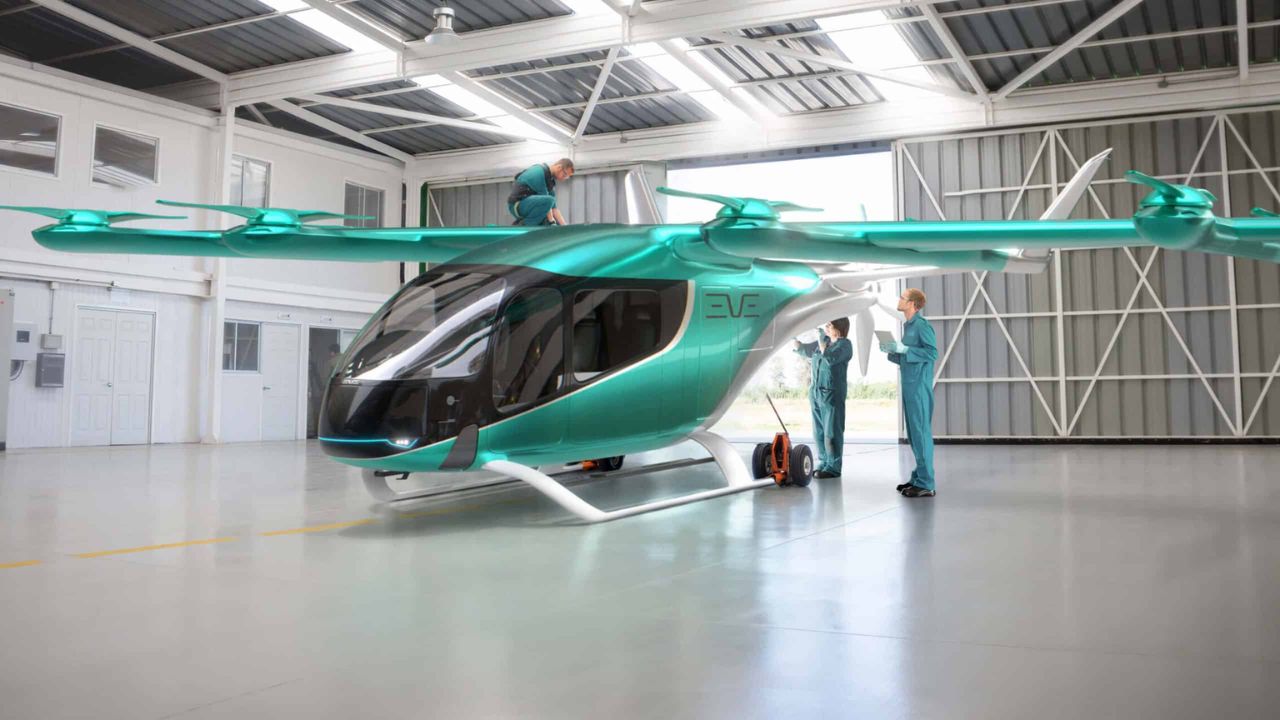
Eve differentiates itself by combining emerging technologies, which include electric propulsion, automation systems, and connectivity solutions applied to urban air transportation. In addition to prototyping the vehicle, the company is also developing its own software to manage air traffic in urban centers.
The Brazilian Flying Car
The eVTOL designed by Eve will have a capacity for five occupants — four passengers and one pilot — with a range of 100 kilometers. The model is expected to begin commercial operations in 2027, with an estimated production of 120 units annually in the initial phase. The expectation is that the aircraft will play an important role in sustainable air mobility, reducing emissions and expanding transportation options in large cities.