






 Portuguese
  Spanish
  4 min of reading
  0 comments


The investigation seeks to identify who accessed the national platform without authorization and sent ten false messages to cell phones of residents in various Brazilian cities
The Federal Police has opened a preliminary investigation to investigate the sending of false extreme alerts attributed to Civil Defense between Friday night (19) and Saturday morning (20).
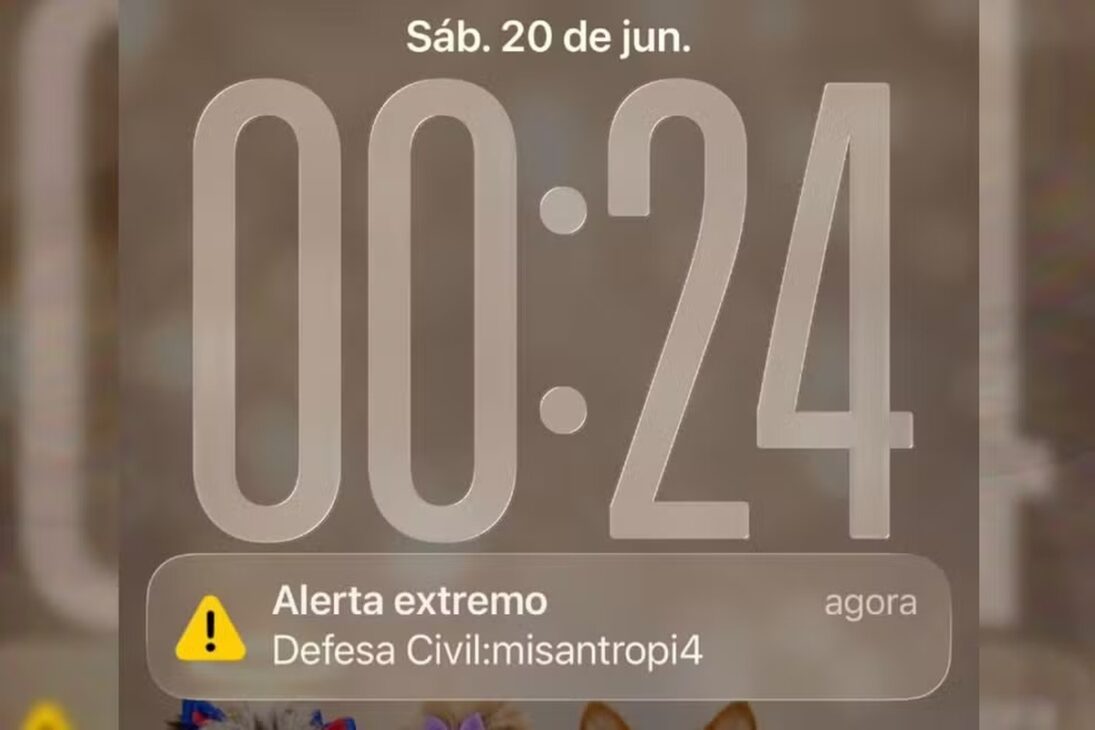
The messages were received by residents of different cities in Brazil. Some of them contained the word “misanthropy”, while others mentioned a supposed alien attack.
However, there was no real emergency situation. Therefore, the Ministry of Integration and Regional Development called in the Federal Police after confirming unauthorized access.
-
Extreme drought causes ghost village to reappear at the bottom of the reservoir that supplies Athens, revealing houses, a school, and ruins swallowed since the 1980s as the lake shrinks and exposes the water crisis threatening the capital of Greece.

-
An entire village lay asleep at the bottom of a lake for 3,000 years: divers suction sediments in Italy and reveal more than 600 wooden stakes, bronze tools, and traces of a Bronze Age settlement hidden underwater.
-
They call it the “Shopee house” and even cardboard, but the R$ 20,000 house is a certified Wood Frame from Alea, financed by Minha Casa Minha Vida: understand if it’s worth more than masonry.

-
Egypt wants to divert 10 million m³ of Nile water per day, equivalent to 4,000 Olympic swimming pools, to build a glass city in the desert and irrigate 2.28 million acres, in a project that attempts to push life out of the country’s most contested valley.



The main suspicion is that the national platform was hacked and used remotely by someone not connected to the National System of Protection and Civil Defense.
Federal Police investigates origin of false extreme alerts
According to the Federal Police, the investigation procedure is already underway. The investigation should clarify how the access occurred and who was responsible for the messages.
According to the national secretary of Protection and Civil Defense, Wolnei Wolff, everything indicates that the episode was caused by a hacker attack.
In total, ten false alerts were sent. Of these, nine were transmitted via the Cell Broadcast system and one was sent by SMS.
Even so, the authorities could not estimate how many devices received the notifications.
The investigation will also determine whether there was a security breach, misuse of credentials, or another form of remote access to the platform.
System was taken offline after invasion
The National Civil Defense reported that the platform was taken offline at 1:30 AM on Saturday (20).
According to the agency, the alert was remotely ordered by someone outside the official system. Additionally, the message was sent in the Extreme Alert category.
This classification represents the most severe level of the tool. It is usually used when there is an imminent risk to life and a need for immediate protection.
The National Civil Defense stated that the service would only be reconnected after the reestablishment of safety conditions.
Meanwhile, the São Paulo Civil Defense also temporarily disabled the tool until federal authorities clarified the incident.

False messages were received in several cities
Reports about the alerts emerged in Curitiba, São Paulo, Rio de Janeiro, Belo Horizonte, Brasília, Salvador, and Campo Grande.
In Rio de Janeiro, residents received messages with spelling errors, abbreviations, and words without context.
In a report sent to g1, the notification featured the term “misantropo” along with an unusual sequence of words.
Meanwhile, in Belo Horizonte, the message advised residents to protect themselves from a supposed “alien attack”.
The Civil Defenses of Paraná, São Paulo, and Rio de Janeiro denied issuing the alerts. The agencies also reinforced that no real danger situation was underway.
In Mato Grosso do Sul, the State Coordination of Protection and Civil Defense reported that the episode would be investigated.
Investigation involves the use of Cell Broadcast
The affected system uses Cell Broadcast technology, created to transmit emergency alerts to cell phones located in specific regions.
Unlike SMS, the alert is not sent individually to registered numbers. The message is transmitted by antennas to compatible devices connected in that area.
Therefore, the service does not require registration, an app, internet, or data package.
The alerts appear over the content displayed on the screen. Additionally, extreme notifications can emit sound signals to attract the population’s attention.
The tool is used in situations of heavy rains, floods, inundations, landslides, gales, and other threats.
Use of the most severe level expands Federal Police investigation
The improper use of the Extreme Alert category increased the severity of the episode investigated by the Federal Police.
The classification is reserved for situations where there is an immediate threat to life. Therefore, false messages can cause panic and compromise trust in the system.
The National Telecommunications Agency, Anatel, maintains a portal with the history of alerts sent by the platform.
On May 31, 2026, for example, an extreme alert was issued for Manaus due to the risk of landslides.
During 2025, the same category was used in occurrences involving storms, floods, hail, flooding, and gales.
Term “misanthropy” reinforced suspicion of invasion
According to the Michaelis dictionary, misanthropy means aversion, rejection, or distrust towards humanity.
The word can also be associated with social isolation, melancholy, or a pessimistic view of other people.
However, the term has no relation to climatic phenomena or emergency situations.
Therefore, its presence in the notifications reinforced the hypothesis of invasion and misuse of the platform, now being investigated by the Federal Police.


Be the first to react!