Portuguese
  Spanish


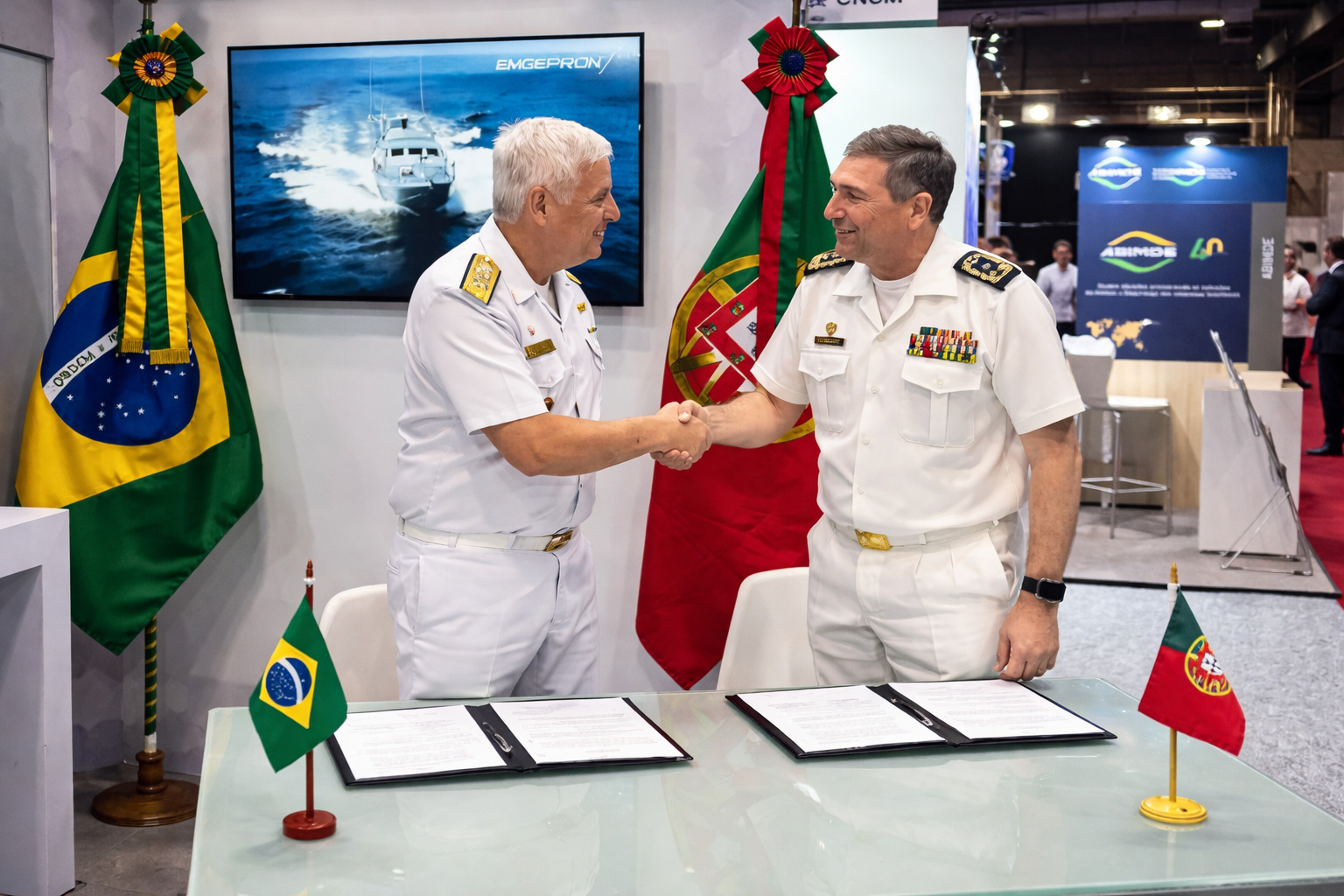

The declaration of intentions signed in São Paulo establishes cooperation in defense, naval technology, humanitarian aid, and disaster response between Brazil and Portugal
The Brazilian Navy and the Portuguese Navy signed, on April 14, 2026, a Declaration of Intentions during the LAAD 2026, held in São Paulo, with the aim of deepening cooperation in the field of defense. The agreement involves research and development, knowledge sharing, and joint naval projects, as well as including actions for natural disaster response and humanitarian aid, which expands the traditional scope of cooperation between the two forces.
The signing was attended by Vice Admiral Jorge Pires, Superintendent of Material of the Portuguese Navy, and Admiral Edgar Barbosa, General Director of Material of the Brazilian Navy, reinforcing the institutional nature of the understanding and highlighting the strategic importance of the agreement for both navies, which maintain historical, linguistic, and operational ties consolidated over time.
Strategic review expands cooperation between navies
The declaration signed in São Paulo represents a movement considered natural between two forces with evident affinities, while also pointing to an agenda with concrete potential for evolution, especially in the areas of technological development, technical exchange, and operational integration, consolidating a favorable environment for continuous and structured cooperation between Brazil and Portugal.
-
Nuclear Submarine USS Alexandria Retired After 35 Years, Having Completed Over 1 Million Miles in Missions

-
MODEC Introduces New Hull Design for FPSO Gato do Mato to Produce Up to 120,000 Barrels of Oil Per Day in Brazil’s Pre-Salt Region
-
This Massive 12-Meter, 21-Ton Underwater Drone Can Operate Autonomously for Up to Five Days

-
Global Shipping Faces Shortage of Certified Maritime Officers, Salaries in the U.S. Can Exceed $100,000 Annually



The document expands the traditional scope of military cooperation by including topics that go beyond classic defense, demonstrating that contemporary naval operations require a more comprehensive approach, capable of integrating different fronts of action and responding to complex demands in varied scenarios, which reinforces the relevance of the agreement in the current context.
Expansion of the scope includes new operational functions
The inclusion of actions aimed at humanitarian aid and natural disaster response highlights a transformation in the role of modern navies, which now combine military capability, logistical flexibility, and institutional presence, operating not only in defense operations but also in direct support to the population in critical situations.
This approach reflects an increasingly present reality in the international scenario, where naval forces are called upon to operate on different fronts, contributing to stability and assistance in emergency situations, significantly expanding the operational field of these institutions.
Strategic impacts in the Atlantic and interoperability
For Portugal, the approach reinforces the connection with a large-scale partner in the South Atlantic, expanding its strategic presence and strengthening relevant international relations, while for Brazil, the agreement opens new possibilities for dialogue with a European navy embedded in the NATO environment and with experience in recent modernization programs.
This interaction can generate significant gains in areas such as doctrine, interoperability, and capability development, promoting technical and operational advances that benefit both nations and contribute to the evolution of their respective naval forces.
Practical execution will be decisive for concrete results
Like any Declaration of Intentions, the real impact of the agreement will depend directly on its practical implementation, which requires the transformation of institutional alignment into concrete initiatives, such as joint programs, integrated exercises, technical exchanges, and industrial projects, capable of materializing the objectives established in the document.
This process will be essential to ensure that cooperation evolves consistently and produces effective results over time, consolidating a partnership that already has solid foundations and significant development potential, which raises a relevant question: will this approach translate into concrete advances in the naval sector in the coming years?