






 Portuguese
  Spanish
  5 min of reading
  0 comments


Slow advancement of the rail network exposes structural limits, incomplete demand recovery, and regional concentration of rail transport in Brazil, with modest growth after the pandemic and persistent challenges for expansion and passenger attraction.
Urban rail transport in Brazil made little progress in 2025 and once again highlighted historical difficulties in expanding at a pace compatible with the growth of metropolitan areas, keeping the sector far from a more consistent structural leap.
According to ANPTrilhos, the operational network reached 1,144.7 kilometers, with an increase of only 7.2 kilometers, while the total number of passengers reached 2.59 billion, recording a modest increase of 0.8% compared to the previous year.
Even with growth, the volume remains below the 3.2 billion users recorded in 2019, the period before the pandemic, indicating that demand recovery remains incomplete and still distant from the levels considered normal by the sector.
-
Railway returns to prominence in Brazil after STF approval: a R$ 25.2 billion project promises to save R$ 9 billion in freight, transport 50 million tons per year, and transform Sinop into a logistics powerhouse for agribusiness.

-
Retired trains leave European tracks and become tons of steel, aluminum, and copper in dismantling yards where recycling exceeds 90%, but batteries, composites, and electronics create a new frontier of railway waste.

-
The strategic railway of Santa Catarina will receive R$ 608 million, will undergo historic modernization, and could transform logistics between Mafra and the Port of São Francisco do Sul.
-
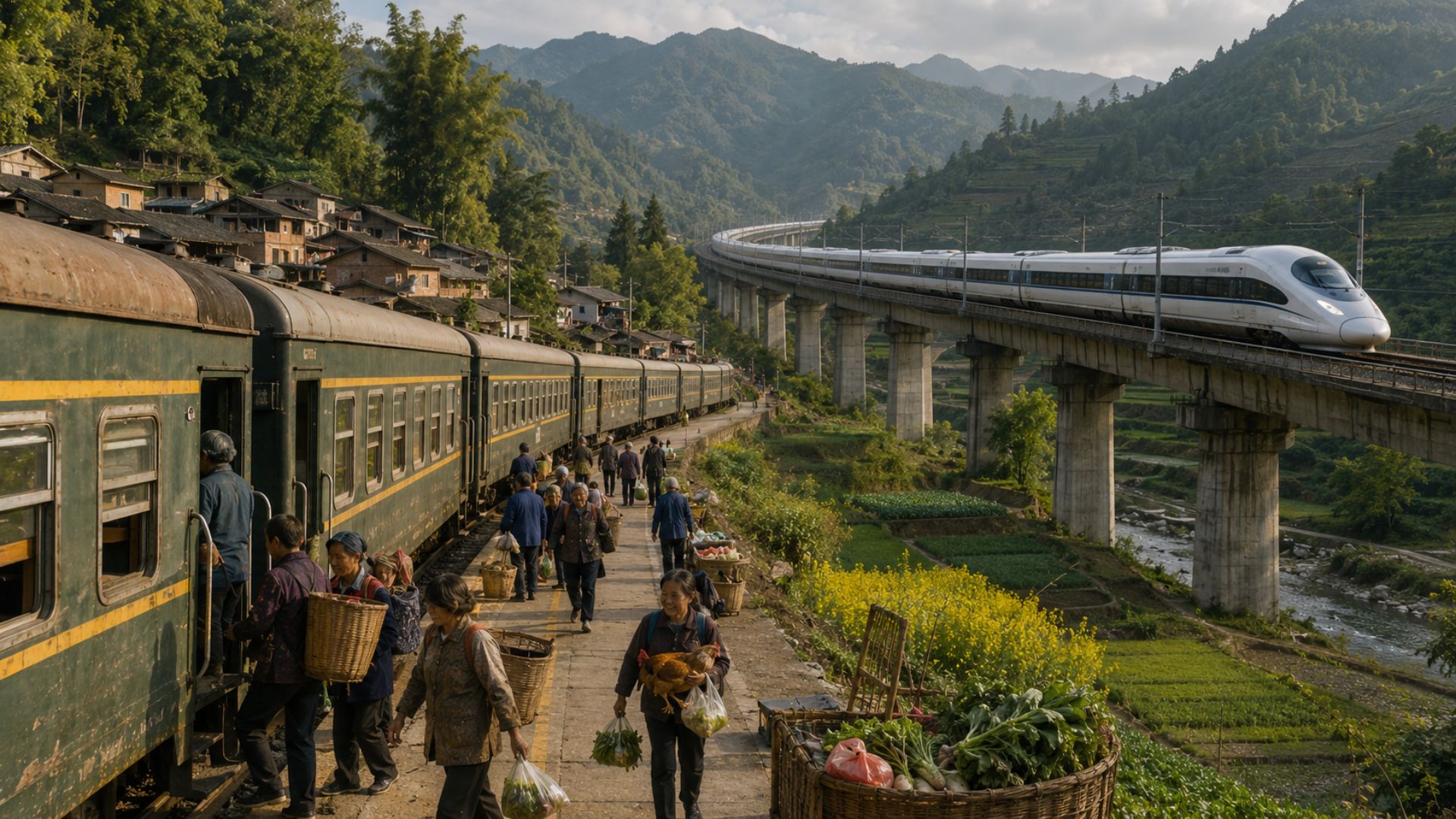
While showcasing bullet trains traveling at over 300 km/h, China maintains about 81 slow train lines that travel at 40 km/h, charge less than R$ 2 for a ticket, and cross remote villages carrying residents, students, and even chickens and vegetables to the market.


Growth slows after the pandemic
Upon observing recent developments, a scenario of deceleration is evident both in infrastructure expansion and in demand recovery, reinforcing the view that the sector lost momentum after the most critical period of the pandemic.
In a long-term analysis, the Brazilian network grew from 1,015.7 kilometers in 2015 to the current 1,144.7 kilometers, a growth that, although positive, appears limited in light of urban mobility needs in large centers.

When comparing the most recent cycles, the contrast becomes more evident and helps to gauge the loss of dynamism in the expansion of the metro-rail network over the past few years.
Between 2016 and 2019, the accumulated expansion was 103.8 kilometers, while in the period from 2022 to 2025, growth totaled only 37 kilometers, indicating a significant reduction in the pace of investments.
In light of this scenario, the post-pandemic recovery did not solidify as a new cycle of robust expansion, but rather as a partial recovery that failed to sustain the same level of growth observed previously.
Number of passengers still below pre-pandemic levels
Regarding passenger flow, the data also indicates a slower recovery than expected, with clear signs of deceleration over the last analyzed year.
While in 2024 the system transported 2.57 billion people, with a growth of 3.6%, in 2025 the increase was more modest, reaching 2.59 billion, which represents a rise of only 0.8%.
This behavior highlights a loss of momentum in the recovery of demand, which has not yet returned to the levels observed before the health crisis that began in 2020.
According to the president of ANPTrilhos, Ana Patrizia Lira, the expectation of limited growth had already been signaled earlier, especially after the release of partial data throughout the year.
“We do not believe there will be a significant change in the number of passengers unless there are either new public policies or new kilometers of tracks,” she said.
In the entity’s assessment, the sector has started to operate within a “new normal,” where demand tends to remain stable unless there is significant expansion of infrastructure.
Network expansion directly impacts demand
This scenario is directly connected to the logic of rail transport, whose ability to attract users strongly depends on the expansion of the network and the offer of new connections.

Whenever new lines or stations come into operation, there is an increase in demand, especially in metropolitan areas marked by congestion and long daily commuting times.
On the other hand, the absence of significant expansion limits this growth, causing the system to operate close to its current capacity, without substantial gains in the number of passengers.
Despite the existence of ongoing projects and studies for new implementations, the effects of these initiatives have not yet been significantly reflected in the most recent sector numbers.
Network distribution and regional concentration
In the daily life of the served cities, the average number of passengers on weekdays reached 8.7 million, slightly above the 8.6 million recorded the previous year, indicating stability in system usage.
Although rail transport remains essential for millions of daily commutes, the modest growth reinforces the perception of stagnation in light of the existing potential demand.
Currently, the system serves about 49.8 million people in 73 municipalities, highlighting its social relevance, but also revealing a still limited coverage for a country of continental dimensions.
Geographically, the concentration of the network remains evident, with São Paulo leading with 396.9 kilometers, followed by Rio de Janeiro, which has 285.9 kilometers of operational tracks.
In terms of composition, urban trains represent 46.8% of the network, totaling 536.1 kilometers, while subways account for 27.1%, with 310.8 kilometers in operation.
VLTs total 283.4 kilometers, equivalent to 24.8%, while the monorail has a smaller share, with 14.5 kilometers, representing 1.3% of the national network.
Historical series shows irregularity in progress
The historical analysis reveals that the growth of railway infrastructure in Brazil occurs irregularly, alternating between periods of more significant advancement and moments of retraction.
The greatest recent growth was recorded in 2018, when 41 kilometers were added to the network, while the worst performance occurred in 2021, with the deactivation of 11.8 kilometers.
This irregular behavior complicates long-term planning and undermines the creation of structural corridors capable of transforming urban mobility on a large scale.
Although there are expansion projections for the coming years, with works planned between 2026 and 2028, the most recent data indicates that the country still operates below what is necessary to consolidate rail transport as the central axis of urban mobility.
With limited expansion and partial recovery of demand, the sector remains at a modest growth level, reflecting structural challenges that continue without a consistent solution in the current scenario.



Be the first to react!