Portuguese
  Spanish


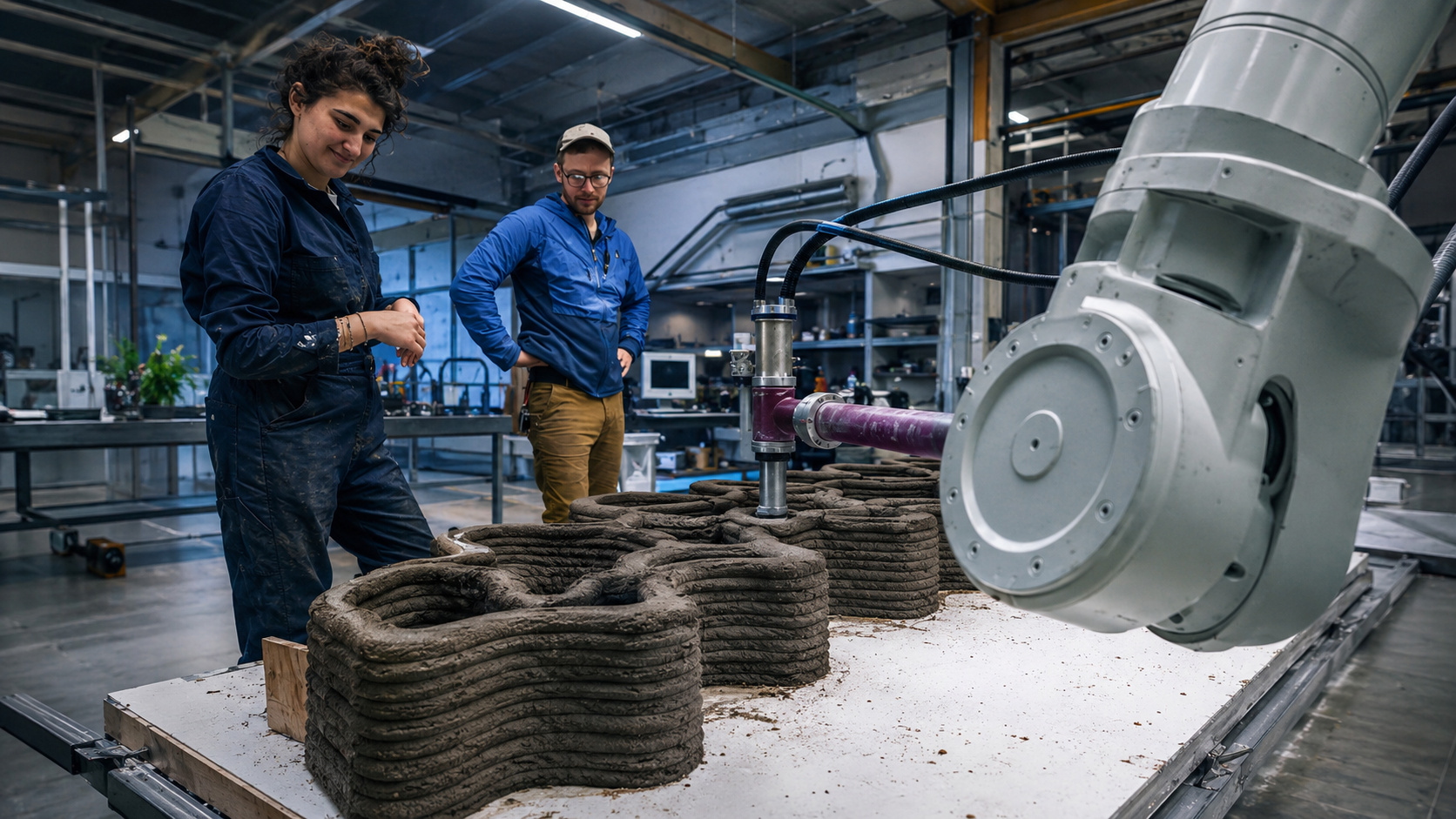


The technique transforms treated soil into a recyclable mold for concrete, reduces the use of disposable forms, facilitates curved pieces, and shows how civil construction can rethink an expensive, hidden, and wasteful stage on construction sites
MIT researchers use clay from the construction site itself as a recyclable mold for curved concrete, in a technique that draws attention for addressing a problem rarely seen by those who only follow the finished work.
The information was published by MIT News, the news site of the Massachusetts Institute of Technology. The proposal uses lightly treated soil, including earth removed from the construction site itself, to create temporary molds where the concrete is poured.
The most curious point is that the clay does not become the final wall. It functions as a concrete form, a temporary structure that helps the material take shape before hardening. Later, this mold can return to the usage cycle as soil.
-
Black Granite Sarcophagus Found in Alexandria Reveals Three Skeletons, Strange Liquid, and an Ongoing Archaeological Mystery in Egypt

-
Childhood Psychology: Experts Highlight How Playing Outdoors Until Dusk Boosted Autonomy, Decision-Making, and Resilience in Previous Generations, Influencing Adult Behavior Today
-
Former Truck Driver from Brazil Builds Logistics Company Aiming for $70 Million Revenue with 11 Branches, 700 Monthly Clients, and $10 Million Fleet Investment

-
World’s First Plasma Dress Turns Fashion Show into Scientific Spectacle with Controlled Electric Discharges and Ionized Gases in Iris Van Herpen’s Groundbreaking Tech-Fashion Creation





The most forgotten part of the construction also weighs on the budget and on-site waste
In a concrete construction, many people think only of cement, sand, gravel, and iron. But before the concrete hardens, it needs to be placed inside a temporary structure.


This structure is the concrete form. It holds the fresh material until the piece gains strength. In many constructions, these forms are made with wood, plastic, or other materials that can be costly and generate waste.
The problem becomes bigger when the piece is not straight. A curved wall, a beam with a different design, or a more complex structure requires more labor-intensive molds.
This is where clay as a recyclable mold comes in as a strong idea. The innovation is not in replacing concrete with soil, but in changing the stage that comes before it.
How clay becomes a technical mold and can later return to being material
The technique uses mud or lightly treated soil to assemble the mold. This soil can come from the construction site itself, which reduces the need to manufacture a separate form just to receive the concrete.
The process uses large-scale 3D printing to transform the soil into a defined shape. Thus, the material stops being just loose clay and takes on a precise function within the construction.
The research also includes straw and a wax-like coating. This layer helps prevent the water in the concrete from escaping into the soil during concreting.
Sandy Curth, a doctoral researcher in the MIT Department of Architecture, summarized the idea in a straightforward sentence: “We found a way to make infinitely recyclable forms. It’s just earth.”
Curved concrete becomes easier when the mold doesn’t rely on crafted wood
Curved pieces often increase construction costs because they require custom forms. The more different the design, the harder it is to assemble the temporary structure that will receive the concrete.
With the soil printed in the right shape, the mold can follow more complex curves and designs. This opens up possibilities for curved concrete without relying so much on wood that is cut, assembled, and then discarded.
MIT News, the news site of the Massachusetts Institute of Technology, detailed that the method is called EarthWorks. The proposal brings complex forms closer to a more practical construction, with less waste and more freedom in the design of the pieces.
This detail matters because many structures are made straight not because they are always the best choice, but because they are simpler to mold. When the form becomes more flexible, the project also gains new possibilities.
Clay as a mold is not related to clay houses or earth blocks
The technique should not be confused with rammed earth, adobe, or houses made of earth. In these cases, the soil can be part of the wall or the final body of the construction.
Here, the clay has a different role. It is used as a temporary mold for concrete, only during one stage of the construction.
After the concrete takes shape, the soil does not need to become waste. The idea is that it can be reused in the process itself.
This difference changes everything. The focus is not to replace concrete, but to reduce the waste of the forms that usually appear before the final piece exists.
Less waste and more efficiency can change the logic of forms in civil construction
Construction in concrete accounts for up to 8 percent of global carbon emissions cited in the source. Therefore, any change that reduces waste and helps use material more efficiently gains relevance.
The method can also facilitate pieces with shapes designed to use concrete only where it is necessary. This does not mean abandoning safety or structure, but seeking more efficient designs.
Caitlin Mueller, associate professor at MIT, stated that the technique brings complex and optimized structures closer to reality, with low-cost and low-carbon shape fabrication.
Sandy Curth also highlighted that the technology can make reinforced concrete buildings more efficient in material use, with a direct impact on global carbon emissions.
The limits still involve humidity, precision, and real use on the construction site
The idea is promising, but still faces challenges. The clay needs to maintain the correct shape, withstand the weight of fresh concrete, and prevent water from leaving the material prematurely.
Precision is also essential. In a real construction, small differences can affect fittings, finish, and performance of the piece.
Another point is the operation on the site. The method requires a large-scale 3D printer on site, which changes the construction routine and requires a prepared team.

Even so, the research draws attention because it targets a very practical stage. The form is temporary, but it can weigh on the cost, time, and amount of waste of a construction.
A curious technology that starts on the ground and targets the future of concrete
The use of clay as a recyclable mold shows that a significant change can arise in a hidden part of the construction. The form is born from the soil itself, receives the concrete, and can return to the cycle of use.
The technique does not turn clay into the protagonist of the final construction. It shows that the path to ready concrete can be cheaper, more flexible, and less disposable.
If the construction site’s own ground could become a mold for concrete, what invisible part of Brazilian constructions might still hide an economy that almost no one notices? Share your opinion in the comments.