Portuguese
  Spanish


Projects in São Paulo and Santa Catarina bring Brazil closer to inaugurating an unprecedented technology in its road infrastructure, with immersed tunnels planned to shorten crossings, preserve port navigation, and reorganize travel in regions marked by ferries, congested highways, and long waits.
Brazil is preparing to build its first immersed tunnels in two urban corridors separated by port areas: the Santos-Guarujá connection on the coast of São Paulo, and the connection between Itajaí and Navegantes on the northern coast of Santa Catarina.
With a more advanced contract and a defined public schedule, the São Paulo project is expected to start operation in 2031, while the Santa Catarina project is still undergoing technical and financial structuring before reaching the execution stage.
The symbolic race for the country’s first immersed tunnel has gained momentum because both solutions face similar urban mobility problems, especially in neighboring cities that rely on navigation channels, ferries, highways, or longer routes.
-
Half of Brazil’s Federal Public Works Projects Stalled: Audit Reveals 11,469 Abandoned Constructions and Billions Spent Without Delivering Schools, Hospitals, or Roads

-
Sanitation Worker Transforms Street-Discarded Books into Library to Aid Underprivileged Children in Brazil

-
Gifted 8-Year-Old Brazilian Boy with IQ of 134, Holder of Over 15 Science Olympiad Medals, Faces Unexpected Challenge Highlighting a Widespread Issue for Families in Brazil.
-
End of an Era: Major Manufacturer Shuts Down Factory After 64 Years, Laying Off Over 150 Workers in Brazil
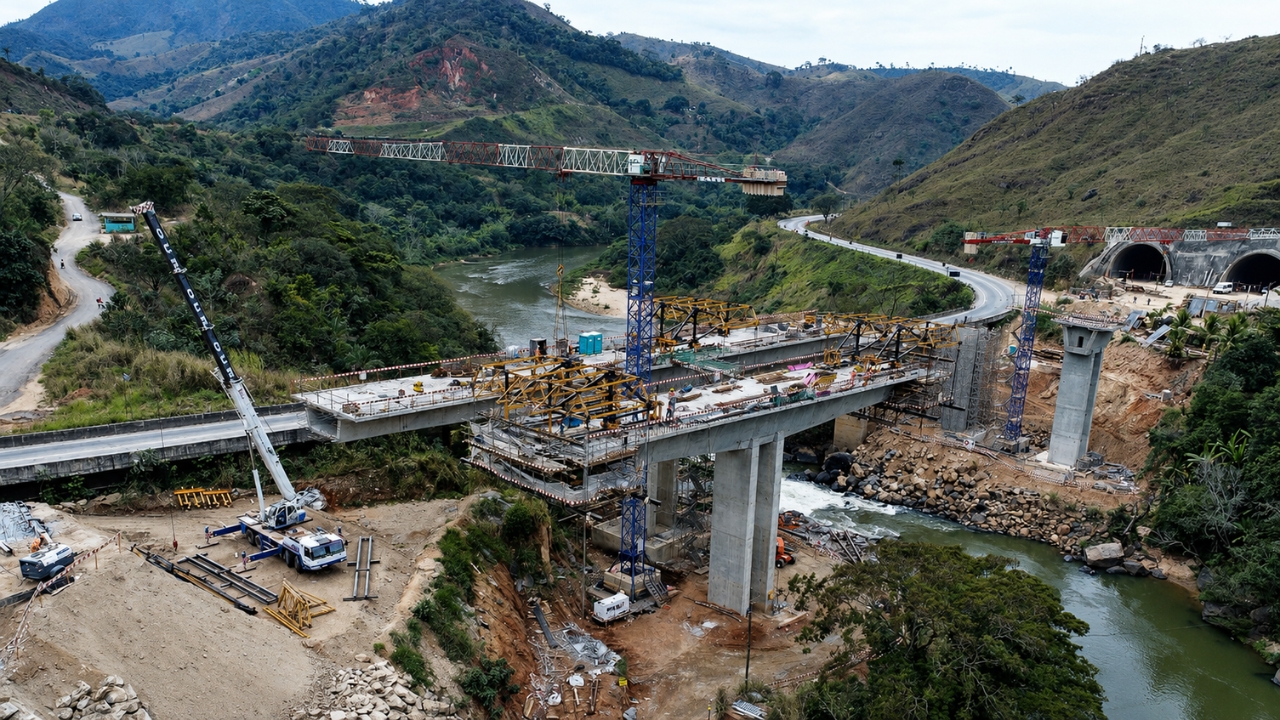


In these regions, each crossing can involve waits, detours, and pressure on already busy roads, a scenario that helps explain the choice for underground structures capable of connecting opposite banks without blocking port operations.
Santos-Guarujá Tunnel leads the race on the São Paulo coast
On the São Paulo coast, the Santos-Guarujá tunnel is ahead for having already gone through the auction, formalized the public-private partnership, and entered the contract preparation stage with the concessionaire responsible for the work.
According to the official project website, the connection foresees R$ 6.8 billion in investments and is expected to reduce the crossing between the two cities to less than five minutes when in operation.
The structure will have a total length of 1.5 kilometers, with 870 meters submerged under the port channel, in a layout planned to integrate urban mobility, vehicle circulation, public transport, and non-motorized travel.
In addition to the three lanes in each direction, the project includes a passage for pedestrians and cyclists, a service gallery, and an exclusive lane for Light Rail Vehicles, extending the reach of the connection beyond regular traffic.
Responsible for the concession, the Portuguese company Mota-Engil took on the construction, operation, and maintenance of the structure after signing the PPP contract in 2026, a stage following the awarding and homologation completed in 2025.
Still in 2026, the schedule foresees the development of the functional and executive projects, in addition to complementary studies necessary to enable the implementation and organize the preparation of the work fronts.
From 2027, the mobilization of the construction sites, the construction of the dry dock, and the preliminary dredging should occur, a phase that marks the practical advancement of the work before the manufacturing of the concrete modules.
According to the disclosed planning, these modules will be produced in 2028 and immersed in 2029, while 2030 will be reserved for finishing, system installation, and operational tests prior to the opening of the connection.
Immersed work should reduce crossing time between Santos and Guarujá
Chosen to reduce interferences on navigation, the immersed method allows for the fabrication of modules outside the channel and positioning them on the submerged bed, a strategy considered relevant in areas where the flow of ships needs to be preserved.
In Santos, this condition carries special weight because the connection will pass under one of the most relevant port areas in the country, where prolonged interruptions could affect cargo movement and the regional logistics routine.
In practice, the work seeks to replace a crossing historically dependent on ferries or longer road trips, alternatives that can increase travel time during periods of higher movement.
Those traveling between Santos and Guarujá today depend on options subject to queues, delays, and demand variations, especially during peak hours, holidays, and seasons of higher circulation on the São Paulo coast.
For the São Paulo government, the tunnel combines regional mobility, logistics, public transport, and urban integration, with monitoring and supervision by the São Paulo State Transport Agency and the São Paulo Government.
Itajaí-Navegantes Tunnel advances with PPP modeling
In Santa Catarina, the connection between Itajaí and Navegantes is part of Promobis, a mobility program of the Itajaí River Mouth aimed at reorganizing travel in a region marked by intense port activity.
The project foresees an immersed tunnel under the Itajaí-Açu River, creating a direct connection between two cities that currently concentrate a high flow of vehicles and rely on road alternatives pressured by regional dynamics.
In December 2025, the Executive Secretariat of International Articulation of Santa Catarina informed that the Senate approved financing of US$ 90 million with the World Bank for Promobis.
Adding the counterparts and the forecast of private capital, the package was estimated at US$ 366 million, about R$ 2 billion at the exchange rate informed by the Santa Catarina government in that announcement.
The financial design combines international loans, municipal participation, state support, and the forecast of private resources through PPP, a structure that still requires modeling before defining the company responsible for the construction.
This path helps explain why the Santa Catarina project is at a less advanced stage than the São Paulo project, although it is already part of a regional program with authorized international financing.
Planned to avoid the construction of a bridge over the channel, the immersed solution seeks to preserve navigation and reduce structural requirements that could arise in an elevated crossing over a port area.
By passing under the river, the tunnel tends to create a direct connection between Itajaí and Navegantes without imposing obstacles to the circulation of vessels, a central point for cities connected to port activity.
First immersed tunnel in Brazil expected to be in São Paulo
At the current stage, São Paulo appears to be ahead in the race for the first immersed tunnel in Brazil, as the Santos-Guarujá project has a signed contract, defined concessionaire, public schedule, and expected operation in 2031.
In the case of Santa Catarina, the Promobis has authorized international financing and a forecast of private investments, but still depends on the contracting of studies, partnership modeling, and future bidding to advance to the construction site.
Although the timelines are different, both projects indicate a change in how Brazilian port regions are beginning to discuss mobility, especially where bridges, ferries, and road routes alone do not meet the demand.
When the structures are ready, the most direct impact will be felt by residents, workers, and transporters who cross areas where water separates short routes but imposes long waits and inefficient displacements.
Which of the two connections is expected to transform the routine of those who cross these cities every day the most?