Portuguese
  Spanish


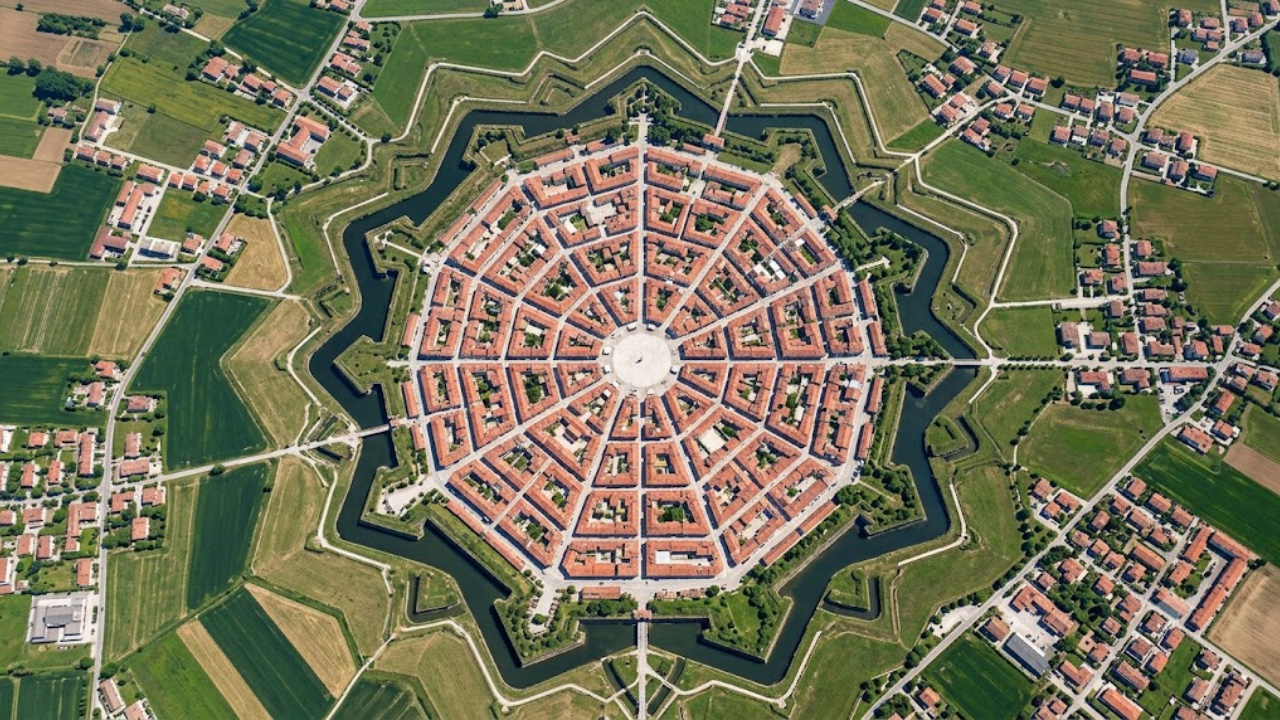

Discover the fascinating history and military architecture of Palmanova, the famous Italian fortified city that has the exact shape of a star.
The intellectuals and designers of the Renaissance period strongly believed that visual harmony, symmetry, and mathematical proportion of public roads had a direct influence on the morals, behavior, and health of the residents. The pinnacle of this humanist thought materialized in the far north of Italy, in the region of Friuli-Venezia Giulia.
This is Palmanova, an impressive ideal foundation city that surprises observers by revealing, when viewed from above, the precise layout of a gigantic star with nine distinct points.
Learn more about Palmanova
The conception of this structure represents a drastic break from the construction model that prevailed in Europe until then.
-
Teenage Boy’s Soap Business Survives Wars and Centuries, Becoming Global Giant

-
Without a Road to School, Brazilian Vendor Carves 8 km Mountain Path Alone After Watching Children Struggle

-
Tech Expert Leaves $1 Million Google Job to Launch Own AI Startup

-
Entrepreneur Discovers Hidden Generators, Invests R$ 75,000 Without Funds, and Grows Tecnogera into a R$ 750 Million Energy Company




While the common medieval scenario was marked by disorderly growth, with narrow, winding, dark alleys completely at the mercy of natural terrain accidents, the Renaissance proposal sought to apply human reason over geometric space.
Therefore, the planned layout for the municipality prioritized wide streets and large squares. The main objective was to promote environmental ventilation, collective hygiene, and efficient circulation of valuable commercial goods, combining mathematical science and artistic aesthetics to generate security and well-being.
In the most common medieval scenario, narrow streets, disorderly urban growth, and occupation strongly conditioned by the original topography of the land predominated. Ideal foundation cities, on the other hand, were planned with a radial and symmetrical layout, prioritizing ventilation, military security, and the creation of large public squares.
The role of sustainable tourism in heritage conservation
Today, the responsibility of keeping this monumental design intact is shared between public managers and the seasonal flows of visitors who travel to explore the region. The practice of conscious and sustainable tourism in listed destinations encourages travelers to explore the ancient moats and historical areas exclusively on foot.
Therefore, this preventive behavior is fundamental, as it prevents the premature wear of the original stone floors and ensures the integrity of the monuments against the impacts of daily urban pollution.
Furthermore, staying in family-run inns and purchasing crafts from local micro-entrepreneurs injects financial resources directly into the maintenance of the community’s urban infrastructure, valuing the genius of the past through current cultural education.
The impact of the UNESCO seal on the preservation of Palmanova
The appreciation of this heritage reached a new level on July 9, 2017, when the fortress was officially recognized by UNESCO as a World Heritage Site.
The title came with its inclusion in the transnational group of the Venetian Works of Defense from the 16th and 17th centuries, expanding its international projection and boosting the region’s economy through increased tourist and academic interest.
Since then, international recognition has facilitated access to resources aimed at restoring historical structures and permanently conserving the walls and underground tunnels.
In parallel, the municipality invested in strengthening cultural and sustainable tourism, adopting a controlled visitation model and promoting reenactments and historical events that preserve the memory of the ancient garrisons responsible for the defense of northern Italy.
The strategic origin and evolution of the fortress of Palmanova
Although the pursuit of social harmony was an essential pillar of the project, the emergence of this iconic masterpiece of defensive engineering served strictly tactical and geopolitical purposes of territorial protection.
As detailed by the official tourism portal Visit Palmanova, the beginning of the fortress-city’s construction occurred in the emblematic year of 1593, under the command of the government of the former Republic of Venice.


The central goal of the rulers was to create an impenetrable military barrier against the constant invasions of the Ottoman Empire’s troops on the eastern border.
Later, at the beginning of the 19th century, the region changed hands and came under the control of forces under the direct orders of Napoleon Bonaparte, who expanded the original defensive radius by adding a new external line of protection to the fortified complex.
Historical Timeline:
- 1593: Foundation of the fortress city by the government of Venice with an initial structure of three concentric walls.
- 19th Century: Napoleon Bonaparte takes control and adds a new external defensive line to the complex.
- 2017: Official inclusion of Palmanova in the UNESCO World Heritage list for Venetian works.
The Architectural Elements that Form the Nine-Pointed Star in Palmanova
The entire structural complexity that impresses modern engineers was based on revolutionary Renaissance military architecture, conceived from a perfect radial planning that sought to eliminate blind spots and optimize the use of heavy artillery of the time.
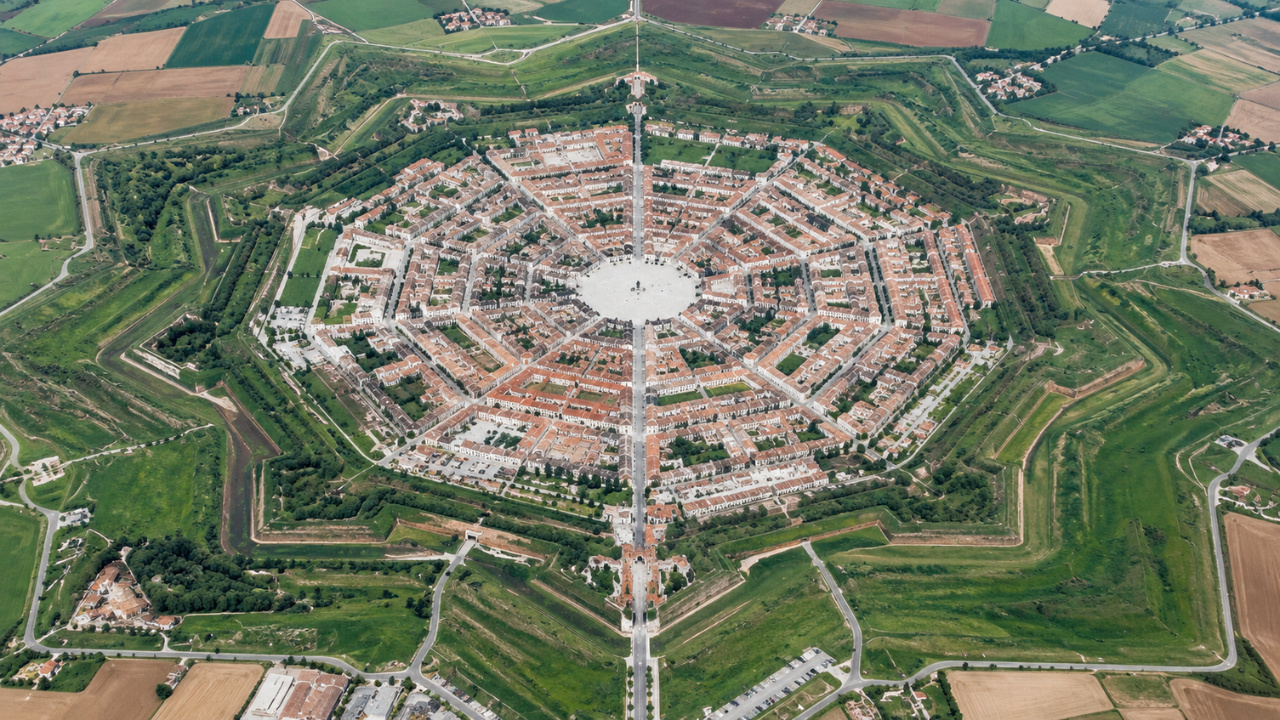
The star-shaped polygon is supported by three large concentric defensive walls, nine strategic pointed bastions, and nine ravelins that protected the main curtains, ensuring that any military garrison could quickly move to the peripheral walls in case of a coordinated surprise attack.
All this infrastructure symmetrically converges to a monumental hexagonal central square called Piazza Grande, the true social and administrative heart of the community. Meanwhile, access to the interior of the fortress was rigidly controlled through three monumental stone gates that remain fully preserved to this day.
This precise geometric configuration ensured that the square could never be directly targeted from outside, protecting citizens from enemy bombardments.
Main Components of the Structure:
- Three fortified rings: Thick stone walls that overlap in an orderly manner.
- Nine advanced bastions: Structures that allowed defensive crossfire against enemy infantry battalions.
- Central Piazza Grande: Hexagonal-shaped space from which radial streets lead to the edges.
- Three large historical portals: Preserved gates that served as the only official entry points.
With information from Olhar Digital