






 Portuguese
  Spanish
  6 min of reading
  0 comments


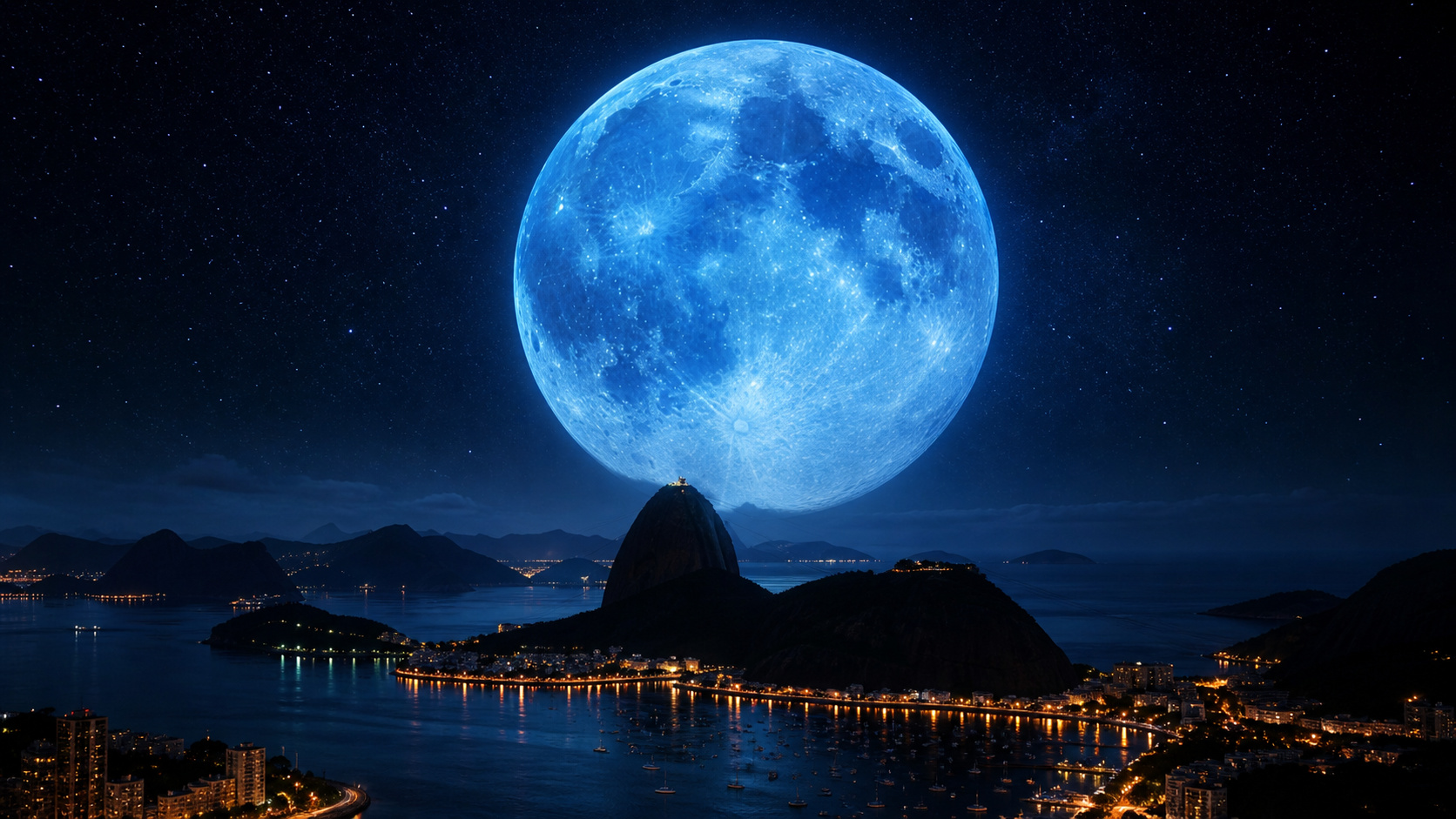
Blue Moon on May 31, 2026, will be visible throughout Brazil, coinciding with lunar apogee and appearing as the smallest Full Moon of the year.
According to CNN Brasil, May 2026 will have two full moons, a phenomenon that repeats on average every 18 months. The second, on May 31, is officially named the Blue Moon. The peak illumination will occur at 5:45 AM, Brasília time. This means the Moon will already appear practically full on the night of May 30 and will remain in full phase throughout May 31. Observers in any region of Brazil will be able to see the phenomenon with the naked eye, even in cities with moderate light pollution.
The rarest detail is the coincidence with the apogee, the point in the lunar orbit farthest from Earth. The Moon will be approximately 401 thousand kilometers away, compared to an average of 384 thousand kilometers, making it a micromoon and the smallest full lunar disk visible in Brazil in 2026.
Blue Moon on May 31, 2026, will be visible in Brazil, but it won’t be blue
The first question about the Blue Moon is simple: will it be blue? The answer is no. The name does not describe the color of the Moon, but a rare occurrence in the lunar calendar.
-
Scientists “listen to the heart” of the Sun and, after 40 years, discover something truly surprising

-
Lack of physical activity can accelerate memory loss, reduce circulation in the brain, and increase risks associated with cognitive decline.
-
Roblox changes the rules for children and teenagers in Brazil and promises a safer platform with selfies and parental control.

-
Water can carry pesticides invisible to common treatment, but nanosensors developed by Brazilian researchers promise to speed up the alert before the risk reaches the tap.



The expression “blue moon”, in English, has been used for centuries to indicate something very rare. The connection with astronomy became popular in 1946, when an article in Sky & Telescope magazine defined a Blue Moon as the second full moon in the same month.
The Blue Moon on May 31, 2026, should look like any other full moon: white when high in the sky, yellowish or orangish when near the horizon. What changes is the calendar, not the color of the satellite.
Why May 2026 will have two full moons in the same month
The Blue Moon happens because the lunar cycle and the human calendar do not have the same duration. The Moon’s synodic cycle, the interval between two consecutive full moons, lasts about 29 days, 12 hours, and 44 minutes.
Since most months have 30 or 31 days, two full moons can fit into the same month when the first occurs early on. In May 2026, the first full moon occurred on the 1st, allowing the second to occur on the 31st.
If the first full moon had occurred on May 2, the next would fall on June 1, and May would not have a Blue Moon. It is this difference between the lunar cycle and the Gregorian calendar that creates the phenomenon.
Blue Moon happens on average every 18 months and less than six times per decade
The frequency of the Blue Moon is regular and predictable. On average, the phenomenon occurs every 18 months, when the lunar cycle aligns to allow two full moons in the same month.

This means there are fewer than six Blue Moons per decade. The event is not as rare as a total eclipse, but it also doesn’t happen every year guaranteed.
The year 2026 will have an additional peculiarity: two months with two full moons, May and October. This type of repetition is more uncommon and occurs when February passes without any full moon.
Micromoon on May 31 will be the smallest visible Full Moon of 2026
The Blue Moon of May 2026 will be even more special because it will occur near the lunar apogee. The apogee is the point in the orbit where the Moon is farthest from Earth.
The lunar orbit is not a perfect circle, but an ellipse. Therefore, the distance between Earth and Moon varies throughout the month, ranging from about 356 thousand kilometers at perigee to approximately 406 thousand kilometers at apogee.
On May 31, the Moon will be about 401,017 kilometers from Earth, which classifies it as a micromoon. In practice, it will be the opposite of a supermoon: a full Moon slightly smaller and less bright than the largest full moons of the year.
Difference between supermoon and micromoon can reach 14% in apparent size
The visual difference between a supermoon and a micromoon can reach approximately 14% in apparent diameter and 30% in brightness. This difference is real, physical, and caused by the Moon’s orbital variation.
Even so, it is usually difficult to perceive without direct comparison in photos. For the casual observer, the horizon illusion often seems stronger than the real difference between a supermoon and a micromoon.

The Blue Moon of May 31 should appear smaller than the full Moon of December 2026, which is expected to be the largest supermoon of the year. The difference between the two involves about 45 thousand kilometers of orbital distance.
Best time to observe the Blue Moon in Brazil will be between May 30 and 31
The technical peak of the full Moon will occur at 5:45 AM on May 31, Brasília time. This does not mean, however, that this will be the best visual moment for observation.
For the Brazilian public, Saturday night, May 30, will be the most convenient window. The Moon will already be practically full after sunset and will remain visible during Sunday morning.
The visual difference between observing on the night of the 30th and on the 31st will be practically imperceptible to the naked eye. The best time for photos and observation will be the Moon’s rise on the eastern horizon, near sunset.
How to observe May’s Blue Moon without a telescope or special equipment
The Blue Moon can be seen with the naked eye throughout Brazil, provided the sky is clear. No telescope, binoculars, filter, or any special eye protection will be necessary.
The ideal is to look for a location with a clear view of the eastern horizon, away from tall buildings, trees, and very bright streetlights. The full Moon is bright enough to be seen even in urban areas.
For those using binoculars or a small telescope, it will be possible to observe craters, lunar seas, and surface details. Apps like Stellarium, Star Walk, and SkyMap help locate the Moon in real-time.
Venus, Jupiter, and Antares may also appear in the sky during the Blue Moon
The night of the Blue Moon will have other interesting elements for astronomical observation. Shortly after sunset, Venus should appear brightly on the western horizon, in its evening visibility phase.
Jupiter will also be close to Venus, creating a strong visual combination in the sky. While these planets appear to the west, the Blue Moon rises on the eastern horizon.
As the night progresses, bright stars like Arcturus, Spica, and Antares will also be visible. The Moon will be in the constellation Scorpius, with Antares close to the lunar disk in the early hours of the night.
Why the expression “once in a Blue Moon” became synonymous with rarity
The expression “once in a blue moon” emerged in English long before the modern definition used by popular astronomy. The original meaning was to indicate something rare, improbable, or almost impossible.

The exact origin is debated by linguists. One hypothesis suggests that “blue” was used in Old English with the meaning of absurd or impossible, making “blue moon” a kind of “impossible moon.”
The current definition, as the second full moon of a month, became popular after 1946. Even though based on a debated interpretation of old almanacs, it has become consolidated and is now the most widely known form to the public.
Blue Moon of 2026 combines calendar rarity and orbital rarity
The Blue Moon of May 31, 2026 will not be blue, will not require equipment, and will not depend on a narrow band of visibility. It can be observed throughout Brazil, if meteorological conditions allow.
What makes the event special is the combination of two factors: it will be the second full moon of May and will occur near the lunar apogee. Therefore, it will also be a micromoon.
In other words, Brazil will see a Blue Moon that doesn’t change color, but changes astronomical meaning. It will be the second full moon of the month and, at the same time, the smallest full moon of 2026.







-

3 people reacted to this.