Portuguese
  Spanish


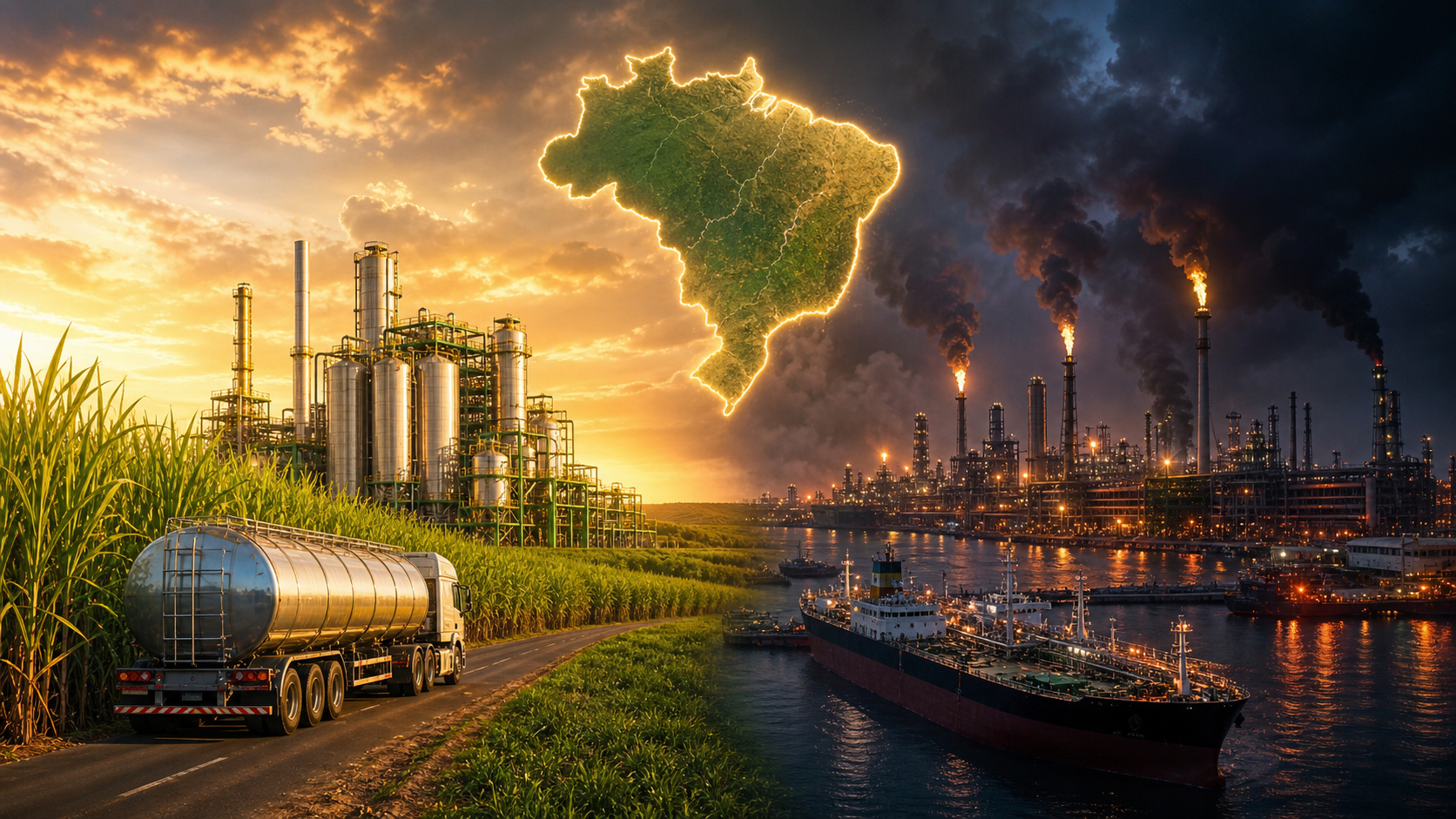

Brazilian government submits proposal to CNPE to raise mandatory anhydrous ethanol blend in gasoline from 30% to 32%, amidst oil pressure, war in the Middle East, and the quest to reduce gasoline imports with domestically produced fuel.
According to Reuters, the Brazilian government announced on April 24, 2026, that the National Energy Policy Council (CNPE), an inter-ministerial body that advises the Presidency of the Republic on energy policy, will vote in early May on the proposal to increase the mandatory anhydrous ethanol blend in gasoline from 30% to 32%. The measure has a technical name: E32.
“We will submit E32 to the CNPE, raising the anhydrous ethanol content in gasoline from 30% to 32%, a percentage for which we already had approved tests when we adopted E30,” said the Minister of Mines and Energy, Alexandre Silveira, at the opening of the sugarcane harvest in Minas Gerais. Two percentage points may seem small at the pump, but they can replace about 1 billion liters of imported gasoline with ethanol produced in Brazil.
What is E32 and why can Brazilian gasoline receive more anhydrous ethanol without changing the driver’s routine
Anhydrous ethanol is fuel alcohol with a water content of less than 0.7%, used directly in the blend with gasoline before the fuel reaches the pumps. Unlike hydrous ethanol, which is filled separately in flex-fuel cars, anhydrous ethanol is invisible to the driver: it is already inside regular gasoline.
-
Ukraine War Impacts Brazilian Fuel Supply: Russian Diesel Imports Drop 65% in June, Brazil Turns to US and India Amid Market Concerns

-
Chinese Nuclear Submarine Launches Simulated Warhead Missile in Pacific, Heightening Regional Tensions Amid Naval Drills with Russia Near Qingdao; New Zealand and Papua New Guinea Warn of Persistent Chinese Military Presence
-
Ayatollah Ali Khamenei’s Funeral Draws 15 to 20 Million in Tehran, Calls for Revenge Against Trump After Joint Israel-U.S. Attack

-
U.S. Establishes Permanent Embassy in Jerusalem, Reigniting International Debate Over Israel’s Capital


Brazil has the highest mandatory ethanol blend in gasoline in the world. It started at 5% in the first decades of Proálcool, gradually rose to 22%, reached 27% in 2015, went to E30 in 2025, and now enters the discussion of E32, with 32% anhydrous ethanol.


Each increase requires technical validation in engines, gaskets, seals, injection systems, and oxygen sensors. According to the Ministry of Mines and Energy, tests for E32 were already carried out during the transition to E30. The technical infrastructure is ready; what was missing was the economic and geopolitical trigger to transform the possibility into immediate public policy.
Why Brazil can increase the ethanol blend in gasoline on a scale few other countries could replicate
What makes Brazil unique in this equation is the combination of three factors that no other major ethanol producer simultaneously possesses. The first is the scale of production: the Brazilian ethanol harvest, combining sugarcane and corn, projects 41.8 billion liters for 2026/27, according to NovaBio.
The second is cost competitiveness. Brazilian ethanol produced from sugarcane is among the cheapest in the world, benefiting from the tropical climate, accumulated agricultural experience, and decades of sugarcane genetic improvement.
The third factor is the flex-fuel fleet. More than 80% of cars in circulation in Brazil can run on any proportion of ethanol and gasoline. In practice, the country has the production, engines, logistics, and agricultural chain to absorb a larger blend without redesigning the fuel system.
An additional billion liters of ethanol can reduce Brazil’s exposure to imported gasoline
Unica, the Brazilian Sugarcane Industry Association, estimates that the increase from 30% to 32% will raise the annual demand for anhydrous ethanol by approximately 1 billion liters. NovaBio arrived at a similar number: 1.052 billion additional liters, a 6.6% increase in total anhydrous ethanol demand.
To contextualize this volume, Brazil imports about 15% of the gasoline it consumes. Any reduction in the required volume of imported gasoline represents less direct exposure to oil volatility, exchange rates, and supply shocks caused by international crises.
With WTI at US$111 and the real in the R$5.70 to R$5.80 range, each barrel of imported fuel weighs more on the national cost. Replacing part of this volume with domestic ethanol means exchanging pressured international oil for fuel produced within the Brazilian agro-industrial chain.
Estimates from Unica, NovaBio, and StoneX indicate significant substitution of gasoline with national fuel
StoneX, a commodity analysis firm, estimated that the measure could generate an increase of approximately 600 million liters of ethanol in the 2026/27 cycle. The number is lower than Unica’s and NovaBio’s because it considers the implementation period and the initial 180-day validity period provided in the proposal.
Even with methodological differences, all three calculations point in the same direction: there will be a significant substitution of imported fuel with national fuel. The scale can vary between 600 million and just over 1 billion liters, depending on the approval date, validity, and market response.
This difference matters, but it does not change the economic meaning of the measure. E32 expands the demand for anhydrous ethanol, reduces the relative need for fossil gasoline, and strengthens a production chain that already operates on an industrial scale in Brazil.
The war in Hormuz made Brazil’s dependence on imported derivatives and international prices visible
Brazil has a structural energy vulnerability that rarely appears in public debate because it manifests gradually, until a crisis suddenly makes it obvious. For diesel, import dependence is approximately 30% of national consumption.
In gas, the dependence on LNG terminals and international routes connects the country to the same global market pressured by the closure of Hormuz. For gasoline, the approximately 15% imported is enough to transmit external shocks to domestic prices within a few weeks.

The 8% increase in the average gasoline price recorded by the ANP after the crisis shows this transmission. The price rises not because Brazil stopped producing oil, as the pre-salt continues to operate, but because derivatives follow international benchmarks. Imported gasoline is the link that connects the Brazilian driver to the geopolitics of the Strait of Hormuz.
E32 does not eliminate energy vulnerability, but it reduces part of the exposure to imported oil
Increasing the blend to E32 alone does not solve Brazil’s structural vulnerability. The country will remain exposed to imported diesel, exchange rates, international oil, and national refining capacity.
Nevertheless, the measure directly mitigates part of the problem. Each additional percentage point of ethanol in gasoline reduces the fraction of fossil gasoline needed in the liter sold to the consumer and, on a national scale, decreases the demand for petroleum-derived fuel.
A two-percentage-point difference may seem small at the pump, but it gains scale when applied to all liters consumed in the country. The real impact of E32 lies precisely in the national sum: less imported gasoline, more Brazilian ethanol, and greater supply security in a moment of global shock.
The sugarcane, corn, and mill chain should be directly benefited by the new blend
The increase in the blend to E32 travels a long chain before reaching the pump. It starts in the field, with more demand for ethanol, more sugarcane crushed, more corn processed, and more activity in the mills of inland São Paulo, Goiás, Mato Grosso, and other producing regions.
The 2026/27 harvest has already begun in April, and the CNPE’s decision in May could arrive in time to influence the allocation of sugarcane between sugar and ethanol. This decision is made by the mills throughout the harvest, according to price signals, demand, and regulation.
At refineries and distributors, the blending logistics already operate with E30. The adjustment to E32 is operational, not structural. Tanks need volume calibration, and blending systems need reprogramming, but there is no need for large capital investment or a long timeframe.
For the motorist, the change should be invisible, with a possible marginal effect on autonomy and price
At gas stations, the change will be practically invisible to the consumer. Regular gasoline will continue to be regular gasoline. What changes is the internal proportion of the liter, with two additional percentage points of anhydrous ethanol.
For gasoline car drivers, the technical effect may be a very small reduction in range. Ethanol has a lower energy density than pure gasoline, so a higher blend could, in theory, marginally increase consumption per kilometer.
With only a two-percentage-point difference, this effect tends to be measurable in a laboratory but practically imperceptible in everyday use. What might be more noticeable is the price, should the substitution of expensive imported gasoline with domestic ethanol help moderate the rise in fuel prices.
Brazilian ethanol emerges as an available, national, and large-scale solution in the face of the oil shock
Evandro Gussi, president of Unica, summarized the moment by stating that increasing the blend is a path Brazil already knows and knows how to operate. According to him, ethanol allows for advancing energy security with an available solution, produced in the country and on a large scale, with environmental gains in the fuel life cycle.
The phrase encapsulates the proposal’s thesis: an available, national, scalable solution with an installed production chain. E32 does not depend on future technology, does not require unprecedented infrastructure, does not require equipment imports, and does not need a new fleet to operate.
Brazil already has mills, crops, distributors, flex-fuel engines, and regulatory experience to produce and consume 1 billion additional liters of ethanol. What was missing was an urgent reason to use this capacity more intensely. Hormuz provided that reason, and the CNPE will decide in May whether to make E32 a new stage in Brazil’s fuel policy.