






 Portuguese
  Spanish


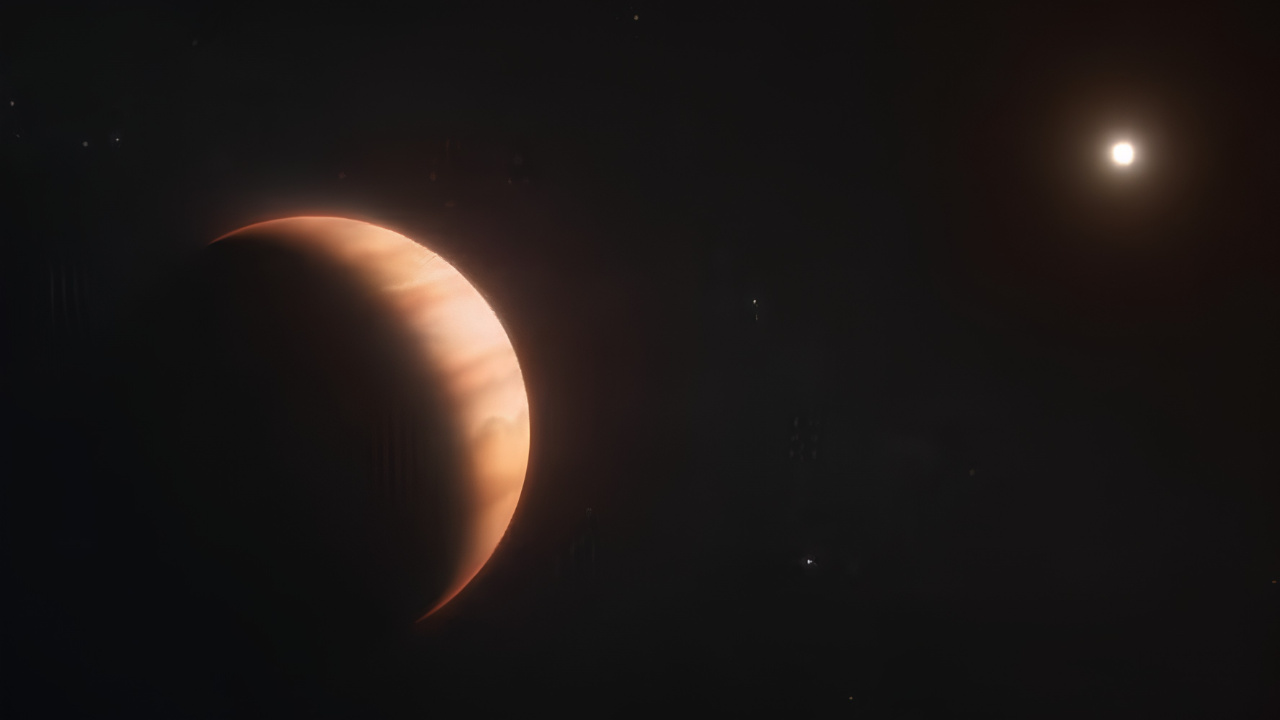
The gas planet WD1856b defied the laws of the cosmos by migrating close to a white dwarf billions of years after the star’s collapse, reveals James Webb.
An international team of scientists unveiled, in a study published on July 1st in the journal Nature, how the giant gas planet WD1856b managed to survive intact the destruction caused by the death of its host star, located 80 light-years from Earth.
Using unprecedented data on atmosphere, mass, and temperature collected by the James Webb Space Telescope (JWST), the researchers reconstructed the star’s trajectory and proved that it escaped being engulfed because it remained in a distant orbit during the violent phase of the local sun, migrating to its current position much closer to the white dwarf only billions of years after the stellar collapse.
The discovery solves a mystery that had intrigued astronomy since 2020 and helps anticipate the final fate of our own Solar System.
-
After 79 Attempts, Students Create Corn Waste Bioplastic That Turns into Fertilizer and Grows Plants When Buried

-
Brazilian Public School Students Win $5,000 at World’s Largest Science Fair with Innovative Water Filter Made from Local Charcoal

-
Xiaomi Launches 17T in Brazil with 120x Zoom, 6,500 mAh Battery, and Leica Cameras to Rival iPhone

-
Young Innovator Develops Low-Cost Synthetic Skin Using Buriti Oil to Aid Burn Victims, Gains International Recognition in the U.S.


The strange architecture of a triple star system
Since it was identified, the WD1856b system has attracted the attention of astronomers for presenting a configuration considered extremely unusual.
The giant planet completes a revolution around the white dwarf in just 1.4 days, remaining in such a close orbit that, if it had already occupied this position when the star was still going through its expansion phase, it would have been destroyed by the intense radiation and ended up engulfed by the star.
To explain this scenario, the researchers point out that the system is not formed only by the dead star and the planet.
There are also two companion stars in much more distant regions, whose gravitational action over billions of years gradually altered the trajectory of the giant gas planet, pushing it into its current orbit. The dimensions of WD1856b itself make the discovery even more impressive.
Estimates indicate that its mass varies between four and eleven times that of Jupiter, reinforcing the exceptional nature of this cosmic arrangement and helping to understand how long-term gravitational interactions can completely reshape the architecture of a star system.
Gravitational forces and the planet’s atmospheric “fever”
The key to deciphering that WD1856b made a late shift was a strong thermal anomaly identified in its gaseous top.
By cross-referencing the indicators from the NASA-operated telescope with mathematical models of planetary cooling over cosmic ages, researchers noticed that the environment was excessively heated.
The behavior of the space thermometer revealed crucial data for the historical reconstruction of the star:
- Recorded temperature: The celestial body’s atmosphere maintains a heat around 400 Kelvin (equivalent to 127 °C).
- Overheating: This thermal index is approximately 240 degrees above what would be expected if the star depended solely on the weak light emitted by the current white dwarf.
- Movement chronology: The gradual approach towards the center of the system occurred between 3 and 5.5 billion years after the local sun had already died.
This extra heat was caused by the intense gravitational tidal interactions of the white dwarf, which acted by compressing and heating the gas giant as it moved.
The future of the Solar System reflected in the cosmos
Monitoring this exotic system serves as a preview of the fate reserved for our own corner of the universe. According to astronomers, the Sun will exhaust its energy in approximately five billion years, expanding its original size by more than 100 times.
This violent process of a red giant will certainly engulf inner planets like Mercury and Venus, also putting Earth’s integrity at serious risk. The confirmation that celestial bodies can persist after the end of their stars’ life cycle brings new perspectives on time and space.
For researcher Ryan MacDonald, affiliated with the University of St. Andrews in Scotland, the experience with the James Webb lenses resembles a time travel.
“We are used to looking into the past when we use telescopes, but this is the first time we have been able to glimpse what might happen to the outer planets around the remnant of a Sun-like star,” compared the astronomer, defining the opportunity as using a time machine aimed at the future.
The advancement of research promises to bring new pieces to this space puzzle. Besides the explanation about the orbit, the detection of methane and the presence of clouds in the atmosphere mark the first characterization of this type around an extinct sun.
Ryan MacDonald celebrated the initial milestone provided by current technology, demonstrating optimism about upcoming astronomical discoveries.
As the researcher concluded, “this is just the beginning of our exploration of planets orbiting dead stars with the JWST. Our results show that stellar death is not the end — some planets experience a vibrant and lively future after their star’s death.”
With information from Revista Galileu


