






 Portuguese
  Spanish


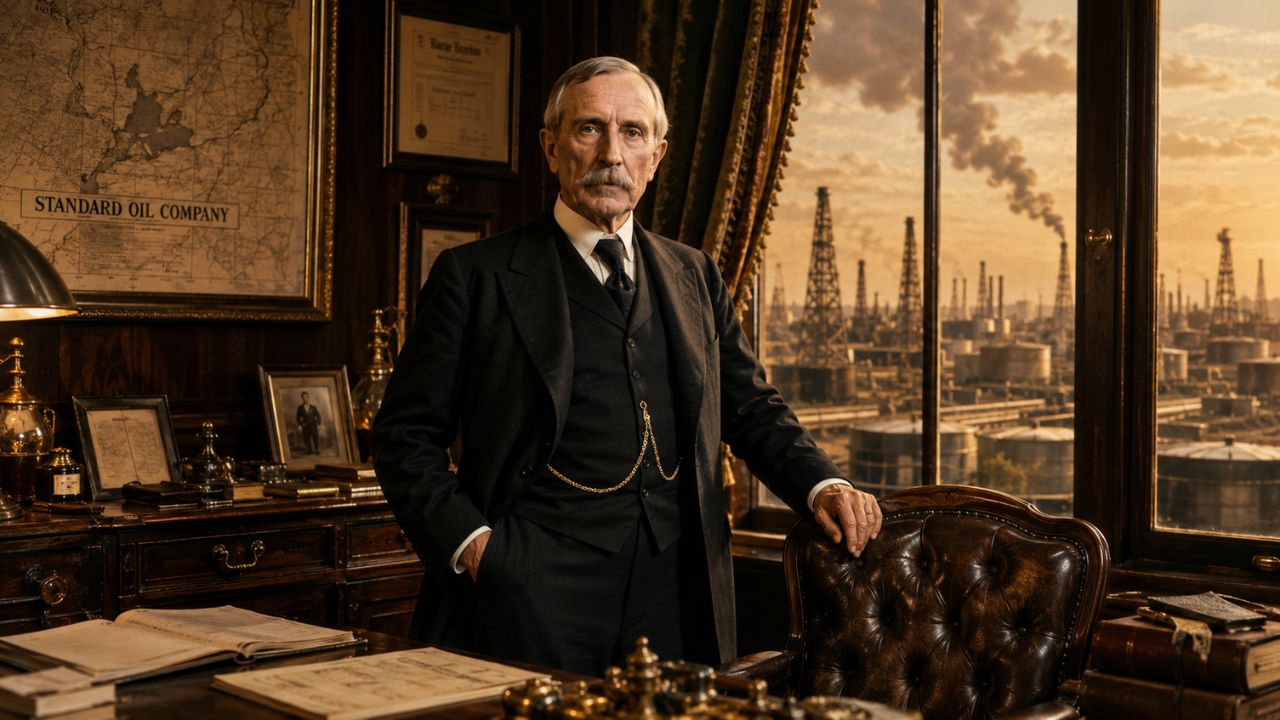

Discover how John D. Rockefeller used the Panic of 1873 to buy bankrupt rivals, create Standard Oil, and become the world’s first billionaire.
The Panic of 1873, one of the largest financial crises in modern history that paralyzed the New York Stock Exchange and caused mass bankruptcies, served as the main catalyst for consolidating John D. Rockefeller as the world’s first billionaire.
While the global market collapsed, the American businessman adopted an aggressive expansion strategy, acquiring weakened competing refineries at negligible prices. Centralizing these assets in the Standard Oil Trust in 1882, he went on to coordinate an empire of 100,000 employees and 20,000 facilities.
His fortune, which reached $1.4 billion in 1937, is estimated by economists to be over 400 billion current dollars if adjusted to the economic weight of the time, surpassing tech leaders like Elon Musk, Jeff Bezos, and Mark Zuckerberg.
-
12-Year-Old Takes the Wheel After Mother Faints, Prevents Highway Tragedy in Brazil, Impresses Rescuers

-
From Father to Daughters: Aline Leaves Career to Modernize Family’s Four-Decade-Old Artisanal Cachaça Business in Rural Brazil, Expanding Production with Her Sister
-
Couple’s 17-Year-Old Home Garden Destroyed by Local Authorities, Threatened with Fines

-
Frustrated by local government inaction, Brazilian villagers crowdfund $800 to build wooden bridge for coffee transport across stream





The collapse of the railroads and the revolution of pipelines
The dominance of Standard Oil, created in 1870 by Rockefeller, his brother William, and businessman Henry Flagler, depended on a complex relationship with the transportation sector.
As the company’s kerosene accounted for about 40% of all U.S. railroad cargo, Rockefeller used this volume to demand exclusive discounts (rebates).


Competing transportation companies, led by magnates like Cornelius Vanderbilt and Tom Scott, tried to react and recover their margins by raising freight rates against the oil giant.
Rockefeller’s counteroffensive permanently changed American industrial infrastructure through strategic actions:
- Independence from rails: The businessman cut contracts with train companies and invested in building his own distribution network.
- Subterranean network: More than 4,000 miles of pipelines were installed across American territory.
- Chain bankruptcy: Without the revenue from oil transportation and pressured by costs, dozens of railway companies collapsed and went bankrupt.
The origins in Cleveland and strategic refining
The path that led Rockefeller to become the world’s first billionaire began well before the oil boom, in his childhood starting in 1839.
He grew up under the influence of two opposing personalities: his father, William Rockefeller, an itinerant salesman with controversial conduct and rough business methods, and his mother, Eliza Davison Rockefeller, an extremely religious woman who instilled in her son discipline and obsessive thriftiness with every penny.
This rigidity was applied in 1855, when, at the age of 16, he got his first job as an accounting assistant at Hewitt & Tuttle, in Cleveland.

Four years later, in 1859, he founded an agricultural products firm with Maurice B. Clark, which earned the equivalent of 450 thousand current dollars in its first year.
Also in 1859, the course of the economy changed with the discovery of the first commercial oil well in Pennsylvania.
Instead of risking capital in crude oil extraction, Rockefeller realized that the real profit was in refining and industrializing the raw material. In 1865, he bought out his partners’ shares and took control of the largest refinery in Cleveland.
In 1871, he partnered with the South Improvement Company and soon after led the so-called “Cleveland Massacre,” incorporating 22 of his 26 local competitors in less than four months to dominate 80% of the region’s capacity.
The White House siege and the fragmentation of the monopoly
Standard Oil expanded its market by focusing on kerosene, nicknamed “the poor man’s light” for illuminating homes before electrification.
The trust’s efficiency increased when the company began hiring chemists to transform what was previously considered waste — such as gasoline generated in refining — into lubricating oils.
This absolute power attracted harsh criticism, and the press framed the magnate among the “robber barons” of the Gilded Age. In 1902, journalist Ida Tarbell published The History of the Standard Oil Company, exposing the group’s anti-competitive methods.
The legal outcome occurred under President Theodore Roosevelt, who launched an antitrust offensive against corporations that controlled markets alone.
In 1911, the United States Supreme Court ordered the breakup of Standard Oil into 34 independent companies — from which brands like ExxonMobil and Chevron are descended.

The dissolution, however, increased Rockefeller’s fortune, as he held shares in the new companies, consolidating his title as the world’s first billionaire in 1916.
Before passing away in 1937, at the age of 97, he and his wife, Laura Spelman Rockefeller, transferred the management of the business to their son, John D. Rockefeller Jr., who, along with his sisters, managed the legacy.
The magnate directed more than 530 million dollars to philanthropy, structuring globally impactful foundations:
- Rockefeller Foundation: Focused on the development of education and social welfare.
- Rockefeller Institute for Medical Research: A center supporting medical science that later transformed into the current Rockefeller University.
With information from ig (último segundo)


