






 Portuguese
  Spanish


In the United States, the government allocated US$ 900 million to General Matter, a company co-founded by Scott Nolan, to produce HALEU domestically, the uranium for advanced reactors that powers the reactors of the future: the goal is to reposition the USA in the nuclear fuel race, currently dominated by Russia and China.
The next-generation nuclear reactors require a special fuel that the United States hardly produces. To change this, the American government has just put US$ 900 million on the table. The money was allocated to General Matter, a company co-founded by Scott Nolan, with a clear mission: to produce uranium for advanced reactors on American soil. The bet is to free the USA from dependence on Russia and China and reposition the country in the race for the nuclear fuel of the future.
The contract was announced by the United States Department of Energy, the DOE, according to PR Newswire. The target is HALEU, a type of enriched uranium that advanced reactors need and that today is only manufactured on a commercial scale by Russians and Chinese. It’s not a laboratory curiosity: it’s a strategic industrial supply for the country’s energy.
US$ 900 million for a rare fuel
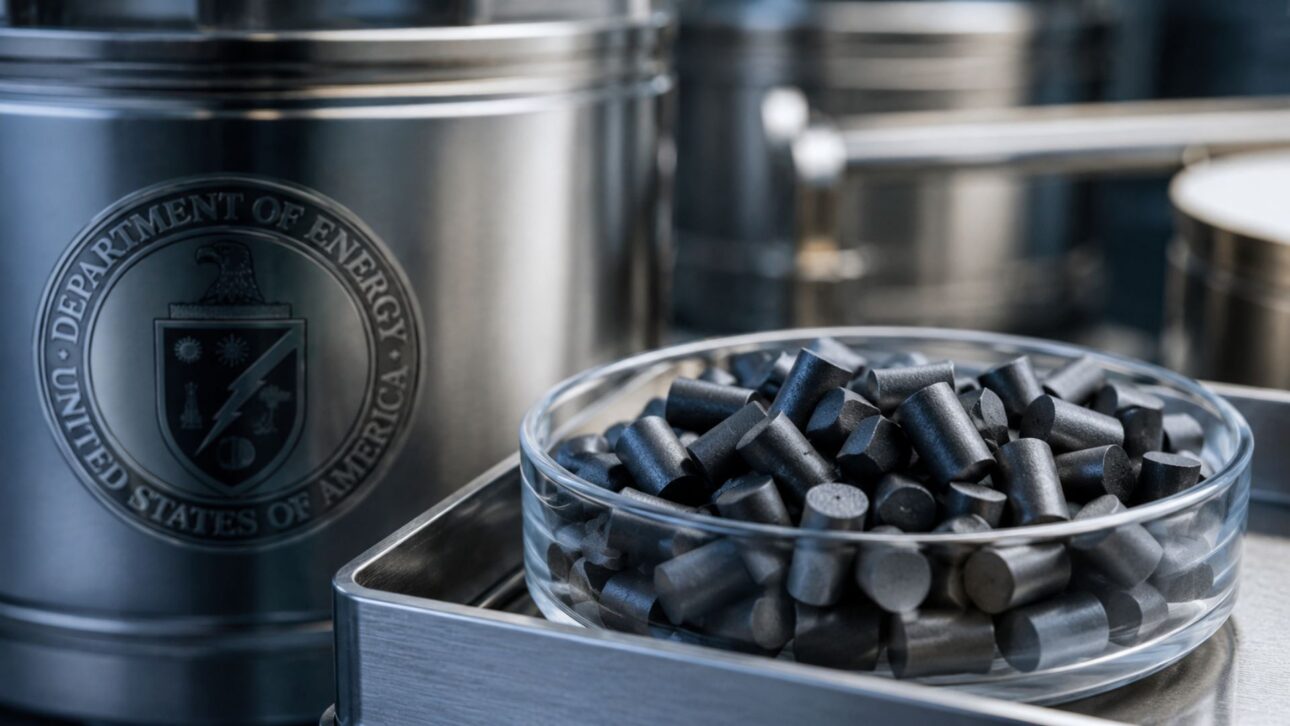
The DOE allocated US$ 900 million to General Matter to strengthen the domestic production of advanced nuclear fuel in the United States.
-
Construction Begins on First U.S. Modular Nuclear Reactor, Smaller Than a Sports Court

-
Dutch Innovator Develops Dual Battery and Electrolyzer Machine for Solar and Wind Energy Storage, Raises €30 Million Following 1 MW Pilot

-
Hiker in Norway Discovers Rare 1,500-Year-Old Gold Sword Ornament, One of Only 17 Worldwide
-
Brazil’s Largest Grain Port Faces Delays in the Hinterlands, Missing Rail Link Costs Agribusiness Billions


This amount is part of a larger program, of US$ 2.7 billion, in which the American government also awarded two other companies in the enrichment sector. In other words, the USA is playing hard to rebuild a chain they had set aside.
General Matter received one of the largest shares. It is public money betting that the private industry will handle a national security problem.
What is HALEU and why future reactors need it
The fuel at the center of it all has a technical name: HALEU. The acronym, in English, stands for high-assay low-enriched uranium, a type of uranium enriched to a higher level than that of common reactors, but still below military grade.
Most advanced reactors, like small modular reactors, are designed to run on HALEU, not the fuel of traditional plants. Without this uranium for advanced reactors, much of the new nuclear generation simply does not materialize.
This is why HALEU has become a key piece. Ensuring uranium for advanced reactors is ensuring the future of nuclear energy.
Only Russia and China manufacture today
Here is the problem that scares Americans. Currently, only Russia and China produce HALEU on a commercial scale, which places the energy and national security of the USA in the hands of rivals.
Relying on geopolitical adversaries for the nuclear fuel of their own reactors is a risk that Washington wants to eliminate. It was this vulnerability that motivated the billion-dollar investment.
Rebuilding enrichment capacity at home reduces foreign dependence and strengthens the American nuclear industry. Nuclear fuel has also become a matter of sovereignty.
Who is Scott Nolan and General Matter
Behind the venture is a name from the world of technology and investment. Scott Nolan is one of the founders of General Matter, a company created precisely to return the ability to enrich uranium to the USA.
For Scott Nolan, the contract is, in his words, a decisive moment for energy security and American leadership. General Matter is not a state-owned company, but a private company betting on a market that the government wants to see grow.
Combining private capital with state money and urgency is the formula of the moment in the sector. And Scott Nolan is at the center of this bet.
The factory in Paducah and the goal for the 2030s
The project already has an address and schedule. General Matter will fulfill the contract at a commercial enrichment plant in Paducah, in the state of Kentucky, on the site of a former gaseous diffusion plant.
The construction began in August, and the $900 million will accelerate the building and start-up of the factory, according to Power Magazine. The goal is ambitious: the company believes it will be able to supply the entire domestic demand for HALEU in the USA by the early 2030s.
Repurposing an old nuclear plant to manufacture the fuel of the future carries strong symbolism. From historical site to strategic factory, the leap is set.
Why this puts the US back in the nuclear race
The move goes far beyond a factory. Nuclear energy has returned to the center of the debate as a clean and constant source, and advanced reactors are the big bet for the next wave.
Without its own nuclear fuel, the US would fall behind just when the sector promises to grow. Securing HALEU at home unlocks reactor projects that were stalled waiting for fuel.
It also helps lower costs for utilities and consumers in the long run. It is the missing piece for the US to compete equally in the global nuclear race.
What the General Matter case shows
The biggest lesson is that fuel is as strategic as the reactor. Scott Nolan and General Matter show that it is useless to design advanced reactors if there is no uranium for advanced reactors available at home.
Of course, it’s important to stay grounded. The $900 million accelerates the work, but the factory still needs to be built and prove it delivers the promised HALEU, and the goal to supply the entire country is for the early 2030s, not tomorrow.
Even so, seeing the American government inject nearly a billion dollars to rebuild nuclear fuel production is the kind of move that redraws the energy map. From uranium to the plant, the US wants to regain control of its own nuclear chain and proves that, in the race for the energy of the future, those who dominate the fuel start ahead.
And you, did you know that the nuclear reactors of the future depend on uranium that few countries produce? Tell us in the comments what you think about the return of nuclear energy as a strategic bet.


