Portuguese
  Spanish


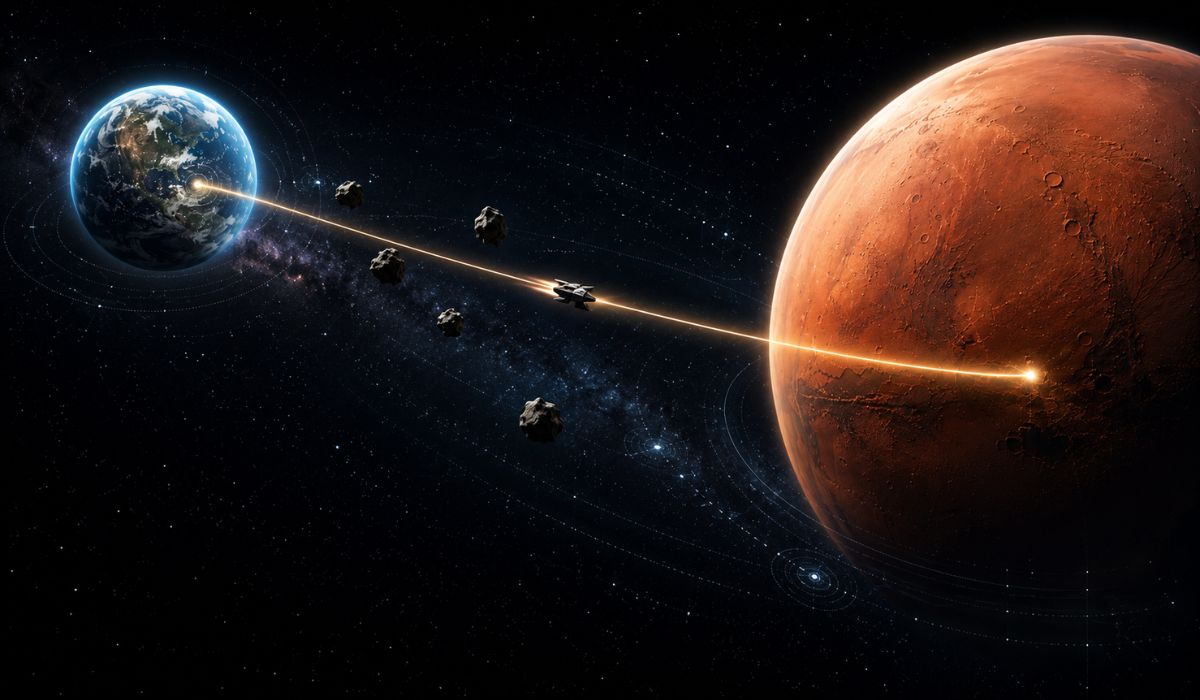


Brazilian research proposes a shorter route for missions to Mars based on asteroid orbital data and gained international recognition after publication in a scientific journal in the space field.
A study by Brazilian physicist Marcelo de Oliveira Souza, a professor at the Darcy Ribeiro State University of Northern Rio de Janeiro, gained international recognition after proposing a round trip to Mars with a total duration of up to seven months.
According to the researcher, who informed CNN Brasil, the work has been cited or reproduced in about 50 countries and in more than 26 languages since it became public.
The research was published in the scientific journal Acta Astronautica on April 11, with the English title “Using Asteroid Early Orbital Data for Rapid Mars Missions”.
-
She heard for decades that space was not a place for women, became a pioneer in aviation, was part of the Mercury 13, and at 82, finally traveled with Jeff Bezos before dying at 87.

-
Scientists investigate microplastics in the airways of patients with sleep apnea and reveal a new focus for research on environmental pollution, human exposure, and possible impacts on breathing quality.
-
For the first time, scientists have seen the ocean floor open up in real-time—plates moving apart by two meters in a few days and 160 million cubic meters of lava emerging on the seafloor.
-
Iraq floats and sinks under an arm of the Euphrates 10 giant concrete boxes of 46,000 tons and 125 meters each to assemble a 2.4 km submerged tunnel and open a new land route between Asia and Europe.





The free translation of the article’s name is “Using early orbital data from asteroids for rapid missions to Mars”.
The study also appears on the ScienceDirect platform, which gathers international academic publications.
The proposal analyzes early asteroid orbit data to identify trajectories that can reduce travel time between Earth and Mars.
Instead of using this information only to track small celestial bodies, Souza investigated whether certain orbital patterns could serve as a reference for faster interplanetary transfers.
Route to Mars can reduce travel time
According to the calculations presented in the study, the mission could last between 153 and 226 days, depending on the technological scenario adopted.
The model identified as closest to current capabilities predicts a total of 226 days, including travel to Mars, stay on Mars, and return to Earth.
According to CNN Brasil, conventional missions to the red planet are usually estimated to take a total of two to three years.
The researcher himself states that the proposal still depends on new stages of analysis before any practical application.
“Of course, to carry out a trip, it is necessary to adjust the rocket’s speed to see if it reaches what I proposed, there is the question of what can be carried, the payload… I made the theoretical proposal,” Souza told CNN Brasil.
In the same interview, the professor explained that he simulated two models.
The first considers a higher speed, still incompatible with available technology.
The second was presented as an alternative closer to current conditions.
“This would be a one-way trip, staying for a period on Mars and returning to Earth, totaling 226 days,” he stated.
The difference between the two scenarios indicates that the work does not describe a mission ready for launch.
The article presents a method for searching for trajectories, based on paths suggested by the orbits of asteroids that pass through regions close to Earth and Mars.
These paths were treated in the research as possible geometric corridors for displacements in the Solar System.
Asteroids enter the mission calculation
The project began in 2015, when Souza started studying asteroids with trajectories close to Earth and the red planet.
Initially, according to CNN Brasil, the calculations were done manually and required more time.
In a later stage, the researcher began to use computational simulations and artificial intelligence tools to test combinations of routes.
The analysis focused on early orbital data, which are estimates made before the complete refinement of an asteroid’s trajectory.
As new observations are made, calculations about the orbit of these celestial bodies become more precise.
In the study, Souza analyzed whether these initial configurations could reveal useful patterns for planning displacements between planets.
The work also points to a window considered favorable for 2031, when Mars’ position would allow one of the simulated trajectories.
In an interview with CNN Brasil, the researcher stated that he had found a result compatible with a configuration predicted for that year.
The proposal does not, by itself, solve the challenges of a crewed mission to Mars.
It would still be necessary to consider launch speed, fuel, payload, radiation protection, orbital insertion, landing, and return.
These points remain among the main technical obstacles for a human journey to the planet.
In this context, the article focuses on a specific stage of space planning: trajectory identification.
By working with asteroid data, the study presents a mathematical alternative to compare routes and evaluate possibilities for travel in shorter periods.
Brazilian study resonates abroad
CNN Brasil reported having anticipated the study before its scientific publication.
After its release, the research began circulating on science portals and pages in different countries.
According to the researcher, there were publications in places like Argentina, Spain, India, and Indonesia, in addition to mentions in international outlets.
The repercussion is related to the scientific and technological interest in missions to Mars.
The planet is one of the main targets of space exploration programs, and the travel time is a relevant variable for any mission plan.
In longer journeys, periods of exposure to environmental and operational risks in space increase.
Even so, the research was not presented as a mission approved by a space agency.
What the article describes is a theoretical possibility of orbital planning, dependent on future validations and compatibility with propulsion, navigation, and landing technologies.
In astrodynamics, an area that studies the movement of objects in space, small variations in position, time, and velocity can significantly alter a trajectory.
Therefore, simulation methods are used to test launch windows and arrival conditions at other celestial bodies.
Who is Marcelo de Oliveira Souza
Marcelo de Oliveira Souza holds a degree in Physics and a doctorate in Cosmology from the Federal University of Rio de Janeiro.
Currently, he works as a professor at UENF, in Campos dos Goytacazes, in northern Rio de Janeiro state, and develops activities related to astronomy, teaching, and scientific dissemination.
The researcher also founded the Louis Cruls Astronomy Club, an organization that has completed 30 years of activity.
The entity participates in astronomy popularization initiatives and, according to CNN Brasil, played a role in bringing astronaut Buzz Aldrin, the second man to walk on the Moon, to Brazil for his first lecture in the country.
In addition to the research on routes to Mars, Souza received recognition from Dark Sky International for actions related to dark sky preservation.
The organization works to defend areas with low light pollution, a topic associated with astronomical observation and environmental conservation.
The professor was also involved in the certification process of Parque Estadual do Desengano, in Rio de Janeiro, as the first International Dark Sky Park in Latin America.
The certification recognizes areas that adopt measures to protect the night sky and reduce the impacts of artificial lighting.
Another area of activity for the physicist is the project Jovens Astros do Amanhã, which receives support from the U.S. Consulate General in Rio de Janeiro.
The initiative is aimed at scientific training and encouraging students interested in astronomy.
The research on Mars brings together three elements of public interest: space exploration, asteroids, and the use of computational tools to analyze large volumes of data.
From this intersection, the Brazilian study became part of the debate on ways to reduce the time required for a trip to the red planet.