Portuguese
  Spanish


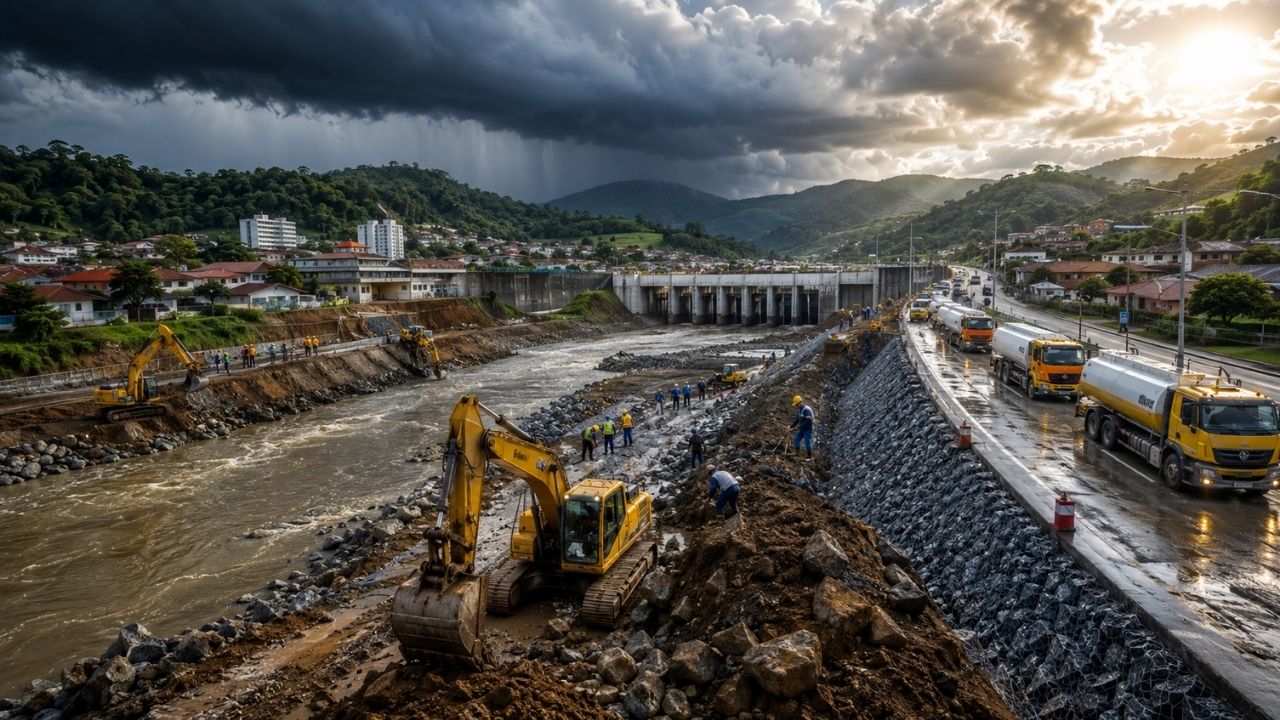

In Santa Catarina, disaster prevention in the face of El Niño involves dams, river cleaning, bridges, water trucks, and equipment for Civil Defense. The government reported about R$ 1 billion in actions, while the Spring Operation should mobilize the 295 municipalities of Santa Catarina between June and September 2026.
Santa Catarina intensified disaster prevention in the face of the possibility of El Niño in the second half of 2026. According to information released by the state government and Civil Defense, about R$ 1 billion were allocated to dams, river dredging, access structures, and equipment destined for the municipalities.
According to ND Mais, the mobilization involves the 295 municipalities of the state and will have an operational phase between June 1 and September 21, with the Spring Operation 2026. The initiative aims to prepare areas subject to flooding, inundations, and mass movements, such as landslides, while the climatic behavior continues to be monitored by technicians.
Possibility of El Niño raises attention to risks in the state
The prospect of El Niño formation in the second half has put hydrological risks back at the center of planning in Santa Catarina. In a technical note, state agencies highlighted that the phenomenon may favor periods of above-average rainfall, but its intensity and impacts still depend on the evolution of atmospheric conditions.
-
28-meter, 156-ton titans traveled 20,000 km from China to the port of Santa Catarina: Portonave received 7 fully electric megacranes, part of a R$ 210 million package, to double container handling.

-
They exchanged the idea of a large house for a 35 m² warehouse, spent US$ 12,000 on the structure, and created a tiny house in Colorado with space to live and work.

-
A newly opened terminal in the middle of the Amazon has begun transporting soy and corn through Amapá, eyeing the queue of ships that is congesting the ports in the South.

-
Goodbye to old tiles: renovation technique without construction transforms bathrooms in a few hours, eliminates debris, and reduces costs with coverings using special paints, high-resistance adhesives, and modern finishes that completely renew the space.



Disaster prevention considers that floods, flash floods, and landslides are not the automatic result of a single phenomenon. Even so, the possible influence of El Niño requires anticipation in vulnerable regions. Preparing structures and teams before occurrences is the central point of the state strategy.
Dams and rivers are part of the reported R$ 1 billion package
According to data presented by the state government, Santa Catarina gathers approximately R$ 1 billion in initiatives associated with prevention. The package includes works on dams, modernization of existing structures, and actions for river dredging and cleaning, measures aimed at reducing vulnerabilities in the face of high rainfall volumes.
Dams integrate flood retention capacity, while cleaning watercourses aims to preserve flow where sediments and debris can exacerbate overflows. In disaster prevention, structural works do not eliminate all risk, but they can reduce damage and extend response time.
Municipal Civil Defense receives technology and vehicles
Another aspect of the package involves the allocation of R$ 64 million to municipal Civil Defense structures. According to the announcement, the funds financed equipment such as 4×4 vehicles, rugged notebooks, tablets, mapping drones, and screens for monitoring meteorological information.
For Civil Defense, local capacity for recognition and movement is crucial in the first hours of an emergency. Drones can assist in surveying affected areas, while suitable vehicles facilitate access to muddy or blocked sections. Disaster prevention also depends on municipalities capable of acting quickly.
Bridges and water trucks expand response to different extremes

The investment also covers accesses affected by water. With R$ 45 million allocated to the bridge kit program, 641 structures were reported delivered: 205 concrete bridges and 436 metal kits. In rural or isolated areas of Santa Catarina, damaged crossings can interrupt rescue, supply, and movement of residents.
Although El Niño focuses attention on rain, the state also reported R$ 55 million to tackle drought and emergency supply. The action enabled 839 reservoirs and water transport kits for 51 municipalities, in addition to 126 water trucks. The protection structure needs to respond to both excess and lack of water.
Spring Operation will reach the 295 municipalities
The Spring Operation 2026 is expected to mobilize the 295 municipalities of Santa Catarina between June 1 and September 21. The planned actions include river cleaning and drainage, tree management, bridge kit installation, and training, with priority for locations classified at medium, high, or very high risk of flooding, inundations, and mass movements.
Planning connects monitoring and territorial execution. While experts monitor the possibility of El Niño, each municipality needs to transform alerts into maintenance, response organization, and communication with residents. For Civil Defense, coordinated action is decisive when a severe event affects more than one region simultaneously.
Schools also join the disaster prevention policy
In addition to works and equipment, the state presented numbers from the Civil Defense in Schools program, which received R$ 22.1 million since 2023 and reached 1,567 schools in 290 municipalities. The initiative seeks to teach students to recognize risk areas and adopt self-protection measures.
The training expands disaster prevention beyond dams, bridges, and vehicles. In Santa Catarina, where different extremes can occur throughout the year, public information and infrastructure need to work together, especially in the face of alerts associated with climate behavior.
The disaster prevention can only be fully evaluated as actions are executed and events occur. For you, should climate protection works and equipment receive permanent priority, regardless of the confirmation of a specific phenomenon? Leave your opinion in the comments.