Portuguese
  Spanish


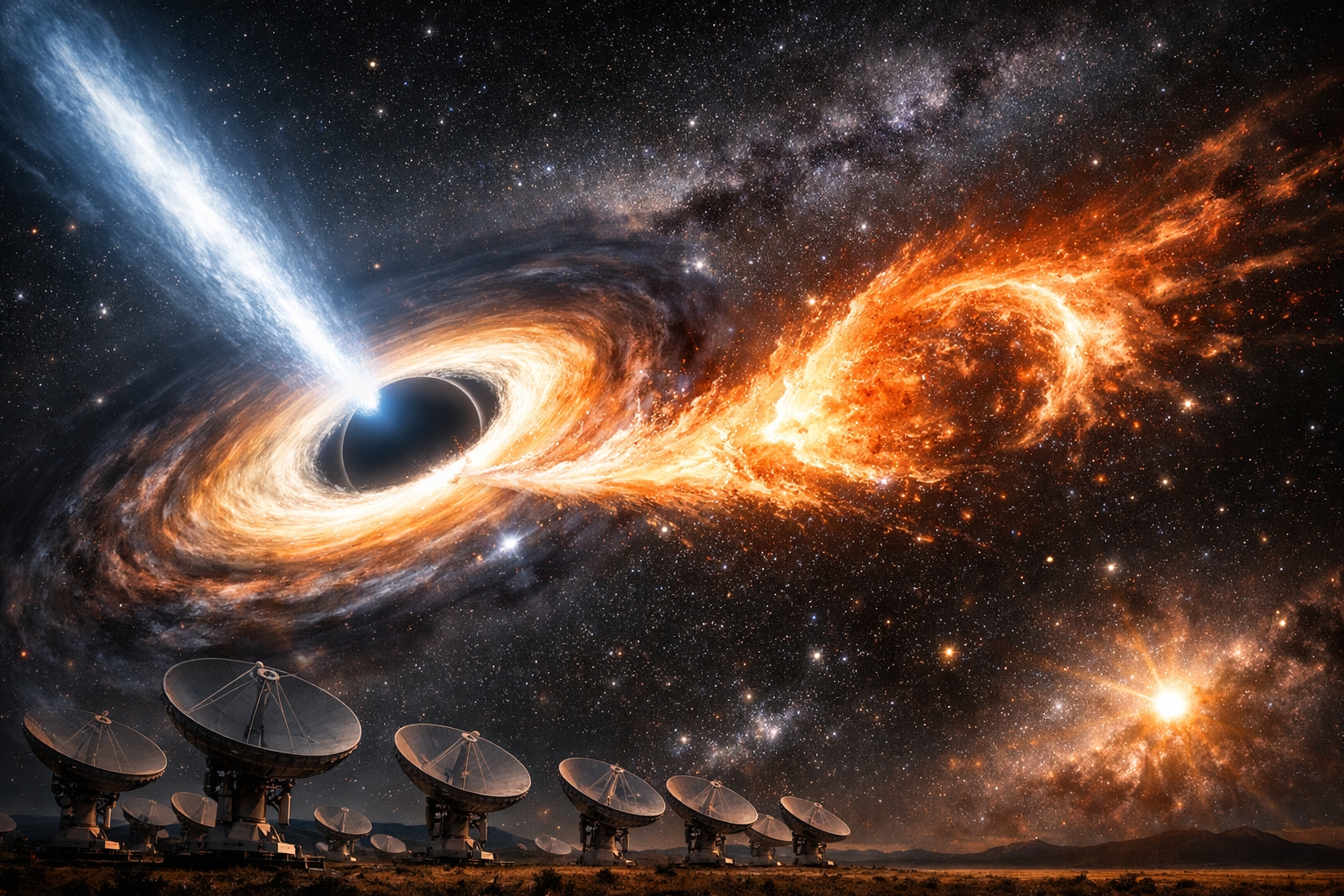


In The Universe, A Team Led By Yvette Cendes Monitored For More Than 2000 Days The Black Hole AT2018hyz – 100 Trillion Times More Powerful Than The Death Star From Star Wars, To Understand Why Its Radio Emission Increased 50 Times And Does Not Stop Growing
Black Hole, 100 Trillion Times More Powerful Than The ‘Death Star From Star Wars? That’s Right, The Supermassive Black Hole AT2018hyz Destroyed An Entire Star In 2018. What Initially Seemed Like Just Another Extreme Event In The Universe Has Turned Into One Of The Most Intriguing Phenomena Of Modern Astronomy.
Four Years After Engulfing The Star, The Object Known As AT2018hyz Continues To Increase Its Radio Emission And Is Now About 50 Times Brighter Than When It Was First Detected At This Wavelength. Models Indicate That The Peak May Happen In 2027.
The Case Attracts Attention Not Only For The Cosmic Violence But Also For Its Direct Impact On Space Observation Technology And How Major Energetic Events Are Monitored.
-
Brazilian Researcher Develops Protein Supplement from Tilapia Waste, Combining Innovation and Sustainability with Economic Potential

-
Women in São Paulo Unknowingly Tracked by Coin-Sized Tags Hidden in Cars and Belongings, Raising Stalking Concerns
-
Near a $750 million AI data center in Brazil, a resident’s well runs dry, leaving her unable to afford the $25,000 needed for repairs.

-
16-Year-Old from Brazil’s Sertão Wins Young Scientist Award for AI Predicting Rainfall with 94.5% Accuracy to Aid Farmers



What Happened In Space
In 2018, The All-Sky Automated Survey For Supernovae Identified An Unusual Brightness Coming From A Distant Galaxy. It Was A Tidal Disruption Event, Known By The Acronym TDE.
This Phenomenon Occurs When A Star Passes Too Close To A Supermassive Black Hole And Is Shredded By The Gravitational Force. Part Of The Material Is Captured. Another Part Is Ejected Into Space.
Until Then, Everything Was Within The Expected Parameters For The Scientific Community.
The Behavior Changed Years Later.
The Signal That Appeared Almost Three Years Later
The AT2018hyz Was Initially Observed In Visible Light. However, The Radio Emission Only Appeared 972 Days After The Star’s Destruction.
The Most Surprising Thing Is That Instead Of Weakening, The Signal Keeps Growing.
Observations Conducted Over More Than Two Thousand Days Show That The Radio Brightness Continues To Increase Across All Analyzed Frequencies. This Behavior Strays From The Typical Pattern In Which The Released Energy Tends To Decrease Over Time.
The Team Led By Astronomer Yvette Cendes Is Monitoring The Phenomenon To Understand The Reason Behind This Late Surge.
The Two Most Likely Explanations
There Are Two Main Scenarios Being Analyzed.
The First Involves The Late Release Of A Large Volume Of Material, Known As Spherical Outflow. In This Case, The Black Hole Would Have Ejected Matter Into Space More Than A Year After The Star’s Destruction, Generating The Increasing Radio Emission.
The Second Scenario Points To The Formation Of A Relativistic Jet, Composed Of Particles Traveling At Speeds Close To The Speed Of Light. If This Jet Is Out Of Our Direct Line Of Sight, The Brightness May Take Time To Appear. As It Slows Down And Expands, The Signal Increases Rapidly.
Events With Jets Of This Kind Can Reach Energy Levels Comparable To Those Of A Gamma-Ray Burst, Considered One Of The Most Powerful Explosions In The Universe.
Extreme Energy From The Black Hole, 100 Trillion Times More Powerful Than The ‘Death Star From Star Wars’
Estimates Indicate That The Energy Released By The AT2018hyz Is Of The Same Order Of Magnitude As Gamma-Ray Explosions.
To Illustrate The Scale, Popular Comparisons Suggest That The Phenomenon Can Release Trillions Of Times More Energy Than Fictional Estimates Attributed To The Weapon From The Star Wars Franchise.
Even Considering The Natural Uncertainties Of Measurements Made At Cosmic Distances, The Numbers Are Impressive.
The Impact On Technology And Space Engineering
The Case Could Bring Significant Changes In The Way Such Events Are Monitored.
The Observation Time In Radio Telescopes Is Limited And Highly Competitive. When An Event Does Not Present Initial Radio Emission, It Often Loses Priority In Monitoring.
The AT2018hyz Shows That This Can Be A Strategic Mistake.
If Other Events Show Similar Behavior, It Will Be Necessary To Review Protocols, Extend Monitoring Time, And Invest In Long-Term Monitoring Strategies.
What Could Happen In 2027 With The Black Hole 100 Trillion Times More Powerful Than The ‘Death Star From Star Wars’
Current Models Indicate That Brightness Will Continue To Increase Until It Reaches A Predicted Peak In 2027. If This Prediction Is Confirmed, The AT2018hyz Could Become One Of The Main Case Studies On How Supermassive Black Holes Release Energy Late And Over Prolonged Periods.
The Big Question Now Is How Many Similar Phenomena May Have Gone Unnoticed Simply Because No One Continued Observing For Long Enough.
The Universe May Not Reveal Its Most Energetic Events At The Moment Of Explosion. In Some Cases, Like This One, The Spectacle Begins Years Later.
Do You Think This Phenomenon Is An Isolated Case Or Could It Be More Common Than We Imagine? Share Your Thoughts In The Comments And Join The Discussion About The Future Of Black Hole Monitoring.