Portuguese
  Spanish


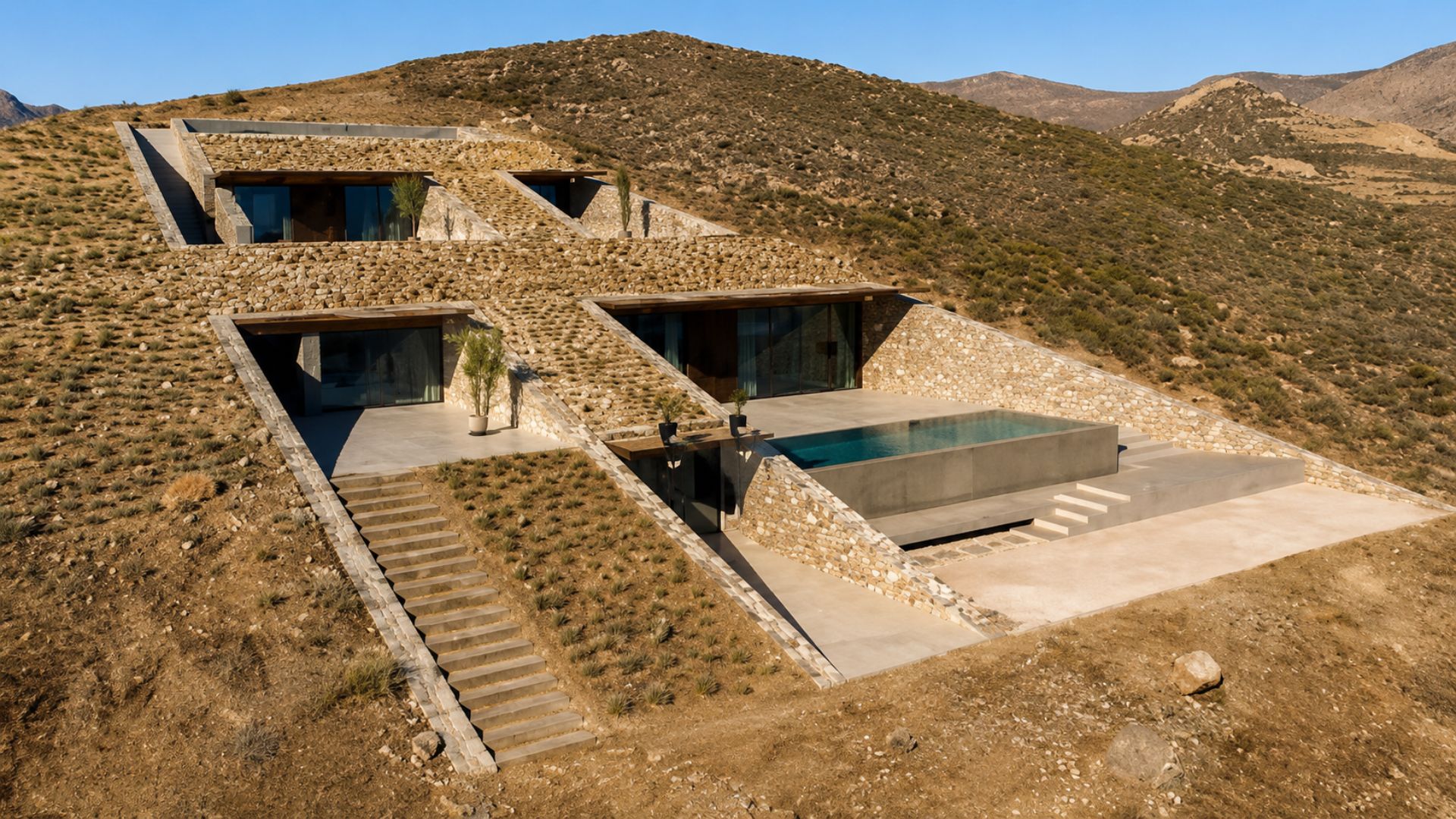


nCAVED House Project by MOLD Architects buries the house on the Greek island of Serifos to protect environments from northern winds, open views to the sea, and use stone, concrete, wood, glass, internal patios, and pergolas as a discreet, bioclimatic architectural solution integrated into the local rocky slope.
The house nCAVED House, designed by MOLD Architects and completed in 2020, was built in Serifos, Greece, as a partially buried residence in a small rocky cove. The solution arose to protect the environments from the strong northern winds while taking advantage of the sea views.
The project works by drilling into the slope instead of erecting a fully exposed construction. The residence uses stone, concrete, wood, metal, and glass to appear as part of the landscape, while patios, movable facades, and pergolas bring light, air, and shade to the hidden spaces. The house seems to disappear, but inside it reveals an open, airy, and light-filled architecture.
House was buried to face the wind without losing the view

The decision to bury the house was born from the terrain conditions. On an exposed Greek island, the project needed to respond to two challenges at the same time: open the residence to the landscape and protect the environments from the strong winds coming from the north.
-
Concrete-filled PVC homes could be cheaper than traditional masonry, UPF research finds; with ready modular panels, less waste, and faster construction, the Concrete-PVC system aims to cut costs and transform affordable housing in Brazil.

-
Brazilian House Built with 32.8 Tons of Construction Debris Offers Affordable Housing Solution
-
Americans Build Entire Homes in a Day Using Compact Sand Foundations and Pre-Made Wooden Trusses, Reducing Construction Costs

-
China’s Largest Floating LNG Plant, NGUYA, Sets Sail for Congo: 2.4 Million Tons Annually for Italy’s Eni


Instead of placing volumes above ground, the architects chose to insert the construction into the slope. The result is not a common house with a sea view, but a residence that uses the rock itself as a shelter. This choice reduces wind exposure and maintains a more discreet visual presence in the landscape.
Greek island of Serifos received an almost invisible residence

The nCAVED House is located in a small rocky cove in Serifos, Greece. The location helps explain the impact of the project, because the Greek island offers relief, open horizon, and a mineral landscape that directly dialogues with the architecture.
The residence does not try to compete with the hillside. On the contrary, it settles into it. From the outside, it appears less like a traditional building and more like a carefully fitted intervention in the terrain. Therefore, the house approaches the idea of a dugout shelter, without abandoning the comfort of a contemporary construction.
Stone, concrete, wood, and glass create the appearance of a natural cavity
The choice of materials reinforces the feeling that the house was born from the hillside itself. The combination of stone, concrete, wood, and glass creates rustic interiors, with a mineral appearance, yet still clear and functional.
The stone appears as an element of mass and protection. The exposed concrete reinforces the idea of a dugout structure. The wood warms the environments and prevents the interior from feeling too cold. Meanwhile, the glass opens the construction to the sea, the sky, and the internal gardens. The strength of the project lies precisely in this contrast between weight and transparency.
Movable facades open the residence to the horizon
The transverse facades use large glass openings with embedded sliding doors. When opened, they connect the internal environments to the external spaces and enhance the sense of continuity with the landscape.
This feature allows the house to alternate between protection and openness. In windy moments, the spaces can be shielded. In favorable conditions, the facades open completely. The residence is not just buried; it breathes through the hillside.
Internal patios bring light and air to the underground rooms

The roof of the residence is traversed by protected patios and open terraces. These voids allow light and ventilation to enter the environments below ground level, avoiding the feeling of confinement.
The patios also organize the relationship between interior and exterior. They create gardens, visual cutouts, and air entries that traverse the residence. Without these voids, the house might seem heavy; with them, the underground space gains lightness.
Pergolas create moving shade within the environments
Pergolas appear as elements of solar protection. They filter the light, create shadow patterns, and change the atmosphere of the environments throughout the day.
Besides the practical function, pergolas enhance the visual character of the project. They seem to float apart from the surface and show that the house does not simply try to disappear. The residence integrates with the landscape but still maintains its own architectural presence.
Three levels organize bedrooms, social areas, and guests

The house is divided into three levels. The bedrooms are located in the narrowest and highest part of the slope, while the common areas and guest house appear on lower levels.
An external staircase connects the three levels and leads to the main entrance, located on the mezzanine of the living area. The circulation is part of the residence experience, as descending into the house reveals spaces that, from the outside, remain almost hidden.
Geometry creates a board of solids and voids
MOLD Architects worked with a rectangular geometry applied to the slope. This strategy produces a kind of three-dimensional board, with alternating solids and voids between built areas, patios, terraces, and passages.
This composition helps to accommodate and isolate the residence’s bedrooms. At the same time, a diagonal wall expands the view of the living room. The project uses a rigid geometric logic, but the final effect seems natural because it follows the strength of the terrain.
Bioclimatic architecture reduces dependence on artificial solutions
The residence incorporates important bioclimatic features. The project uses front and rear openings for cross ventilation and light entry, as well as a green roof, proper insulation, and energy-efficient glass panels.
These resources help make the environments more comfortable in a partially underground construction. The stone, concrete, wood, and glass work together to balance protection, lighting, ventilation, and integration with the landscape.
A house buried in Serifos shows how a modern residence can hide in the landscape without sacrificing light, ventilation, and view. MOLD Architects transformed the rocky slope into part of the project, using stone, concrete, wood, and glass to create an architecture that is both underground and open.
The result draws attention because it doesn’t rely on visual excess. The strength lies in discretion, in the patios, the movable facades, and the pergolas that let light pass through the hidden environments. Would you live in a house buried in the slope or would you prefer a more traditional and exposed construction? Share your opinion.