






 Portuguese
  Spanish




Elevated Water Tanks Are Part of the National Urban Landscape and Ensure Supply Amidst Fluctuations in the Public Network, Governed by Technical Standards and Municipal Regulations Across Brazil.
The water tank on the roof is present in houses and buildings throughout the country. More than an architectural detail, the elevated reservoir is a response to the challenges of Brazilian water infrastructure, marked by frequent episodes of intermittency, pressure variations, and the need to ensure domestic resilience in the face of failures in public supply.
The use and regulation of the water tank on the roof reveal an essential adaptation strategy to the Brazilian reality, involving national technical standards and municipal regulations.
Functioning and Importance of the Elevated Reservoir
The functioning of the elevated reservoir is simple yet fundamental.
-
Frustrated by delays, Brazilian entrepreneur builds toll road in 3 days to avoid 23 km detour.

-
Pomodoro Technique: World’s Most Popular Study Method Boosts Focus and Learning with 25-Minute Sessions and Short Breaks

-
World’s Oldest Liquid Wine Found in 2,000-Year-Old Roman Tomb in Spain, Contained in a 5-Liter Glass Urn with Submerged Human Bones

-
Mother from Brazil’s Maranhão Creates Lactose-Free Cookie for Daughter with Cerebral Palsy, Now Producing 10 Tons Annually and Exporting to Mexico




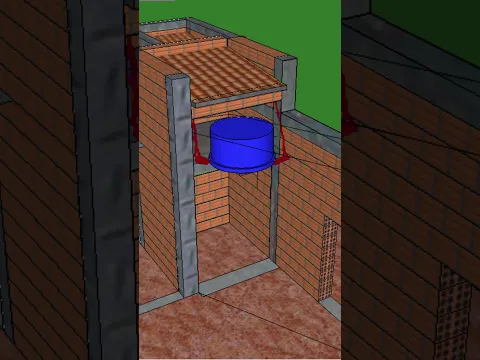
Positioned at the highest point of the property, the water tank uses gravity to distribute water with adequate pressure to all points of consumption, such as faucets, showers, and toilets.
Thus, the solution ensures continuous supply during maintenance periods or temporary failures in the public network.
Even if the supply is interrupted, the resident has a reserve for approximately 24 hours of normal consumption, as determined by NBR 5626 of the Brazilian Association of Technical Standards (ABNT).
The standard, revised in 2020, establishes that the reservoir’s capacity must guarantee this daily autonomy but does not set a unique value per person, recommending that sizing take into account parameters from local projects and guidelines from municipal authorities.

Regulatory Framework and Requirement for the Roof Water Tank
The requirement for the use of a water tank on the roof in Brazil does not stem from an explicit demand in federal legislation, such as Law 11.445/2007 – which establishes national guidelines for basic sanitation and sets general principles for public service provision.
The realization of this requirement primarily occurs from municipal regulations, building codes, and oversight by local entities such as the Municipal Department of Water and Sewage (DMAE) or the Autonomous Water and Sewage Service (SAAE), along with adherence to national technical standards, especially NBR 5626.
Thus, the Brazilian regulatory context is formed by a layered structure, where federal guidelines steer general policies, technical standards detail performance benchmarks, and local legislation implements and supervises the installation and maintenance requirements.
Water Tank on the Roof as a Response to the Brazilian Reality
The massive adoption of elevated reservoirs reflects the need to adapt to Brazil’s water infrastructure, characterized by losses, leaks, low pressure, and intermittent supply in many urban centers.
For a large portion of the population, the water tank on the roof represents the primary way to ensure the continuity of supply, protecting against possible failures in the public network.
This is even more evident during prolonged drought periods or water crises, when the demand for autonomy and security increases.
International Comparison and Evolution of Supply Systems
In comparison to other countries, the Brazilian solution reveals aspects of resilience and adaptation.
While direct pressurized systems are common in regions with modern infrastructure, such as parts of North America and some European cities, there are notable exceptions.
Older properties in the United Kingdom still use water tanks in attics, while regions like Sicily in Italy face intermittency and rely on domestic reservoirs.
In the United States, well systems often employ pressurized tanks to supply residences.
The diversity of these international scenarios highlights that the adoption or non-adoption of elevated reservoirs is directly related to the characteristics and limitations of local water infrastructure, rather than a superiority of model.
Future of the Water Tank and Hybrid Technologies
The future of water supply in Brazil is likely to combine the tradition of roof water tanks with new technologies.
Hydropneumatic systems, which use ground-level reservoirs and pumps for pressurization, are gaining traction in modern buildings and areas where the public network already offers more stable conditions.
Additionally, initiatives such as the requirement for rainwater harvesting in new constructions, adopted in some cities, point to a scenario of hybrid solutions focused on water security, efficiency, and sustainability.

Public Health and Maintenance of Elevated Reservoirs
Another fundamental aspect is the positive impact of the elevated reservoir on public health.
By ensuring that residences maintain a reserve of safe water protected from contamination, the water tank helps reduce the risks of diseases related to supply disruptions and inadequate storage.
However, periodic maintenance remains essential.
It is recommended to clean the reservoir at least twice a year, as well as checking the sealing and integrity of the structure to prevent vector entry and ensure water quality.
Water Tank on the Roof: A Symbol of Brazilian Urban Resilience
Amidst so many challenges and adaptations, the water tank on the roof remains a central solution for Brazilian residential supply infrastructure, not just by tradition, but by proven resilience in face of the country’s conditions.
And considering the evolution of urban systems, will future generations forego the elevated reservoir or will it continue to be a symbol of safety and autonomy in the everyday lives of Brazilians?


