Portuguese
  Spanish




Homemade Lorentz Cannon and the Real Risks of High Voltage Pulsed Plasma in the Air with Shock Waves and Severe Electronic Damage in an Urban Environment
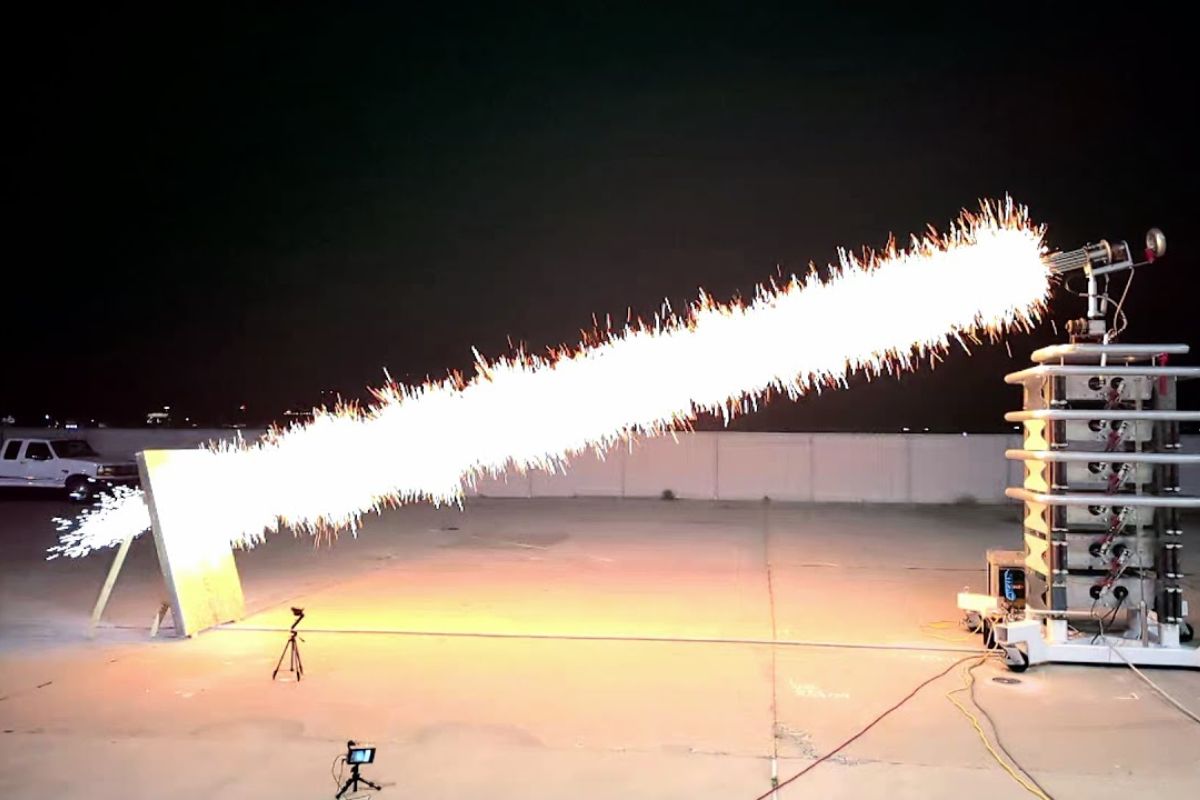
In a testing yard in South Florida, near Miami, a high voltage experiment described as a homemade Lorentz cannon was associated with pulses in the hundreds of thousands of volts and the formation of a plasma channel in the air, with acoustic shock effects and destruction of targets.
The report includes figures such as 240,000 volts and peaks reaching 210,000 volts, along with mentions of currents in the tens of thousands of amperes, deafening noise, and destructive interference in electronics, highlighting why systems of this type are treated as extreme risk outside controlled environments.
What Happens When an Extreme Pulse Turns into Plasma in the Air

When the potential difference reaches very high levels, air can stop acting as an insulator and start conducting. In the described scenario, this appears as a visible plasma channel, compared to electrical conditions found in natural lightning, with the discharge “clearing a path” to a grounded target.
-
The Trap of Modern Technology: How Screen Overload and Digital Connections Can Impact Your Mental Health and Well-being

-
Wyoming Couple Grows Tropical Fruits Year-Round in -40°C Using Geothermal Greenhouse, Demonstrating Earth’s Heat Can Produce Oranges and Lemons in Snow Without Traditional Heating

-
Ship Returns from Brazilian Coast with Thirty Newly Discovered Life Forms
-
Nigerian Professor Invents Electricity-Free Refrigerator Using Clay Pots and Wet Sand, Extending Shelf Life of Vegetables to 27 Days; 7,000 Units Distributed in Energy-Deprived Villages



Plasma, in this context, is an ionized gas. It forms when the electric field is strong enough to tear electrons from air molecules, creating a conductive trail. The result is a discharge that is not just a “spark”: it is a path with concentrated energy, capable of producing intense light, localized heat, and electromagnetic disturbance.
In the described test, the discharge is accompanied by a shock wave reported as familiar and deafening, with an echo perceived at great distances, on the scale of hundreds of meters. In physical terms, the sudden heating of the air in the plasma channel expands the gas violently, creating a pressure pulse.
This pressure can manifest as the displacement of objects, rupture of lightweight materials, and indirect impact on structures. Thus, the noise is not a “cinematic” detail: it is an indicator of energy released rapidly into the environment.
Wood, Shrapnel, and the Mechanical Effect of an Electric Discharge

The report includes perforation and destruction of plywood, mentioning traces of destruction and the target being shattered when the energy is elevated. There is also a description of shrapnel being launched at high speeds, suggesting that the damage does not depend only on “burning” the material but on transferring mechanical impulse.
The technical message here is straightforward: high voltage pulsed electricity is not just electricity, it is also an event of very rapid compression and expansion of air, with real mechanical effects on fragile materials.
The test with a TV describes a typical behavior of discharges and intense fields: even when the plasma channel does not pass directly through a structure, it can bypass and connect to regions where the field finds a path to ground, affecting internal circuits.
This manifests as damage to components and abnormal operation, because pulses of this type can induce overvoltages, internal arcs, and breakdown of insulation in boards and cables. In simple and precise terms: common electronics are not designed to survive plasma events and local electromagnetic pulses.
Why This Is Dangerous Outside of Laboratory and Why the “Homemade” Version Aggravates Everything

The very set of effects described already explains the severity: hundreds of thousands of volts, enormous currents, plasma in the air, deafening noise, destruction of materials, and failure of electronics. In a residential or urban environment, this implies direct risk of burns, cardiac arrest, fire, hearing damage, and injuries from shrapnel.
When something like this is treated as “homemade,” the risk increases for two practical reasons: the absence of professional safety redundancies and a greater chance of component failure under stress, with unpredictable behavior. The report cites “violent” failures of capacitors under overload, which is precisely the type of event that, in real life, can result in explosion, fragmentation, and fire.
The cited scenario involves a testing area in a yard, operated from a console, along with mentions of reinforced eye and ear protection and concern for neighbors due to the noise. This type of contextual detail reinforces that the phenomenon is not “bench-top”: it behaves like a high-risk event that affects the surrounding area.
The central point is that a demonstration with high voltage pulsed energy, even when presented as an experiment, produces effects typical of industrial and research environments, not of a garage.
The case combines the classic elements of an extreme electrical event: plasma in the air, high voltage pulse, shock wave, and electronic damage, with observable physical impacts on wood and equipment. The most important technical message is that the combination of high voltage and artificially induced atmospheric discharge is not a “curious experiment”: it is a real risk, with the potential to injure people, cause fires, and destroy surrounding electronic systems.
Which of these points scares you the most: the deafening shock wave or the ease of destroying electronics without directly touching the target?