Portuguese
  Spanish




Soviet Fighter of 3,500 km/h Flying at 25 km Altitude, the MiG-25 Forced the USA to Rewrite Radars and Marked the Cold War with Extreme Speed.
During the Cold War, the rivalry between the United States and the Soviet Union was not limited to the space race. In the skies, especially from the late 1950s onwards, the advance of strategic bombers and reconnaissance programs led both blocs to invest in increasingly faster, higher, and harder-to-intercept aircraft. It was in this environment that the MiG-25 Foxbat was born, a Soviet project that drew the world’s attention for a simple reason: it was absurdly fast.
The Context That Explains Why the MiG-25 Existed
In the late 1950s and early 1960s, the United States was introducing aircraft such as the B-58 Hustler and the SR-71 Blackbird, both capable of flying at supersonic speeds and high altitudes. For Moscow, this represented a strategic challenge: how to intercept an aircraft flying too high for conventional missiles and too fast for ordinary fighters?
The Soviet response came from the Mikoyan-Gurevich bureau: an interceptor built almost like a manned missile, with giant engines, wings designed for high altitudes, and a fuselage engineered not to melt during flight.
-
Stingless Bee Honey from Brazil Can Cost Up to $120 a Liter, Surprises with Flavors of Wood, Citrus, and Even Cheese

-
Woman Claims to Have Spotted a Technical Pattern in Recent FIFA Tournaments, Predicts Possible World Cup Winner
-
Chevrolet Offers Chance to Win a 2026 Sonic RS for Free via WhatsApp
-
Earthquake vs. Tsunami: Which Causes More Destruction and Why One Can Be Even More Dangerous


The result was the MiG-25, which made its first flight in 1964 and entered service in 1970.
Absurd Speed and “Almost Spatial” Flight
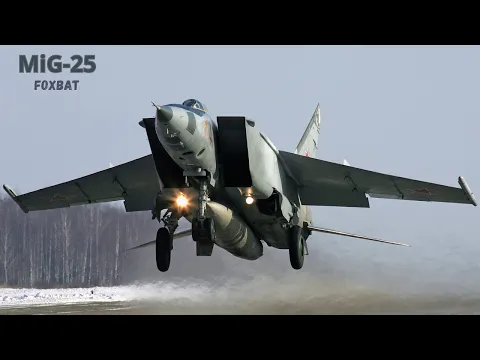

Despite its intimidating appearance, the statistic that really drew attention was performance:
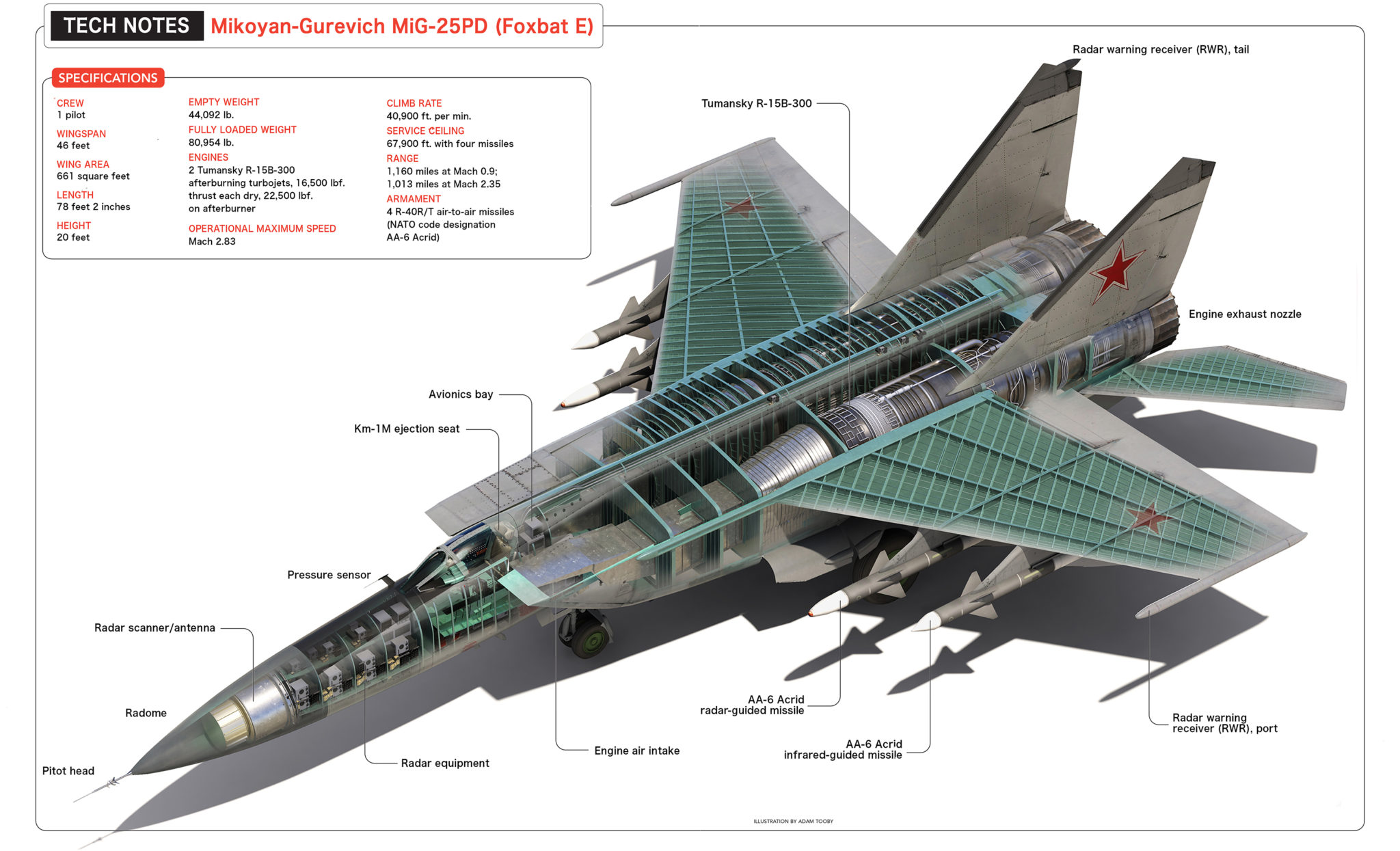
- Theoretical Maximum Speed: Mach 3.2 (about 3,500 km/h)
- Safe Operating Speed: Mach 2.8 (about 3,000 km/h)
- Maximum Recorded Altitude: about 25,000 meters
- Rate of Climb: over 200 meters per second
It is important to highlight that Mach 3.2 was never used in normal missions because that speed exceeds the thermal limit of the fuselage’s metal alloy.
The difference in speed compared to common fighters is enormous: a modern fighter like an F-16, for example, typically operates between Mach 1.2 and Mach 2.0.
Above 25 km altitude, the MiG-25 operated in a range where the sky begins to darken and the curvature of the Earth becomes visible—something pilots described as a “stratospheric feeling.”
Why Was the MiG-25 So Fast?
Soviet engineering achieved this performance without resorting to exotic materials like titanium (as was the case with the American SR-71). Instead:
- about 80% of the structure was made of special steel alloy
- critical parts used nickel and titanium only where indispensable
- the Tumansky R-15B-300 engines were giant turbines with afterburners, designed for massive volumes of air and fuel
When the pilot activated the afterburner, the consumption increased so much that the aircraft had limited range at Mach 2.8, reinforcing its origin: it was an interceptor, not a long-duration patrol aircraft.
Heat as an Enemy
Flying too fast in the MiG-25 had a price: heat. Air friction heated the fuselage to levels capable of:
- warping panels
- damaging engines
- compromising sensors
That is why there was a speed of Mach 2.8 as a safe limit. Test episodes above that served much more to prove physically than for real use.
The “Theft” Episode That Exposed the Secrets of the Foxbat to the World
One of the most sensitive moments in the history of the MiG-25 occurred on September 6, 1976, when the Soviet pilot Viktor Belenko, then 29 years old, took off from the airfield at Chuguyevka, in the Soviet Far East, on a flight that initially simulated a routine mission, but whose true destination was Japan.
With limited range and flying at altitudes that would reduce the chance of detection, Belenko crossed the Sea of Japan and headed for the island of Hokkaido, where he landed at the civil airport of Hakodate with critical fuel.
The episode had an immediate diplomatic effect: while Moscow demanded the return of the aircraft and the pilot, Tokyo allowed American technicians to examine the MiG-25, even though formally the fighter was on Japanese soil.

The detailed examination revealed valuable secrets for the West: the predominant use of stainless steel instead of titanium alloys, the interceptor nature of the aircraft, the configuration of the radars, and operational limitations that contradicted assumptions made by NATO. Belenko eventually received political asylum in the United States while the USSR dismantled its official version, claiming that the pilot suffered from “psychological stress.”
This episode, though treated as defection by diplomacy, was widely seen as the “theft” of the MiG-25, becoming one of the factors that dissolved the Soviet technological myth surrounding the Foxbat and accelerated adjustments in Western defense programs.
The “Psychological Effect” of the MiG-25
In the 1960s, before its complete analysis, the disclosed performance caused concerns:
- NATO initially believed it would be an air superiority fighter
- it was thought that it would have high maneuverability
- it was speculated that it would be a “Soviet SR-71”
When its true nature was discovered, the scenario adjusted: it was an extreme speed interceptor, not a multirole fighter.
Even so, its impact was profound: no one had put into service something so fast.
Who Did the MiG-25 Hunt?

The Foxbat was designed as a response to:
- strategic bombers B-58 and B-52
- reconnaissance aircraft U-2 and SR-71
Its role was high-altitude interception, where speed and climb were more important than maneuverability.
Real Legacy
The MiG-25 remains to this day the fastest military fighter ever produced in series. Are there faster planes? Yes, but not operational combat aircraft:
- the SR-71 is faster, but it is not a fighter; it is a strategic reconnaissance aircraft
- experimental prototypes have existed, but they were not produced in series

The Foxbat remains the record holder in the interceptor fighter in service category.
The MiG-25 Foxbat was born from a unique historical moment, driven by strategic fear, technological advances, and geopolitical disputes. It showed that:
- extreme speed was possible without titanium
- interception could reach Mach 3
- altitudes of 25 km were achievable
- radars would need to evolve
- air doctrines could be altered by a single project
And perhaps its greatest legacy has been psychological: it is not always necessary to defeat the adversary in combat; sometimes it is enough to force them to redesign everything they know.