Portuguese
  Spanish


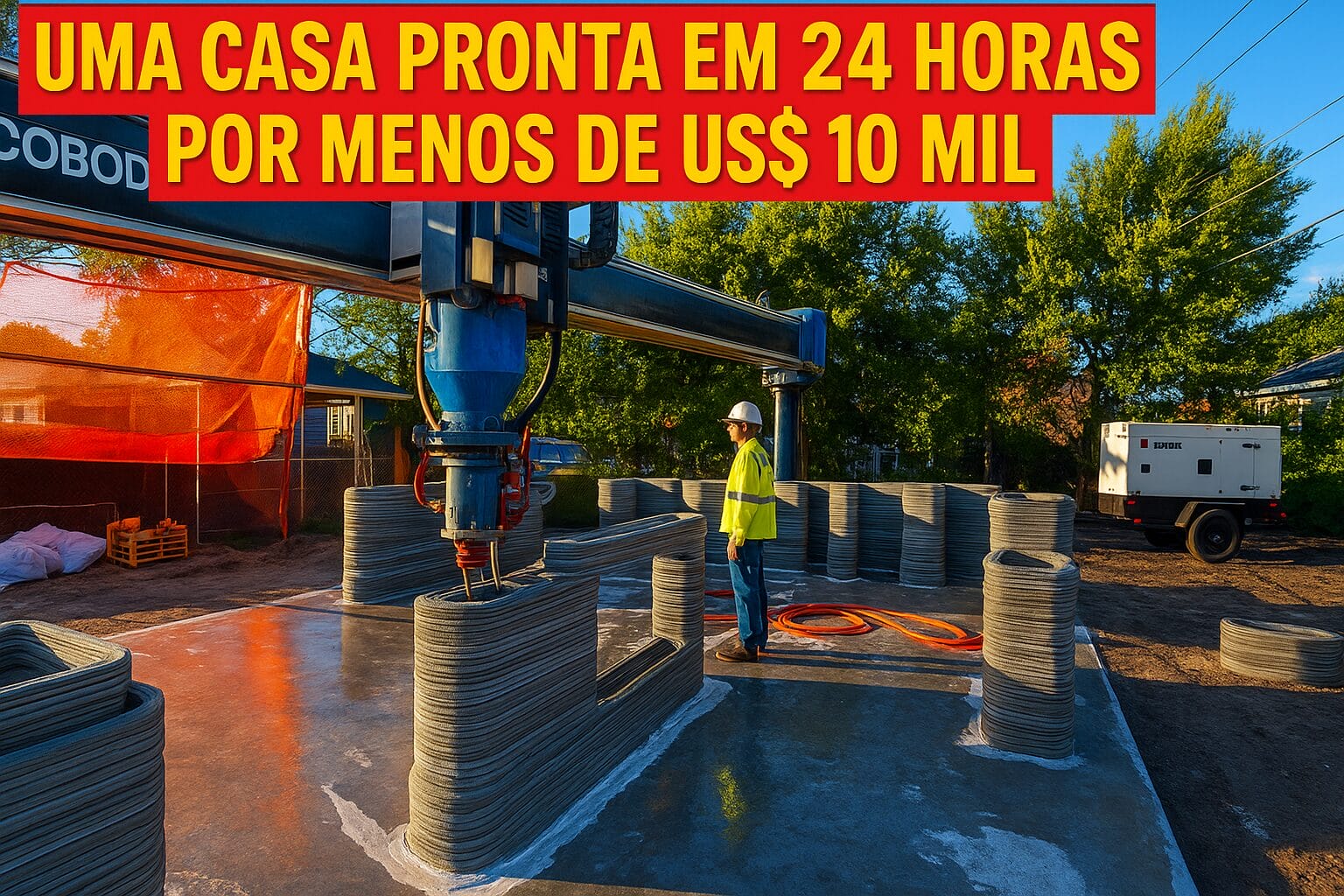

A House Ready In 24 Hours For Less Than US$ 10 Thousand: Meet The 3D Printer That Can Transform The Future Of Construction With Speed And Low Cost.
In just 24 hours and at a total cost of less than US$ 10 thousand, a 38-square-meter house was built on the outskirts of Moscow using a portable 3D printer. The feat, accomplished by the American startup Apis Cor, highlighted a new frontier in construction: the printing of entire houses with concrete, directly on the job site.
The pilot project, completed in 2017, drew worldwide attention not only for its speed and low cost but for the promise of democratizing access to housing with sustainability and efficiency. The technology is already considered a viable solution for housing in remote areas, regions affected by disasters, and even, in the future, beyond Earth.
3D Printer That Prints Entire Structures
Unlike modular or prefabricated systems, Apis Cor’s printer constructs directly on the site, layer by layer. Using a special mixture of concrete, the machine’s robotic arm shapes the external and internal walls according to a pre-programmed design.
-
Brazil Invests in Massive Waterway to Transport Soybeans by Barge, Reducing Costly Truck Reliance

-
Bridge Rebuilt in Just One Year Reconnects Two Brazilian States
-
Custom Furniture Costs in Brazil Expected to Range from $350 to Over $1,450 per Square Meter by 2026, with Kitchens, Closets, and Laundries Highlighting the Impact of Premium Features
-
Australia Builds Entire Airport from Scratch to Spark Development of New City


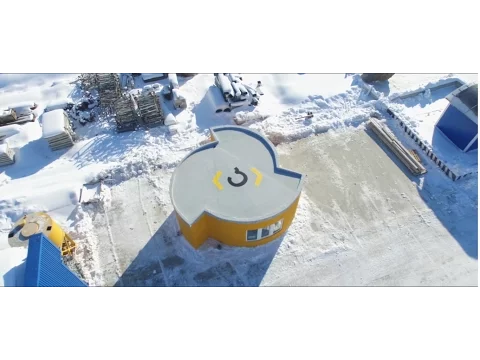

The model printed in Stupino, Russia, had a circular design and included a living room, kitchen, bathroom, and entrance hall. After the structure was printed, components such as the roof, windows, doors, electrical and plumbing systems were installed manually. Nevertheless, the total cost of the construction—with all these finishes—was around US$ 10,134.
Sustainability And Economy In Construction
The technique drastically reduces material waste. Since the 3D printer uses only the exact amount of concrete needed for each part of the house, there is savings on supplies and less waste generation. Additionally, the speed of construction reduces energy consumption and the need for intensive labor.
Another factor attracting attention in the construction sector is durability: according to Apis Cor, the printed house can have a lifespan of up to 175 years. The concrete used is formulated to withstand extreme temperature and humidity conditions, and the geometry of the structures can be optimized for structural stability without the need for traditional columns.
Social Applications And Scalability
The house built in 24 hours is not just a technological experiment but a practical proposal to tackle real problems. In regions affected by floods, earthquakes, or conflicts, the ability to build housing quickly can be crucial in protecting vulnerable communities.
According to Apis Cor itself, the technology can also be used in popular housing programs, reducing production costs at scale. The company has already formed partnerships with international organizations and is working to adapt the system to different types of terrain, climate, and civil engineering standards around the world.
Other Initiatives In The Sector
The success of the Russian project has inspired other startups and companies around the world. In places like the United States, Mexico, and India, similar initiatives are underway, with 3D printed houses for low-income communities. The NGO New Story, for example, has been using giant printers to build entire villages in partnership with technology startups.
In Europe, 3D printers are being tested to construct bridges, schools, and even modules for social housing in densely populated urban areas. The trend indicates that 3D printing applied to construction goes far beyond emergency housing and may become part of the construction model of the future.
Vision For The Future (Including Beyond Earth)
Apis Cor is also looking into interplanetary applications. In partnership with NASA, the company is exploring the possibility of using 3D printers on missions to the Moon and Mars. The idea is to print habitats using materials found on the surface of these planets, eliminating the need to transport structures from Earth.
Meanwhile, here on Earth, the concrete 3D printer continues to attract attention as a smart alternative for building housing quickly, economically, and with a lower environmental impact. The house built in 24 hours may not be the current standard in the industry, but it is increasingly becoming less of a futuristic exception—and starting to gain ground in a world that needs fast and accessible solutions.