Portuguese
  Spanish


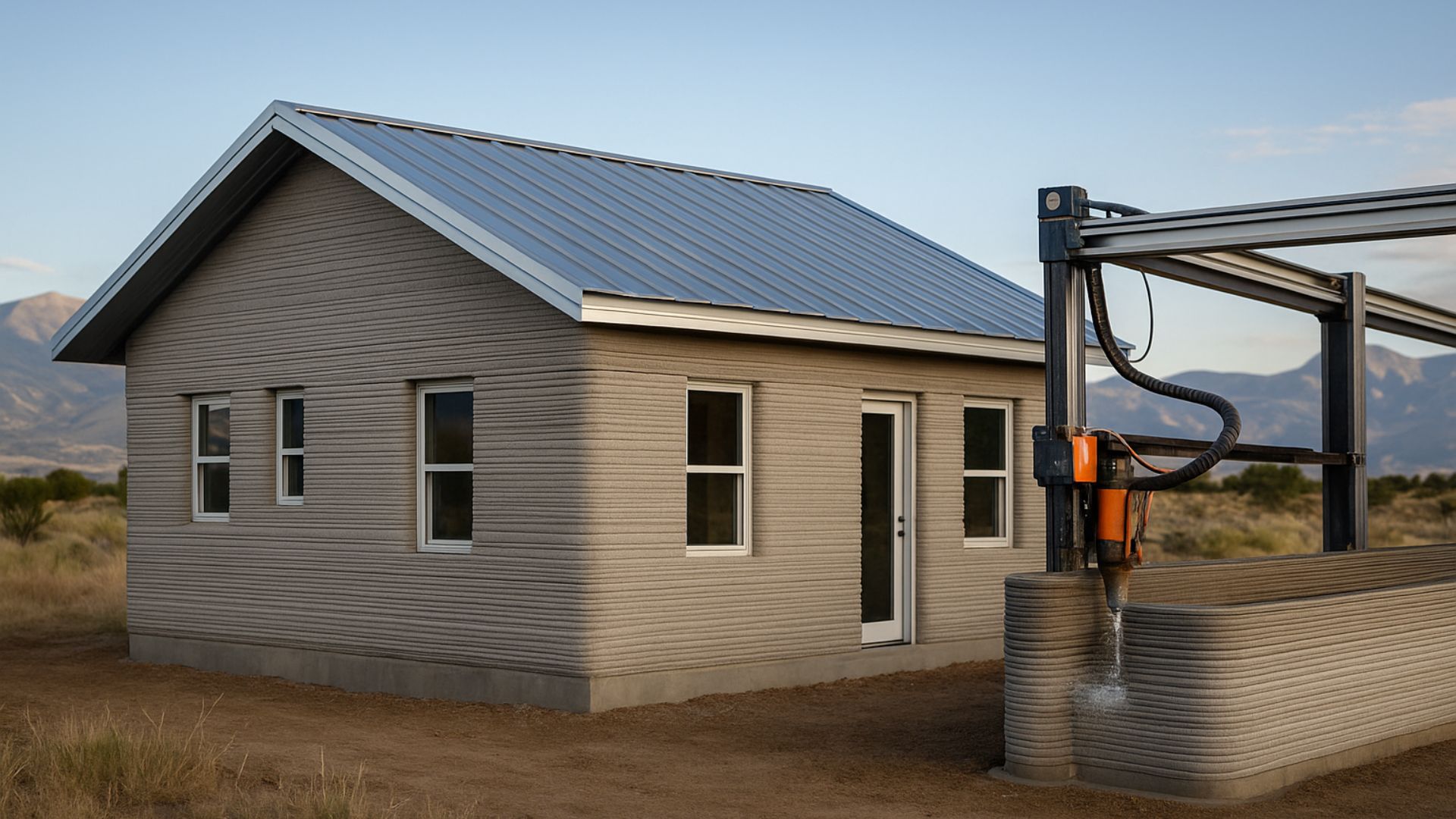


3D Printed Houses Gain Ground in Colorado with Durable Structures, Metal Roofs, and Less Wood Use, While Companies Bet on Cost Reduction and Automation to Speed Up Construction and Expand Access to Housing.
In towns in rural Colorado, in the United States, the first 3D printed houses are already for sale with concrete walls, metal roofs, almost no wood in the structure, and high fire resistance.
The properties, developed by the company VeroTouch, inaugurate a model of automated construction that aims to reduce costs by 20% to 30% compared to traditional construction in the coming years, without compromising safety and energy performance.
3D Houses in Colorado Combine Price, Technology, and Safety
VeroTouch began operations in 2023, in the city of Buena Vista, where it built the first two fully 3D printed houses in Colorado.
-
28-meter, 156-ton titans traveled 20,000 km from China to the port of Santa Catarina: Portonave received 7 fully electric megacranes, part of a R$ 210 million package, to double container handling.

-
They exchanged the idea of a large house for a 35 m² warehouse, spent US$ 12,000 on the structure, and created a tiny house in Colorado with space to live and work.

-
A newly opened terminal in the middle of the Amazon has begun transporting soy and corn through Amapá, eyeing the queue of ships that is congesting the ports in the South.

-
Goodbye to old tiles: renovation technique without construction transforms bathrooms in a few hours, eliminates debris, and reduces costs with coverings using special paints, high-resistance adhesives, and modern finishes that completely renew the space.


With about 1,100 square feet, just over 100 square meters, these units were erected with concrete walls produced by a giant printer and have already been listed for sale and traded in the local market.
After the experience in Buena Vista, the company began to focus its efforts on a new project in the Salida area, in a planned neighborhood with 32 3D printed houses.
Two units are already in advanced stages, while the others will be built sequentially, in a model close to an assembly line to speed up delivery.

The real estate market in Salida is considered expensive by local standards, driven by tourism and the location in an area of strong scenic appeal.
Still, the company claims that as technology matures, it will be possible to offer units 20% to 30% cheaper than houses built with conventional methods, even in a scenario of rising land prices.
How 3D House Printing Works
The foundation of the technology is a large-scale printer, mounted on tracks, that moves a head throughout the house plan.
This equipment extrudes successive layers of concrete with special additives, forming structural walls directly on the construction site.
VeroTouch uses machines produced by the Danish company COBOD, model BOD2, currently one of the most widespread platforms in 3D construction worldwide.
In one of the prototypes, the company completed the structural shell of the second house in just 16 days of printing, a pace considered faster than that of a traditional construction of the same standard.
While the equipment executes the programmed design with millimeter precision, the need for direct labor in the heavy masonry phase decreases significantly.
After printing the walls, other stages follow the standard construction pattern already known: roof installation, framework, electrical, plumbing, and internal finishing.
In some projects, the company combines printed sections with specific areas in wood or conventional structures, such as closets or internal details, seeking a balance between innovation and construction practicality.
Structures with No Wood and Metal Roofs
One of the central points of the proposal is to minimize the use of wood in the main structure.
The walls are made with concrete classified as A1 in fire resistance, a category that indicates non-combustible material.
This type of solution is especially relevant in a state where almost half of the population lives in areas at risk of wildfires.
Moreover, VeroTouch houses feature metal roofs and external cladding designed to eliminate combustible materials in the exposed parts of the construction.
In mountainous areas of Colorado, this feature is seen as a differentiator compared to wooden houses, which are more vulnerable to fire and weather conditions.
 .
.The company’s CEO, Grant Hamel, has repeatedly stated in interviews that automation will gain ground in construction in the coming years and that the idea is to combine more durable materials with robotics to create homes that last for decades.
In an official statement, he defined the goal as creating “legacy homes that can be passed down, rather than torn down.”
Thermal Insulation, Comfort, and Energy Performance
In addition to mechanical resistance, the 3D printed homes are designed to achieve high levels of thermal and acoustic insulation.
In several models, the walls have internal layers of closed-cell foam insulation, combined with concrete, which improves energy efficiency and helps maintain more stable indoor temperatures throughout the year.
In some projects, VeroTouch installed heating systems in bathroom floors, utilizing the thermal inertia of the slab and concrete walls.
The set of solutions aims to reduce energy consumption for heating and cooling, a sensitive point in regions with harsh winters and drier summers.
According to the company itself, the houses have higher insulation values than many conventional wood and drywall constructions.
The combination of solid walls, metal roofs, and absence of combustible external elements also tends to contribute to lower long-term maintenance needs.
How Much Do 3D Printed Houses Cost in Colorado
The final prices do not yet reflect the full potential savings promised by the technology, mainly due to the cost of land in the chosen areas.
The first houses printed in Buena Vista were listed around $625,000, in line with the average price of properties in mountain communities in the state.
The units being built in Salida are expected to be sold starting from $500,000, potentially reaching higher price ranges, depending on standards, square footage, and location in the development.
Representatives of VeroTouch state that the trend is for costs to decrease as operations scale up, aiming to be 20% to 30% below the market price of traditional homes within a one to two-year horizon.
In practice, the company bets that the automation of the structure, the repetition of designs, and the accumulated learning from each new print will reduce construction time and labor costs.
This allows room for discounts to reach the final buyer, even in a context of expensive land and strong demand for housing.

Why Automated Construction is Gaining Ground
The adoption of 3D printers in housing projects addresses two simultaneous challenges: the lack of skilled labor in construction and the deficit of affordable housing.
Instead of replacing all human work, the technology shifts some professionals to operational, planning, system installation, and finishing roles, while the machine takes over the repetitive and heavy task of erecting walls.
Another relevant front is public policy.
VeroTouch received support from the Innovative Housing Incentive Program, an initiative from the state of Colorado that provides incentives for projects capable of expanding the housing supply while also testing more efficient construction methods.
The program aims to support the construction of thousands of housing units over three years, using different technologies, including 3D printing.
Even with this incentive, the company’s executives acknowledge that the segment is still in development phase.
Thus, the first neighborhoods also serve as a real-scale laboratory in which new designs, printing times, finishes, and space use solutions, such as independent suites and additional units attached to the main house, are tested.
As projects advance in Buena Vista and Salida, a question is gaining weight for both residents and industry professionals.
If houses with concrete walls printed in 3D, metal roofs, and almost no wood can be built faster, with more fire safety, and soon at a lower price, what will be the role of this technology in how we want to live and build cities in the coming years?