Portuguese
  Spanish


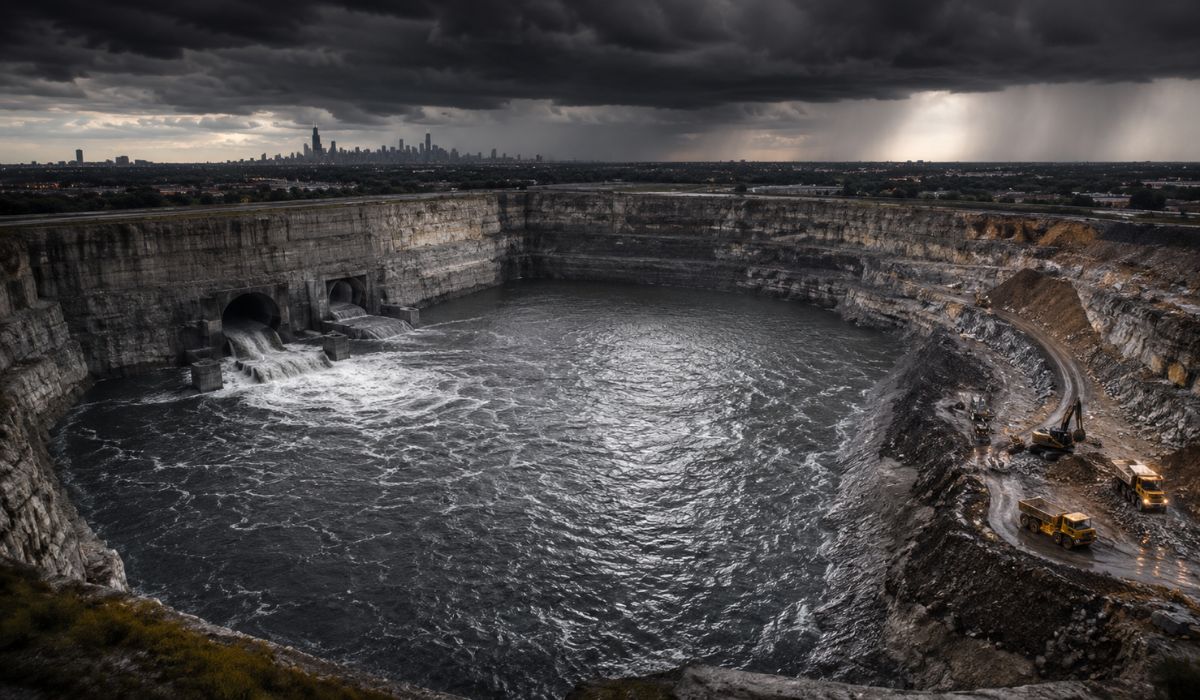

An old quarry on the outskirts of Chicago has been incorporated into an underground system that stores gigantic volumes of water, combines mining and sanitation, and still depends on the stone market to complete its expansion.
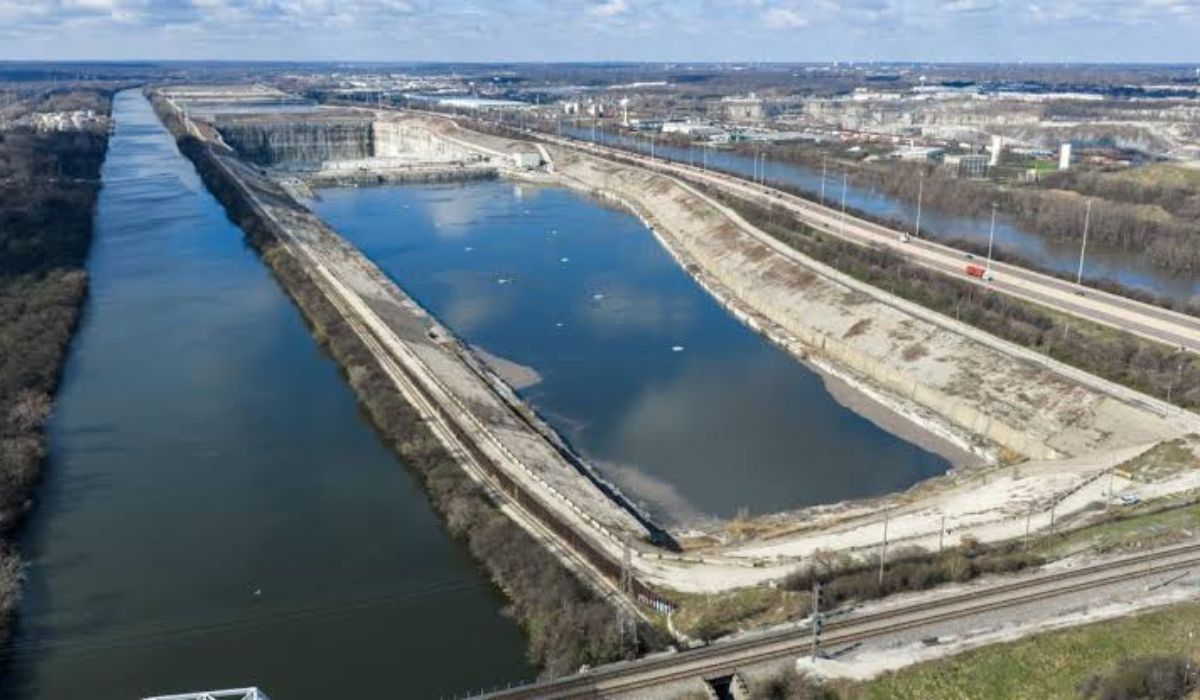
A rock extraction area on the outskirts of Chicago has been converted into one of the largest temporary stormwater and sewage storage structures in the United States.
The McCook Reservoir, located in Bedford Park, reached its maximum capacity on July 3rd for the sixth time only in 2026, according to the Metropolitan Water Reclamation District of Greater Chicago, the agency responsible for the system.
The first stage of the structure holds 3.5 billion US gallons, equivalent to approximately 13.25 billion liters.
-
A couple who grew up surrounded by factory waste transforms ash and silica sludge into cement-free blocks, builds houses in up to 30 days, keeps interiors cooler in India’s heat, and claims to have already helped build homes for 450 families.

-
The oldest crime of humanity is 100,000 years old: a Homo sapiens was stabbed in the face with a stone blade in a cave in Israel, survived the blow, and became the oldest record of violence between people.

-
Walking with hands in pockets is not just shyness, says psychology: the gesture can hide signals that almost no one notices, involve at least 6 silent behaviors, and completely change your interpretation of those who do it.
-
Seen from space, an astronaut from the International Space Station points a Nikon D5 camera at Brazil and captures Porto Alegre shining at night from an altitude of 417 km, with avenues, highways, bridges, and cities of the metropolitan region outlined in light over Rio Grande do Sul.


On Monday morning (06), the reservoir still held 3.4 billion gallons, about 12.87 billion liters, and remained 98% full.
It is a huge cavity carved into rock, connected to tunnels built hundreds of meters below the metropolitan area.
The system is called the Tunnel and Reservoir Plan, or TARP, also known as Deep Tunnel.
How the McCook Quarry Became a Billion-Dollar Reservoir
The transformation of McCook combines mining, sanitary engineering, and urban infrastructure.
Instead of building a conventional reservoir from scratch, the project takes advantage of the space opened by limestone removal and adapts the cavity to receive large volumes of water during periods of sewer system overload.
The first phase began operation at the end of 2017.
The second phase is still being excavated by Vulcan Materials Company, a company that extracts, crushes, and sells the stones extracted from the quarry.
The pace of the work, therefore, is also linked to the construction sector’s demand for this material.
When the expansion is complete, McCook will gain an additional 6.5 billion gallons of capacity.
Combined, the two stages will be able to store 10 billion gallons, or approximately 37.85 billion liters, a volume close to the 38 billion mentioned in the title.
The MWRD states that, in this configuration, the structure will be the largest reservoir of its kind operated by the agency.
The scale of the project is also reflected in the amount of rock removed.
According to a technical sheet from the metropolitan district, the excavation necessary to complete McCook will produce enough material to fill the Willis Tower, one of Chicago’s largest skyscrapers, about 31 times.
The same document estimates that more than 11 stadiums the size of Soldier Field could fit in the final reservoir space.
The comparisons serve to represent a cavity whose dimension is difficult to perceive just by capacity numbers.
Underground tunnels carry water and sewage to McCook
McCook receives flows from two large underground systems: the Mainstream Tunnel System and the Des Plaines Tunnel System.
Together, they span dozens of kilometers under Chicago and neighboring municipalities, transporting rainwater and combined sewage to the reservoir.
The TARP system tunnels are between approximately 45 and 91 meters below ground, depending on the section.
Their diameters range from about 2.4 to 10 meters, allowing for the movement of large volumes when conventional pipelines begin to approach their limit.
This operation is necessary because much of Chicago uses a combined network.
The same pipeline carries sewage produced by homes and businesses and the water that runs off streets, roofs, and sidewalks during rainfalls.
Under normal conditions, the content goes to treatment plants.
When the volume grows rapidly, however, tunnels and reservoirs function as holding areas.
The material is stored until it can be gradually pumped to water recovery units.
Therefore, McCook does not store water intended for human consumption.
The reservoir receives a mixture of sewage and stormwater that, without temporary space, could return to basements, reach public roads, or be discharged into the region’s rivers and canals.
Once the network regains capacity, the MWRD begins to empty the structure.
The stored water is sent to treatment plants, freeing the reservoir and tunnels again for the next period of increased inflow.
Chicago reservoir filled six times in 2026
The number of times McCook reached its limit in 2026 draws attention when compared to previous years.
According to the MWRD, the system had filled up five times in total between 2021 and 2025.
In the first few months of 2026 alone, there were six occurrences.
The sixth filling occurred during the sequence of rains recorded between July 2 and 4.
The United States National Weather Service reported that four rounds of storms hit similar areas, leaving the soil progressively more saturated.
In Aurora, one of the most affected points west of Chicago, the airport recorded 8.22 inches of precipitation during the period, equivalent to approximately 209 millimeters.
The accumulated volume contributed to rapidly increasing the inflow of water into the drainage and treatment systems.
The metropolitan region also uses other reservoirs connected to the Deep Tunnel.
During the same episode, the Thornton Reservoir reached 94% occupancy and stored 7.3 billion gallons.
It was the highest level recorded since the facility began operation in 2015.
Considering reservoirs and tunnels, the MWRD reported that the complex managed to store more than 13 billion gallons, approximately 49.2 billion liters, from the successive waves of rain.
This total does not correspond only to McCook but to different parts of the regional infrastructure.


Reservoir expansion depends on the stone market
The expansion of McCook had the original schedule to complete mining by December 2028 and to start the operation of the second stage by the end of 2029.
The deadline, however, was revised by the metropolitan district.
The current forecast indicates that the new part should enter service on December 31, 2032.
According to the MWRD, the lower demand for stones in the Chicago construction market slowed the pace of material removal from the quarry, prolonging the excavation.
This relationship makes the project different from a construction carried out solely with machines hired to dig a hole.
Vulcan Materials extracts the limestone, processes the rock, and sells the product.
As mining progresses, the space that will form the new reservoir increases.
Even with the change in schedule, the first stage remains in operation.
Since it began operating, it has already received approximately 130 billion gallons of stormwater and wastewater, according to the MWRD, a volume equivalent to about 492 billion liters.
The purpose of the system is not to single-handedly prevent all flooding.
Its function is to provide additional capacity when local networks, interceptors, and treatment plants receive more water than they can process at that moment.
If tunnels and reservoirs also become full, overflows may still occur.
With the future capacity close to 38 billion liters, McCook is expected to extend the available interval to store this flow before treatment.
Until the second phase comes into operation, the region will continue to rely on the current cavity, which has already reached its limit more times in 2026 than in the previous five years combined.