Portuguese
  Spanish


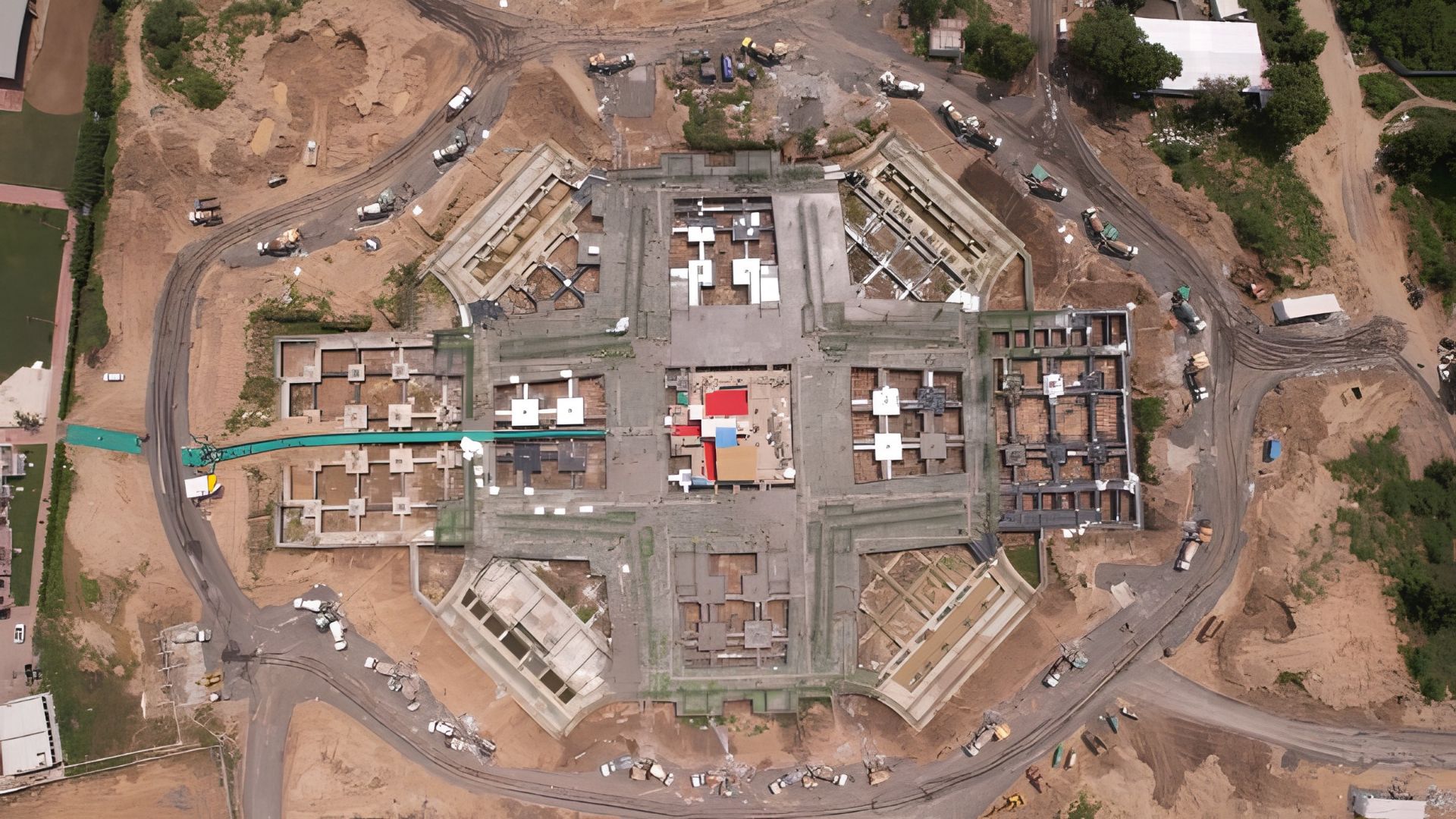

India completed record-breaking foundation with 24,100 m³ of concrete, 285 trucks, 26 plants, and 54 continuous hours for the Umiya Dham temple.
In September 2025, a mega engineering operation in Jaspur, near Ahmedabad, in the Indian state of Gujarat, executed the largest foundation ever recorded in the religious infrastructure category. According to Adani Cement and the Golden Book of World Records, the work was part of the project for the future Jagat Janani Maa Umiya Temple, within the Vishv Umiya Dham complex.
The concreting used 24,100 m³ of ECOMaxX M45 concrete, mobilized 26 concrete plants, 285 or more mixer trucks, and was executed in 54 uninterrupted hours. The record was registered by the Golden Book of World Records as the largest raft casting ever executed for religious infrastructure.
Temple foundation required a giant raft with more than 24,000 m³ of concrete
The base built in Jaspur was a raft foundation, also known as a radier, a solution used to distribute very high loads uniformly over the ground. According to Adani Cement, the block received 24,100 m³ of concrete. The Golden Book of World Records recorded the volume as 24,000 m³ in the official description of the record.
-
They seem like just green hills in Scotland, but they hide a 120-meter distillery, 36 stills, and the capacity to produce 15 million liters per year.

-
Avenue in São José dos Campos will be closed for 342 trucks to pour 2,730 cubic meters of concrete non-stop, forming a giant structural block with 165 piles of 26 meters, placing Jardim Aquarius at the center of the largest concrete pouring ever done in the RM Vale.

-
Family buys abandoned 110-acre ranch in Nevada, finds restaurant, store, apartments, houses, butcher shop, and sheds, removes tons of trash, faces daily leaks, and transforms weed-infested fields into the foundation for a rebuilt rural family complex with irrigation, vegetable garden, and rental income.
-
A woman bought a century-old house from 1926 without a large renovation budget, tore out the carpet, began restoring old details with thrift store pieces, Marketplace, and free materials, and showed that restoring the charm of a century-old property can cost much less than a traditional renovation.


The difference between the two numbers does not change the scale of the work, but it is important for factual accuracy. The more detailed data released by Adani Cement was 24,100 m³, while the Golden Book rounded the volume to 24,000 m³.
According to ETInfra, the raft measures 450 feet by 400 feet by 8 feet, equivalent to approximately 137.2 meters in length, 121.9 meters in width, and 2.44 meters in thickness. It is a massive base designed to support a monumental scale religious superstructure.
Mega operation mobilized 26 plants, 285 trucks, and more than 600 professionals
The continuous execution of the foundation required rare logistics even for large projects. According to Adani Cement, the supply was maintained by 26 ready-mix concrete plants and 285 or more mixer trucks operating in sync throughout the entire concreting window.
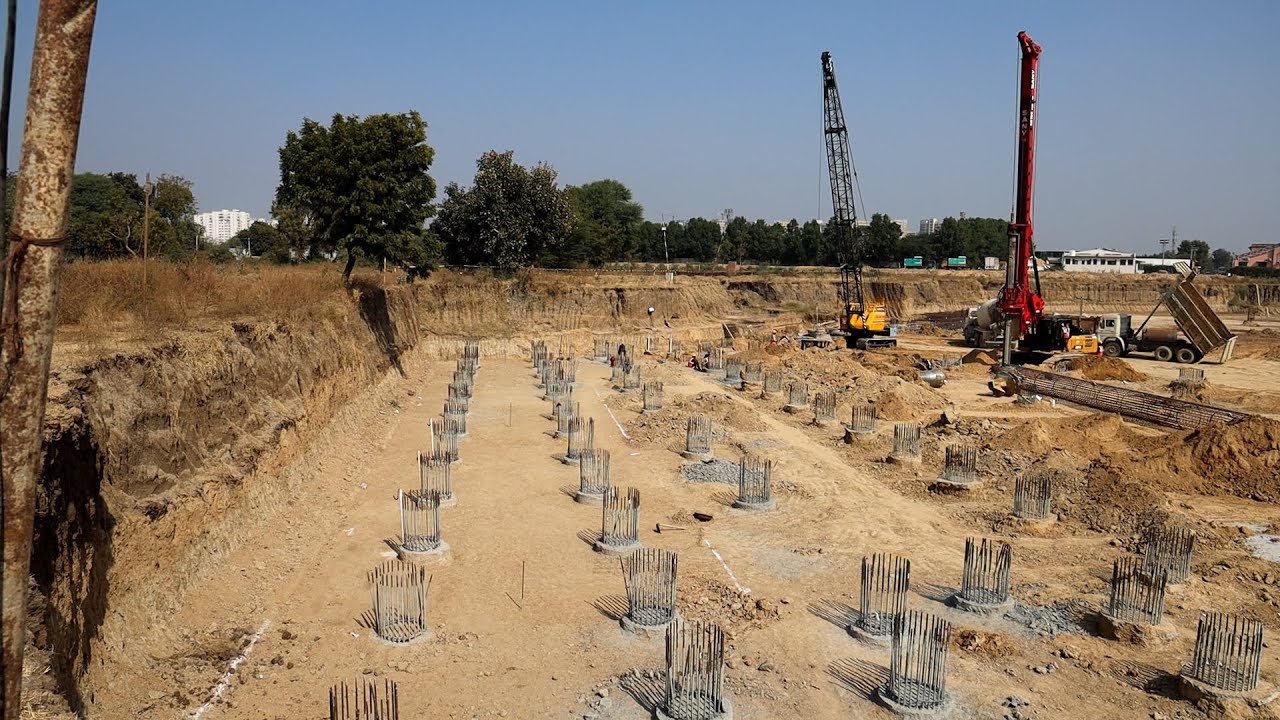
The same source reported that more than 600 workers and technical specialists worked in shifts over three days. In operations of this magnitude, the continuous flow of concrete is not just a matter of productivity but a structural requirement to reduce the risk of discontinuity between layers.
According to Adani Cement, the strategy was planned to avoid cold joints, which occur when a layer of concrete begins to harden before receiving the next layer. In massive blocks, this control is crucial to preserve the integrity of the structure.
Low-carbon concrete and thermal control were central to the execution
The foundation received ECOMaxX M45 concrete, described by Adani Cement as a low-carbon solution for large-scale projects. The company stated that the mix incorporated 66% of Supplementary Cementitious Material, known as SCMs, allowing a 60% reduction in carbon footprint compared to the internal reference adopted by the company.
Besides the record volume, the project also required strict thermal control. ETInfra, reproducing data from the company’s official communication, reported that Coolcrete technology was used to keep the pouring temperature below 28 °C.


The same source reported that the block received embedded thermocouples for real-time monitoring of temperature and durability. This type of monitoring is typical of massive concrete pours, where the heat of cement hydration can generate significant internal stresses.
Raft foundation was designed to support a temple of 504 feet with 1,551 pillars
According to ETInfra, the foundation was designed to support 1,551 Dharma Stambhs, the pillars that will form the base of the future temple of 504 feet in height. Fortune India also echoed the project with the same scale reference, reinforcing the exceptional size of the project.
Adani Cement stated that the temple will be the core of a social and cultural campus in Jaspur, while ETInfra reported that the complex occupies 60 acres. This scale helps explain why the foundation needed to be treated more like heavy infrastructure than a conventional religious construction base.
In practice, the raft became the central structural platform of the project. Before the temple’s elevation, it was necessary to create a base capable of safely distributing the weight of a monumental structure with a high density of pillars.
Golden Book recorded the achievement as the largest raft casting for religious infrastructure
The public recognition of the brand was formalized by the Golden Book of World Records. On the official page, the entity describes the achievement as Largest Raft Casting Executed for Religious Infrastructure, jointly attributed to PSP Projects Limited and Adani Cement, in Jaspur, Gujarat.

According to the record, the execution took place between September 15 and 17, 2025. Fortune India also reported on the record and highlighted that the foundation will support more than 1,500 pillars of the future Jagat Janani Maa Umiya Temple.
The combination of scale, continuous concreting, heavy logistics, and real-time technical monitoring turned the operation into an engineering milestone. More than just a construction phase, the foundation has become the central support element of one of the most ambitious religious projects underway in India.