Portuguese
  Spanish


The Baan Mankong program (“secure housing” in Thai) turned the model upside down: instead of the government planning and building, it is the residents themselves who map the areas, negotiate the land, and rebuild the houses. Between 2003 and 2011, it changed the lives of more than 90,000 families for about US$ 570 each.
About one billion people today live in slums and informal settlements, without basic services and under the constant threat of eviction. In this scenario, Thailand adopted a path that goes against the traditional recipe: instead of removing communities and building complexes, the country started putting money and decisions in the hands of the residents themselves. The Baan Mankong program, which means “secure housing” in Thai, improved the living conditions of more than 90,000 families in 1,546 communities, spread across 277 cities, between 2003 and 2011.
What is most impressive is the cost: about US$ 570 per family, a fraction of what a public housing project usually consumes. Instead of treating the residents as mere aid beneficiaries, the program gives them control of the entire process from mapping the areas to negotiating the land and reconstructing the neighborhoods, in the same place where they already lived. It is a reversal of logic that has been attracting the attention of urban planners worldwide, at a time when the number of people in informal settlements could reach 3 billion by 2050.
The reverse recipe: the residents are in charge
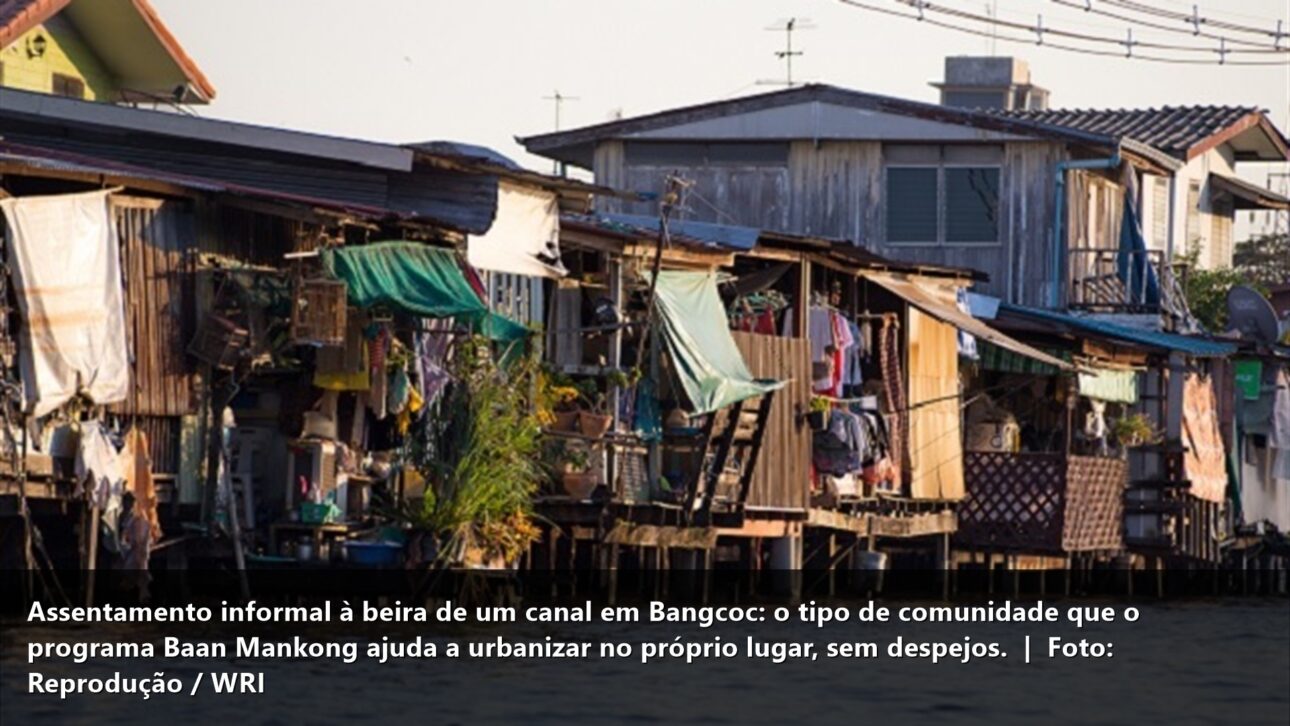
Traditionally, the urbanization of slums is planned, funded, and executed top-down, solely by the government or third parties. The community is left out of the process, and the result is usually a handful of fragmented improvements in a few areas. The international trend, however, is moving in the opposite direction: the Pretoria Declaration, from a thematic meeting of the UN-Habitat on informal settlements, advocates empowering the poor and improving the communities where they already are, instead of removing them.
-
The public school that educates from teenagers to the elderly in the same class: in Araraquara, EJA graduated 36 students at once, including Dona Lourdes, aged 83, who now wants to enter college.

-
Deaf boy heard his parents for the first time, smiled upon recognizing the family’s voices, and tried to repeat “mama” and “papa” with the help of a hearing device, turning a rehabilitation appointment into an emotional video that reached over 5.9 million views on social media.

-
40 km per day swimming in the largest river in the world: the Colombian “Fish Man” crossed the Amazon River from Cusco, Peru, to Santarém, Pará, and denounces with each stroke the plastic that pollutes the waters of the Amazon.
-
Brazil opens a pizzeria every 2 hours and devours 2.78 million pizzas per day: there are already more than 40 thousand establishments in the sector, iFood has reached 50 million orders, and calabresa reigns supreme.


This is exactly the bet of Baan Mankong. The program supports networks of impoverished communities to map and research all precarious settlements in a city and devise improvement plans. Experts from governments, NGOs, and universities provide support, but it is the residents of each settlement who lead the survey, budgeting, and land negotiation. When the community reaches a land agreement and completes its plans, the responsible agency, the Community Organizations Development Institute (CODI), transfers infrastructure subsidies and subsidized loans directly to them.
Collective savings first, loan later
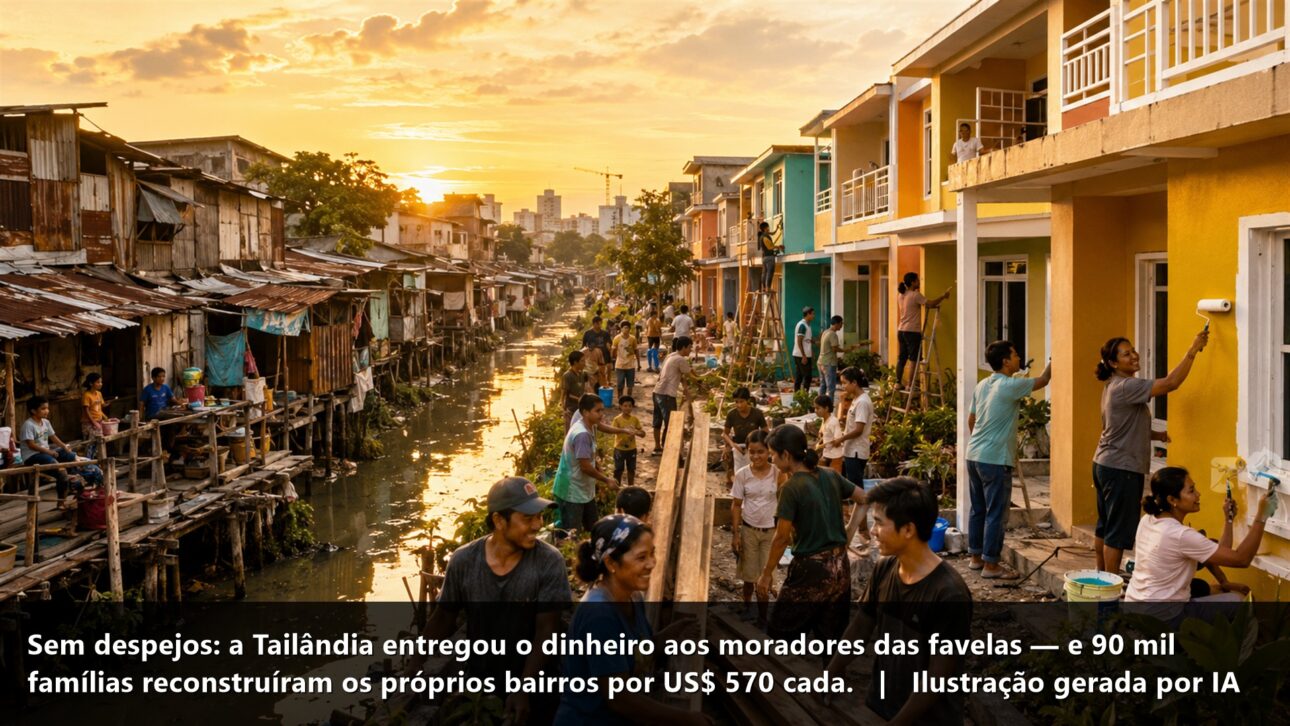
Money doesn’t fall from the sky, and that’s part of the ingenuity of the model. To join the program, each community must first meet two requirements: form a savings and credit group and register as a cooperative. This step unites residents financially and politically, transforming a cluster of families into an organization capable of managing resources.
The logic solves a concrete problem. Those living in informal settlements rarely have assets, and income is often irregular, which makes traditional bank loans, with rigid terms, unfeasible. By pooling resources into a common fund, the community unlocks options that none of its members could achieve alone, such as small emergency and income-generating loans, in addition to accessing CODI’s housing financing.
Negotiate the land to avoid having to leave
The most delicate part is the land. Through Baan Mankong, the communities themselves have the authority to negotiate possession and ownership directly with public or private owners, including the owner of the land they already occupy. These are difficult conversations, where the community needs to balance its priorities in the face of scarce land and limited resources.
In this calculation, staying close to work often weighs more than having a large house. A community may accept a long-term lease, less secure, to stay near jobs, or trade isolated houses for two or three-story terraced houses, which are denser. And the numbers show that the strategy worked: between 2003 and 2011, more than 60% of families reached agreements that allowed them to remain in place, and more than 78% secured a long-term lease (43%) or cooperative land ownership with title (35%).
A cooperative that is also a safety net
Getting the money to arrive is only half the challenge; the other is ensuring it returns. Since loans are granted to the cooperative, not to each isolated family, repayment becomes a collective responsibility. If a family cannot pay an installment, the entire community has an interest in finding a solution — and it starts to function as a social and financial support network for its own members.
There is also a cushion built into the system. Since the loans are subsidized by the government, cooperatives can charge slightly higher, yet still affordable, interest rates and deposit this difference into a reserve fund. Resources from this fund are used to cover delays and support community-driven assistance programs, protecting the most vulnerable residents and reducing the risk of default.
The 15-year rule that blocks gentrification
Every urbanization program faces the same specter: as soon as the neighborhood improves, the market pressures the poor to sell and return to the slum, in a gentrification process that ends up expelling those who benefited. Baan Mankong created a simple lock against this.
The community is required to keep the land for 15 years. This long-term commitment provides breathing room for the difficult process of repaying the loan and maturing as a cooperative, while holding back speculation. Once the debt is paid off, each community decides its own future: to continue as a cooperative or move to individual ownership.
A model that has already crossed borders
What began as a national policy in Thailand, largely envisioned by urban planner Somsook Boonyabancha, at the helm of CODI, has become a reference beyond the country. The idea of allowing residents to collectively manage resources, set priorities, negotiate ownership, and design their own homes has been successful on a large scale.
Following a similar path, the Asian Coalition for Housing Rights (ACHR) ran a five-year program, the ACCA, which supported the improvement of settlements in 215 cities across 19 Asian countries. Models like this have fueled global debates such as the New Urban Agenda, the document guiding global urbanization for the coming decades, proving that the Thai experience is no longer an isolated case.
What Brazil can learn from Thailand
For Brazil, the lesson is closer than it seems. Millions of Brazilians live in favelas and occupations, and a large part of housing policies still bets on removal and the construction of complexes, often far from work and family support networks. The Thai model suggests another starting point: financing resident cooperatives to urbanize in their own place.
It’s not about copying the Baan Mankong line by line; each city has its reality, but about embracing the principle behind it. Treating those who live in the slum as protagonists, and not as passive beneficiaries, is what makes the money stretch further and the connection with the neighborhood remain. This dual gain—keeping people close to where life happens and building social capital along the way—explains why the Thai recipe has become a subject of study worldwide.
Less eviction, more protagonism: Thailand has shown that it is possible to urbanize slums by putting money and decisions in the hands of those who live there, and still at a very low cost per family. It is a shift that challenges the idea that living well requires removal or rebuilding from scratch.
Do you believe that funding resident cooperatives to renovate their own neighborhoods would work in Brazilian cities, or what would the recipe encounter here? Tell us in the comments.