






 Portuguese
  Spanish
  5 min of reading
  3 comments


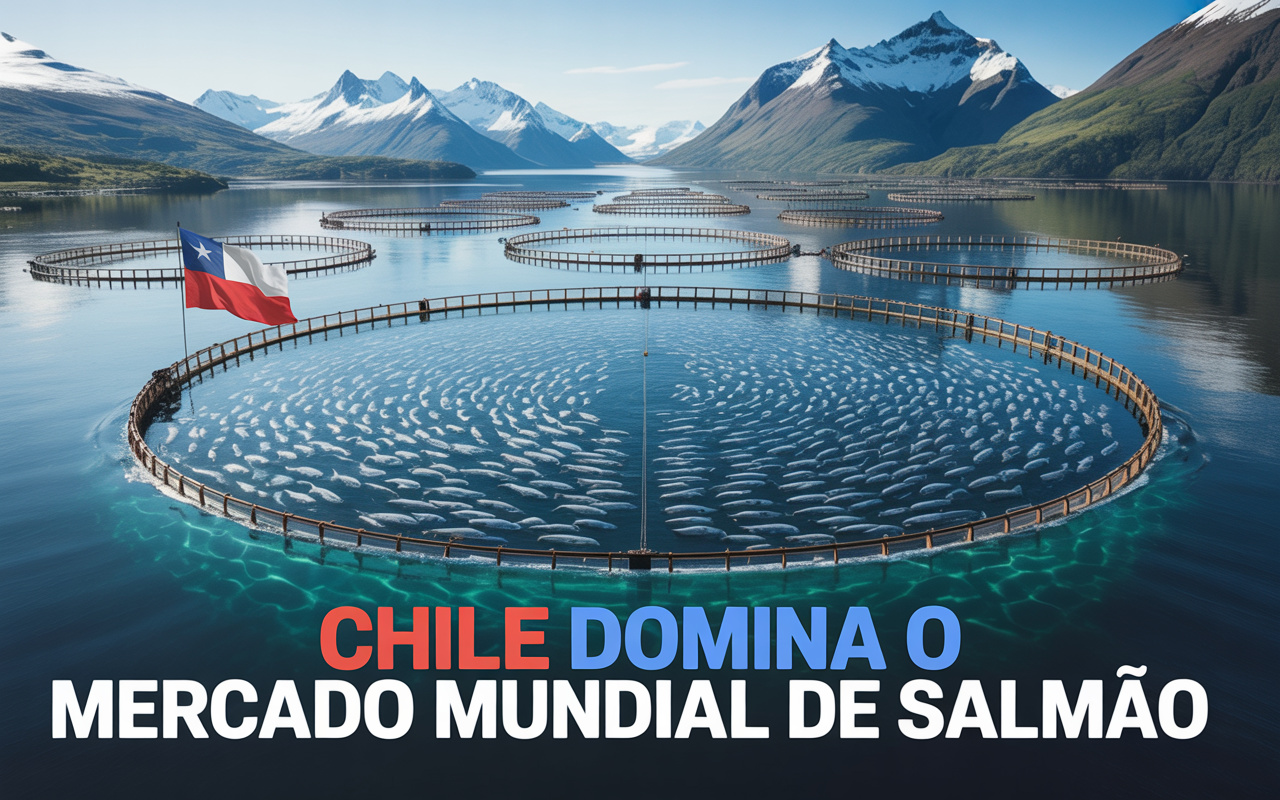


Chile Produces More Than 700 Thousand Tons of Salmon per Year in Mega Farms in Patagonia and Dominates 30% of the Global Market with Advanced Technology and Logistics.
Salmon is now one of the most consumed premium proteins on the planet — and there is one country that has managed to transform icy mountains, deep fjords, and sub-Antarctic waters into one of the most powerful aquaculture systems ever created by man. Chile, which barely appeared in global fishing reports four decades ago, has become the second largest producer of salmon in the world, vying closely with Norway and accounting for more than 700 thousand tons annually. It is such a large scale that the country alone supplies about 30% of the global market and more than half of all of Latin America.
Behind these colossal numbers lies a complex engineering: mega marine farms installed in the icy fjords of Patagonia, containment nets that plunge dozens of meters into the water, automated feeding systems, continuous oxygen monitoring, and a logistics system that needs to function like clockwork to transport tons of fresh fish daily from remote regions of the far south of the continent. This is one of the most impressive cases of modern aquaculture expansion — and illustrates how technology, natural environment, and industrial scale combine to feed a global demand that keeps growing.
The Chilean Patagonia and the Fjords That Allowed for Mega Salmon Farming
Chilean geography is the secret behind the whole model. The Los Lagos, Aysén, and Magallanes regions boast a coast that seems designed for aquaculture: deep fjords, waters with constant circulation, cold temperatures between 4°C and 12°C, and more than 4 thousand kilometers of rugged coastline, creating hundreds of protected bays.
-
Mexican Pest Threatens U.S. Cattle Herds at Historic Lows, Potentially Boosting Brazilian Beef Exports as Burger Prices Soar

-
Avocado Boom for European and U.S. Markets Fuels Water Crisis in Drought-Stricken Chilean Region

-
Capixaba farmer created in 14 years the first registered ginger cultivar in Brazil, with a productivity of 145 tons per hectare, more than double the state average, and is already receiving orders from South Africa and Peru.
-
In Virginia, a family of small-scale farmers refused to swap the countryside for the city and transformed their milk production into award-winning artisanal cheese from Mantiqueira de Minas.




This combination is rare. Salmon requires cold water, abundant oxygen, and areas where natural currents remove waste and renew nutrients. Norway has these conditions; Canada, in part; Chile, extraordinarily. That’s why national and multinational companies have set up some of the largest fattening complexes in the world there.
In many fjords, a single farm can have more than 20 circular nurseries, each with the capacity for 150 to 200 thousand fish. This means that a single location can house 3 million salmon, living in a fully automated routine, with sensors, underwater cameras, and satellite feeding.
Industrial Slaughter: How Chile Delivers 700 Thousand Tons Every Year
The Chilean process has become a global reference because it combines:
- Mega-incubators — where eggs are fertilized and fry spend the first months in freshwater.
- Sea-based fattening centers — more than 300 licensed areas in Patagonia.
- Highly robotic slaughterhouses — with processing capacity that can reach 400 tons per day per plant.
When a batch reaches the ideal weight, between 4 and 6 kg, companies carry out an operation involving specialized vessels, diving teams, hydraulic cranes, and oxygenation machines. The fish are transported alive to the slaughter centers, where they undergo a quick and chilled process to preserve texture, color, and nutritional properties.
This high-turnover system allows Chile to operate as one of the largest exporters of premium protein on the planet, ensuring regular deliveries to the United States, Brazil, Japan, China, and the European Union.
The Most Complex Logistics in Latin America
Producing 700 thousand tons is a challenge; transporting them from one of the most remote regions of the continent is even greater. That’s why Chile has developed a logistics chain that involves:
- Distribution centers close to strategic airports
- Exclusive road routes for refrigerated trucks
- Dedicated air capacity for urgent shipments
- Maritime export in climate-controlled containers
Only the Santiago airport handles more than 100 thousand tons of salmon per year destined mainly for the U.S., where Chilean products dominate the fresh salmon market.
Technology, Genetics, and Sanitary Control: The Pillars of Chilean Production
The gigantism of production depends on science and intense monitoring. Today, Chile uses:
- Artificial intelligence systems to detect feeding patterns
- 4K underwater cameras to assess behavior and growth
- Selected genetics for disease resistance
- Real-time oxygen and salinity sensors
- Drones and ROVs for inspecting nets and structures
These tools reduce losses, prevent parasite outbreaks, and increase yield per unit of water, allowing production to grow without proportionally increasing the number of nurseries.
Economic Impact: Salmon as a Pillar of the Chilean Economy
The sector already represents more than 5 billion dollars annually in exports, forming the second largest exporting complex in Chile — second only to copper. The chain directly and indirectly employs more than 70 thousand people, with a strong impact on previously isolated cities like Puerto Montt, Quellón, and Punta Arenas.
For many communities in the south of the country, the salmon industry is responsible for:
- Raising average income
- Creating port infrastructure
- Attracting new investments
- Improving public services
- Increasing digital connectivity
In other words, in addition to feeding the world, it has reshaped entire regions of Chilean territory.
Sustainability and Challenges: The Future of Mega Farming
Like all intensive activities, salmon farming faces questions about environmental impacts, nursery density, interaction with native species, and nutrient disposal. In recent years, Chile has made progress in:
- Rigid density limits per cubic meter
- Continuous monitoring of the seabed
- Requirements for rest zones for environmental recovery
- Physical and technological barriers against escapes
- Recirculation and closed-system farming projects (RAS)
The sector’s goal is clear: to continue growing, but with environmental standards close to those required in Norway, the global benchmark.
The case of Chile shows how technology applied to the seas can transform a country into a global powerhouse. With more than 700 thousand tons per year, mega farms in icy fjords, advanced genetics, and maritime engineering, the country has consolidated one of the most efficient protein production models on the planet — and will likely continue to lead the segment for decades.


Brasil caminha para ser um dos maiores produtores de peixe em cativeiro. Temos várias espécies que se adaptam perfeitamente ao manejo para criação.
O melhor produto p o consumidor final é o atum, que vive nos mares e não come ração e nem promotores de crescimento, nem cocsidiostaticos
Pelo que vi em uma notícia recente, a Noruega ainda é a campeã do salmão.
Essa diz que 30% do Chile.
A minha dúvida é, qual é o melhor produto para o consumidor final que busca qualidade do produto?
Visto que ambos estão investigando em tecnologia de criação dos mesmo.
Estando no Brasil eu apoiaria o Chile por ser da América do Sul.