






 Portuguese
  Spanish
  4 min of reading
  0 comments


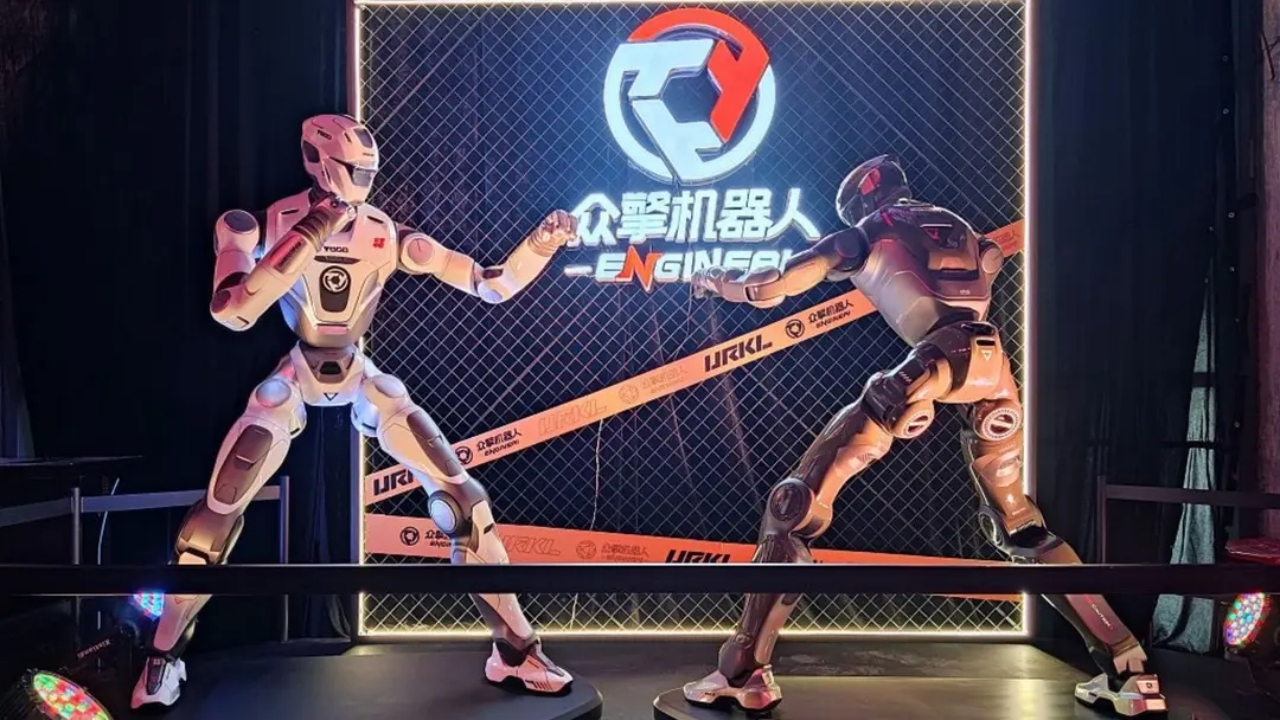
China Launched the UKRL League and Put Free T800 Robots in the Hands of Teams to Compete in 2026, Measure Motion Control and Impact Resistance, and Increase Interest in Robotics.
China launched a league in Shenzhen that bets on the most eye-catching effect possible to talk about humanoid robots: combat, strikes, and arena competition. The project’s name is Ultimate Robot Knockout Legend, or UKRL. The idea is to gather participants using the same robot model, the T800 from EngineAI, provided for free so that teams can train, adjust, and develop in practice.
The prize was also designed to grab attention. The champion team is set to receive a golden belt valued at 10 million yuan, equivalent to US$ 1.44 million, according to the event’s announcement.
UKRL Is the First Combat Fight Between Humanoids
The league was announced as the first of its kind focused on combat between humanoids, debuting in Shenzhen. The 2026 season was described as a stage competition, with a schedule running until December of this year.
-
They wanted artificial intelligence, but they drained the water from a village in Mexico: the water consumption of data centers caused a hepatitis outbreak, and big tech companies Amazon, Microsoft, and Google were forced to halt billion-dollar projects.

-
System created to save lives in disasters turned ‘against’ Brazilians overnight: a hacker attack sent out a false alert from Civil Defense with the word “misantropia” that went off on the phones of half the country, even in silent mode, and took down the Cell Broadcast.
-
In the cold desert of Ladakh, where it hardly rains, engineer Sonam Wangchuk created the ice stupa, a tower that freezes winter water and stores it for irrigating crops in the spring, a simple engineering feat that mimics nature.
-
For the first time in history, solar and wind energy generated more electricity than natural gas worldwide in a single month, April 2026, a milestone in the energy transition that shows renewable sources taking the lead in the global electric system.




The reading behind this is simple: events like this function as a showcase of technology and put robots in situations that generate curiosity, short videos, and quick sharing.
And there’s a strategic detail: when a lot of people watch and comment, interest in applications, investments, and team formation grows.
The T800 Robot, the Strikes That Went Viral, and What It Promises to Do
EngineAI introduced the T800 in early December of last year and published a video where the robot executes fight movements with precision, earning praise on social media.
The company claims it can perform moves like side kicks and a 360-degree aerial spin. This sets the tone for the project’s goal: to showcase body control, balance, and quick reaction.
The T800 was also described as having aerospace-grade aluminum panels and a cleaner exterior, designed to be lightweight and durable.
Battery for Up to 4 Hours, Active Cooling, and Sensors to See Everything Around
The T800’s proposal is to maintain intense performance for a good period. It features an active cooling system between the leg joints and a solid-state lithium battery architecture, promising up to 4 hours of operation at high intensity.
In terms of environmental perception, it uses a multimodal sensor system, combining 360-degree LiDAR, stereoscopic cameras, and rapid processing to maintain awareness of its surroundings and avoid obstacles.
For the joint motors, the company cites up to 450 Nm of torque, which aids in more aggressive movements, such as aerial kicks, capoeira-inspired spins, and quick direction changes.
Combat Will Measure Technical Points Such as Motion Control, Dynamic Balance, and Impact Resistance.
The fight is not just a spectacle. The event aims to measure technical points such as motion control, dynamic balance, and impact resistance.
Specific components should also be observed during combat wear, such as reducers, spindles, and structures related to hands and fine movements.
According to Interesting Engineering, one of the arguments is that combat testing in a real environment can reduce the development cycle by over 30% and accelerate the validation of what was previously limited to laboratory simulation.
Offering the T800 Robot for Free Can Help Smaller Companies Reduce Barriers to Research and Development, Connecting Industry, Academia, and Research Centers.
Experts cited in the coverage point out two sides to this bet. On one hand, competitions increase the public’s familiarity with humanoid robots and push the technology out of the discourse by putting the equipment in real use, with failures, successes, and quick adjustments.
It was also mentioned that offering the T800 for free may help smaller companies reduce barriers to research and development, connecting industry, academia, and research centers.
On the other hand, there’s a warning: training to fight requires short, extreme bursts of impact and agility, which is not the same type of demand as industrial and service tasks, which require stability, reliable repetition, and practical operation over long periods.
Still, with advances in integrated intelligence, the expectation presented is that humanoid robots in China will continue to gain ground in both industrial environments and domestic uses.

The league serves as a loud test for a very direct question: Are humanoid robots ready to take hits, fall, get up, and continue without losing control, breaking, or freezing? Comment on what catches your attention the most about this idea.


-

-

-

-

-

18 people reacted to this.