






 Portuguese
  Spanish


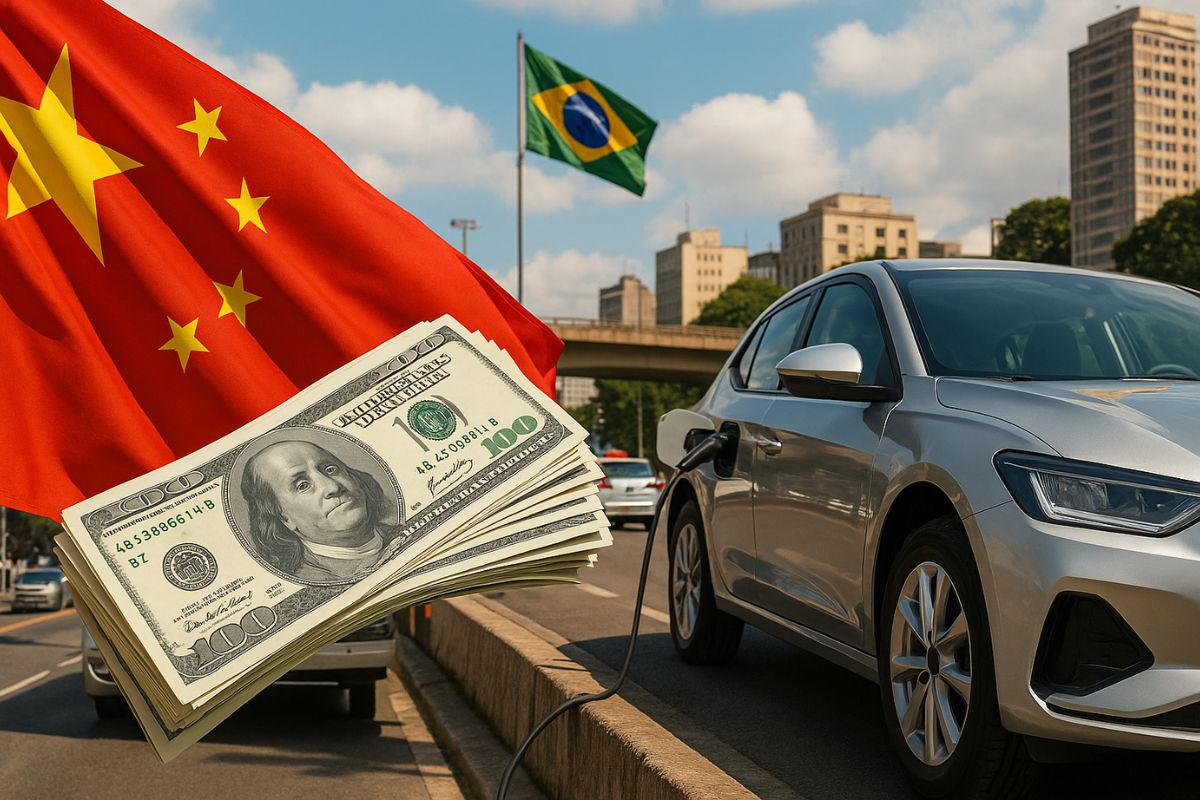


Hidden Debt of Chinese Local Governments Already Exceeds 40 Trillion While the Electric Vehicle Bubble Threatens to Collapse and May Directly Affect Dependent Economies Like Brazil.
The electric vehicle bubble is becoming one of the biggest economic challenges for China. While the country tries to sustain its industry with billion-dollar subsidies, crowded lots of stranded vehicles and bankrupt companies reveal signs of saturation.
According to analyses from AUVP Capital, the risk is not limited to the domestic market: the effects may spill over into global trade and the trade balance of countries like Brazil. In addition, Beijing faces an even more explosive problem: the hidden debt of local governments, which already exceeds 40 trillion, equivalent to five times Brazil’s GDP.
The Real Estate Collapse and the Burden of Invisible Debt
For decades, China was synonymous with rapid growth, bustling factories, and unprecedented urbanization.
-
Brazilian Job Market Surprises: Unemployment Falls to 5.6%, Hits Record Low for May, Brazilian Incomes Rise, and Underemployment Reaches Lowest Level Ever Recorded by IBGE

-
Chinese E-commerce Giant Predicts Robots Will Replace 700,000 Delivery Workers as Autonomous Vehicles Expand to 200 Cities, Offering Training for Workers to Maintain Their Machines

-
Trump warns Europe with 100% tariff threat on digital tax, potentially impacting wine and trade agreements
-
As Homeownership Becomes Unattainable in Brazil, Japanese Municipalities Offer Abandoned Houses for as Low as $3,000 to Revitalize Aging, Emptying Cities


However, following the collapse of the real estate sector, the machinery began to fail. Entire cities were left with unfinished buildings, families lost confidence in the future, and youth unemployment soared.
To navigate the crisis, local governments resorted to accounting tricks and created parallel financial vehicles, pushing the problem into the future.
The result was the formation of an invisible debt estimated at over 40 trillion.
This liability does not appear in official statistics, but functions as a ticking time bomb that threatens not only the Chinese economy but also global stability.
The Electric Vehicle Bubble: Overproduction and Price War
In the face of real estate stagnation, Beijing started betting on the electric vehicle sector as the “new engine of growth.”
Chinese brands like BYD, Nio, and Xpeng gained prominence, fueled by generous government subsidies and easy credit. Between 2009 and 2018, nearly 500 electric car manufacturers emerged; today, fewer than 130 remain active.
The problem is that production capacity now nearly doubles market demand, creating an unsustainable price war.
Lots are jammed with stranded vehicles, and even giants like BYD acknowledge that the sector will experience a “moment of inflection.”
This bubble repeats the logic of the real estate sector: growth inflated by state targets, but without solid long-term foundations.
Impacts in Brazil: Commodities, Industry, and Dependence
Brazil is directly affected by Chinese fragility. More than 90% of the electric vehicles imported by the country originate from China, and overproduction could intensify the influx of cheap vehicles, putting pressure on the national automotive industry.
Moreover, the Chinese slowdown has already impacted commodity prices: soybeans, iron ore, and meat are among the products feeling the decline in demand.
This scenario puts Brazil in a delicate position.
On one hand, consumers may benefit from lower prices, but on the other, the national industry risks losing competitiveness.
And considering that China accounts for about 30% of Brazilian imports, dependence could turn into vulnerability in the event of a deeper collapse.
The Future of China: Stagnation, Reinvention, or Hardening


The scenario points to three possible paths for China’s future. The first is prolonged stagnation, similar to what happened in Japan after the collapse of its bubble in the 1980s.
The second is a reinvention, based on structural reforms and a shift to a consumption-oriented economic model.
The third, more controversial, is political hardening, with increased authoritarianism to try to contain social and economic tensions.
Regardless of the outcome, global repercussions are already tangible. U.S. tariffs on Chinese cars, trade barriers in Europe, and concerns in emerging countries show that the domino effect can spread rapidly.
The Chinese electric vehicle bubble could be the next piece to fall in the global economic domino.
With the hidden debt of local governments above 40 trillion and overproduction threatening foreign industries, the crisis could hit dependent economies like Brazil hard.
And you, do you believe Brazil is prepared to deal with the Chinese slowdown? Do you think the national industry has the capacity to compete with the influx of cheap electric vehicles?
Leave your opinion in the comments—we want to hear from those experiencing this impact firsthand.




40 TRILHÕES DE QUE.
Esqueceram se mencionar que é 40 trilhões de yuan, que em dolares da 5 trilhoes. E essa AUVP Capital pertence ao BTG Pactual que tem relações com EUA ou seja, vao tentar espalhar pânico contra a China por conflito de interesse
Toda hora esse papinho, fazem uns 30 anos que tudo tá colapsando na China, o resto do mundo que tá indo bem kkkkk