Portuguese
  Spanish


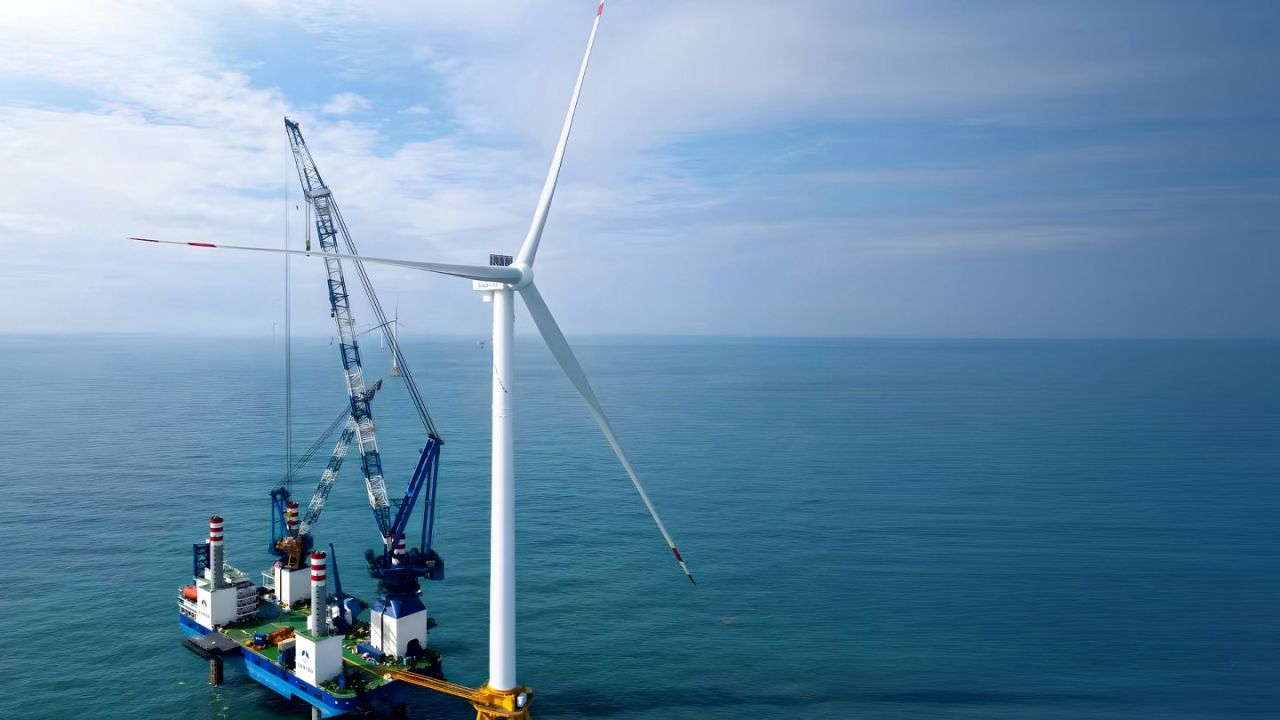


Discover Goldwind’s Record-Breaking GWH252-16MW Wind Turbine Installation in China in 24 Hours. Efficiency and Innovation in Renewable Energy!
The race to build ever-larger wind turbines continues to challenge engineers’ capabilities. Now, the Chinese company Goldwind has installed the largest wind turbine currently in existence in just 24 hours. A record that not only represents a significant advancement in the way to install these gigantic mills in the middle of the ocean but is also a way to greatly reduce costs and make electricity cheaper for consumers.Construction
The news was confirmed by Goldwind on its social media. The new record surpasses what they had achieved last September when they installed a slightly smaller wind turbine (14 MW) in just 30 hours.
Record Also in Electric Production
The GWH252-16MW turbine from Goldwind is the largest commercially available windmill at this time. It has a rotor diameter of 252 m, and its blades cover an area of 50,000 square meters. Thanks to this span (and the passing of a typhoon), it also recently set a record for electric production in a single day with 384.1 MW, enough, according to them, to power nearly 170,000 Chinese homes.
-
Brazil to Convert 80 Public Properties into 11,000 Affordable Homes Across 44 Cities to Address Housing Shortage

-
Brazilian Company Develops Wall Panels from Recycled Refrigerator Foam with Comparable Thermal and Acoustic Performance

-
Brazil’s São Paulo Region Unveils Latin America’s Largest Timber Shopping Mall, Built in 7 Months, Capturing Carbon and Preventing 900 Tons of Emissions
-
Danish Island Uses Seaweed for Durable, Centuries-Old Roofing Solution


The GWH252-16MW went into operation on July 19. Its innovative design—unlike traditional wind turbines that stop their blades when the wind is too strong—allows real-time adjustment of the blade speed, continuing to generate electricity even with winds exceeding 25 meters per second, such as those caused by Typhoon Haikui last September.
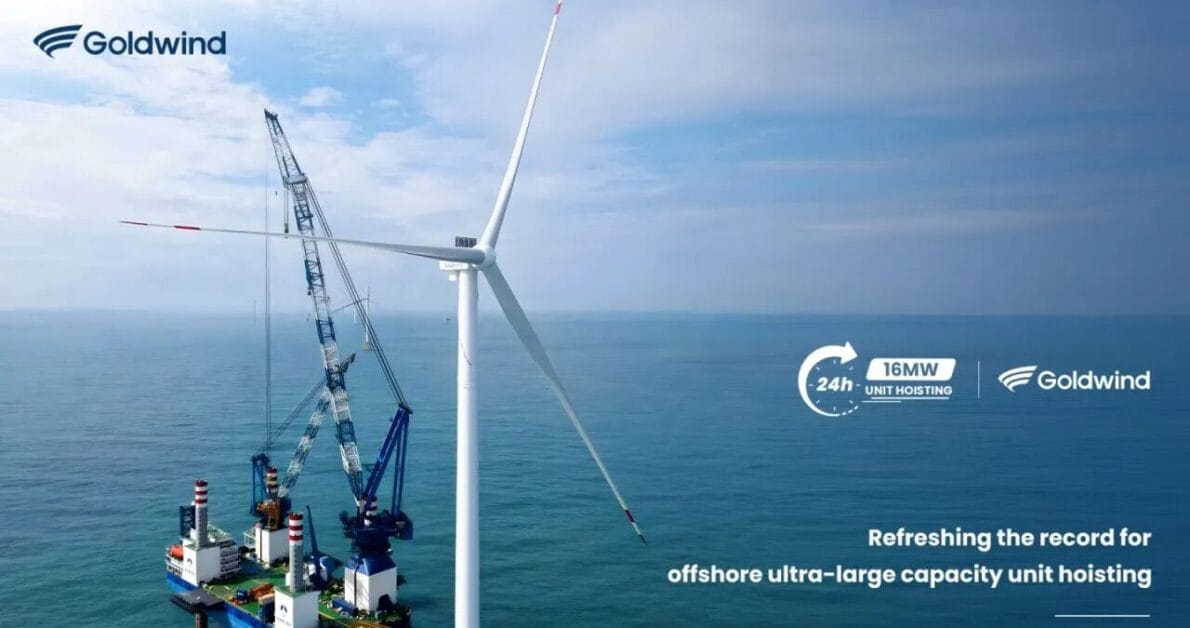
Size Really Matters in a Wind TurbineConstruction
The race to install the largest wind turbine is not simply a competition to see who has the biggest. The larger these mills are, the better they work and the cheaper, proportionally, the resulting energy production becomes. Companies prefer to install these turbines in the middle of the sea, where the impact of the size of their blades is less than on land.
Moreover, one of the biggest costs of this type of offshore structure is its installation, mainly due to its enormous size and the complications of anchoring them to the ocean floor, which is changeable and unstable.Construction
The larger the wind turbines, the deeper the anchorage they need. The greater the depth, the more challenging the task becomes. Therefore, quick installation records like this are good news for the offshore wind sector, which will be able to erect more projects and for the users of its electricity who, in principle, will be able to obtain cheaper energy.Construction
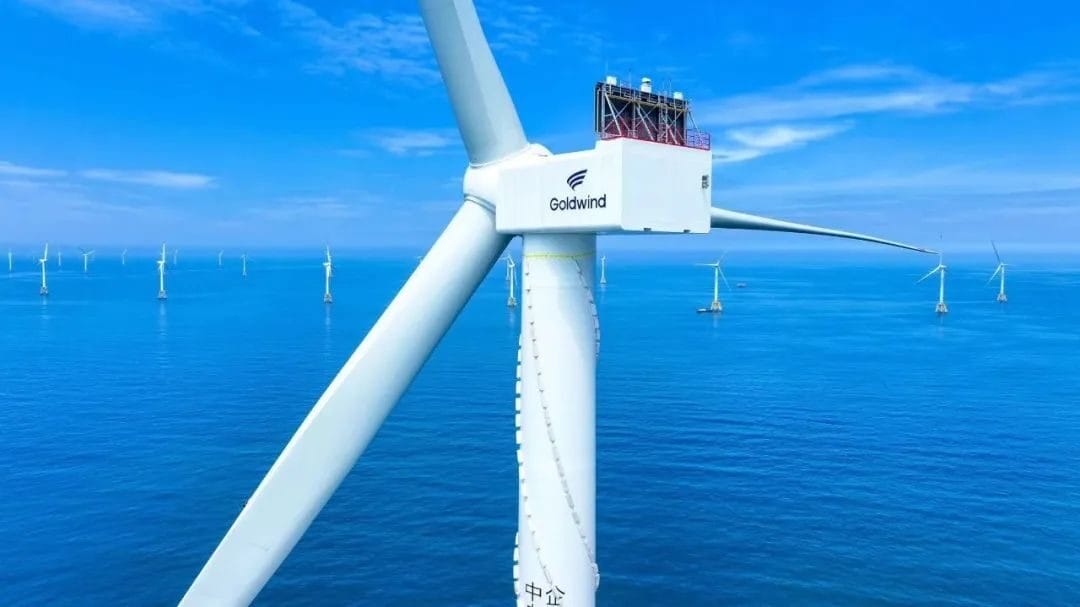
The Challenges Behind Its Construction and Installation
It is important to highlight that the installation of large-scale wind turbines, like Goldwind’s GWH252-16MW, presents particular challenges, such as the transportation and assembly of extremely bulky and heavy components in the middle of the ocean, as well as the need to work under frequently adverse weather and maritime conditions.Construction
One of the main challenges is the sea depth where these turbines are placed. As the depth increases, more robust foundations and more sophisticated installation techniques are required. Goldwind has overcome these obstacles through the implementation of innovative strategies and tools that allow for quick and safe installation. This not only reduces construction times and associated costs, but also minimizes environmental impact during the installation phase.Construction
Another critical aspect is logistics. The transportation of colossal parts such as the blades, tower, and nacelle (the structure housing the turbine’s generating components) requires meticulous planning and specialized vessels. Efficiency in this process is crucial to keeping costs low and meeting installation deadlines.Construction