Portuguese
  Spanish


The Open Mall Praça Pitiguari replaced concrete and steel with plantation forest wood, avoided more than 900 tons of carbon, and was built in record time in the interior of São Paulo
The engineered wood gained its largest monument in Latin America, and it is located in Atibaia, in the interior of São Paulo. The Open Mall Praça Pitiguari was built with more than 1,300 cubic meters of structural wood, the largest volume ever used on the continent, instead of the concrete and steel that dominate construction.
There are almost 700 cubic meters of CLT and more than 600 of glulam supporting a shopping and leisure center of 7,000 built meters. An entire shopping mall made of wood, erected in just 7 months, has become the showcase of what Brazilian construction can be.
1,300 m³ of wood instead of concrete and steel
The number that defines the project is the volume of wood. More than 1,300 cubic meters of structural material make Praça Pitiguari the largest use of engineered wood ever recorded in Latin America, a symbolic milestone for a continent accustomed to building with cement.
-
Danish Island Uses Seaweed for Durable, Centuries-Old Roofing Solution

-
U.S. Organization Builds Sixth Micro-Home Village with Comprehensive Support to Aid Homeless Veterans

-
Engineer from Brazil Develops Eco-Friendly Insulation from Palm Waste, Supporting Quilombola Communities

-
Brazil Constructs 6.5 km Tunnel to Overcome Toughest Stretch in São Francisco River Water Transfer, Delivering 20,000 Liters per Second to Semi-Arid Northeast



Replacing concrete and steel with wood is not an aesthetic choice, it is an engineering decision. Modern structural wood has comparable strength for many uses, with a fraction of the weight and carbon footprint. Where there were concrete beams, there are now tree beams, calculated with millimetric precision.
According to Urbem, the wood supplier for the project, the construction gathers the largest volume of the material ever applied on the continent. It is not a chalet or a house; it is a large-scale commercial enterprise made of wood.
What is engineered wood and why it replaces concrete
Engineered wood is not the common board. They are industrial products made by gluing layers or boards of reforested wood under pressure, creating large, stable, and high structural resistance pieces. It is technology, not artisanal carpentry.
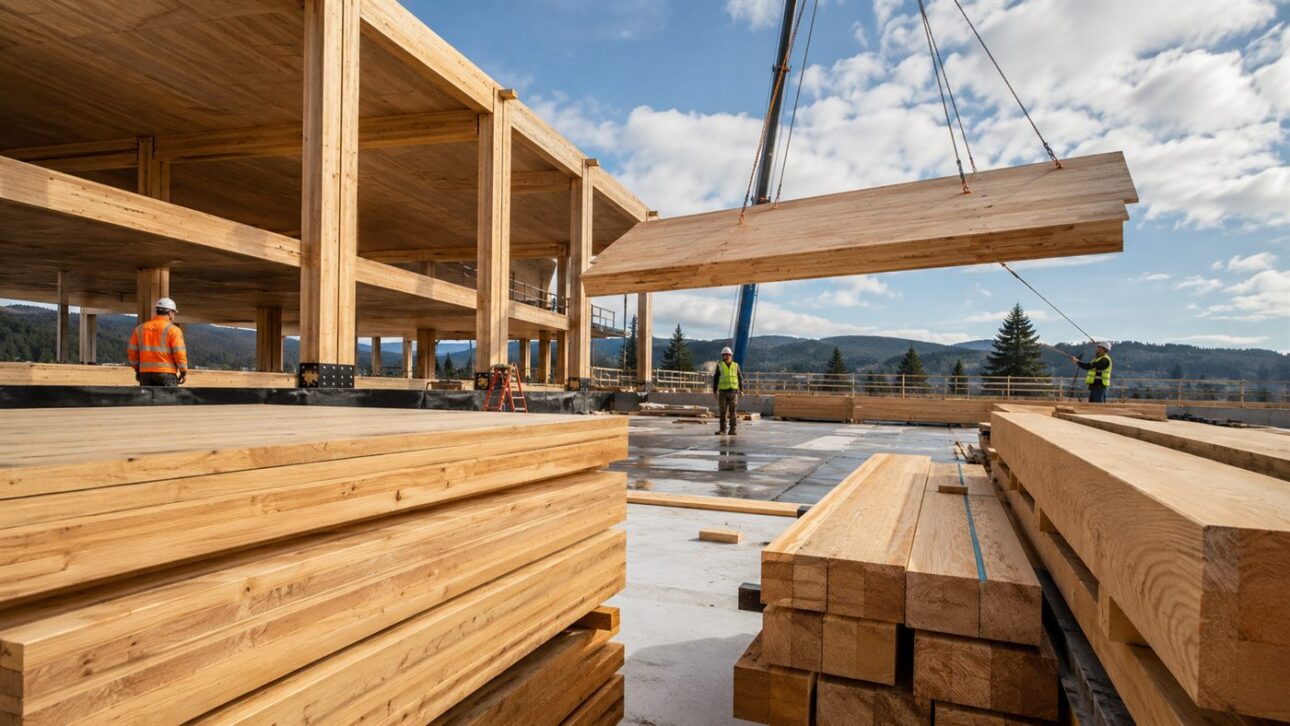
The great advantage is the combination of lightness and strength. A piece of this material can replace a steel beam or a concrete pillar weighing much less, which reduces foundations, transportation, and time. It’s forest material with heavy industry performance.
Contrary to what many think, this type of structure behaves well in fire because solid wood burns from the outside in slowly and predictably, maintaining structural capacity for long enough. The fear of fire here is more myth than reality.
Ready in 7 months: the speed of dry construction
Perhaps the most impressive fact for builders is the timeline. Praça Pitiguari was completed in about 7 months, a speed that conventional concrete construction can hardly achieve for a project of this size.
The secret is the so-called dry construction. The pieces arrive ready from the factory, in the exact size, and are just assembled on site, like a large puzzle. Without waiting for concrete to cure, the project becomes assembly, and assembly is fast.
Less construction time means lower financial costs, less disruption in the surroundings, and a faster return on investment. In a market where time is money, the speed of wood is a compelling argument on its own.
CLT and glulam: the structural duo
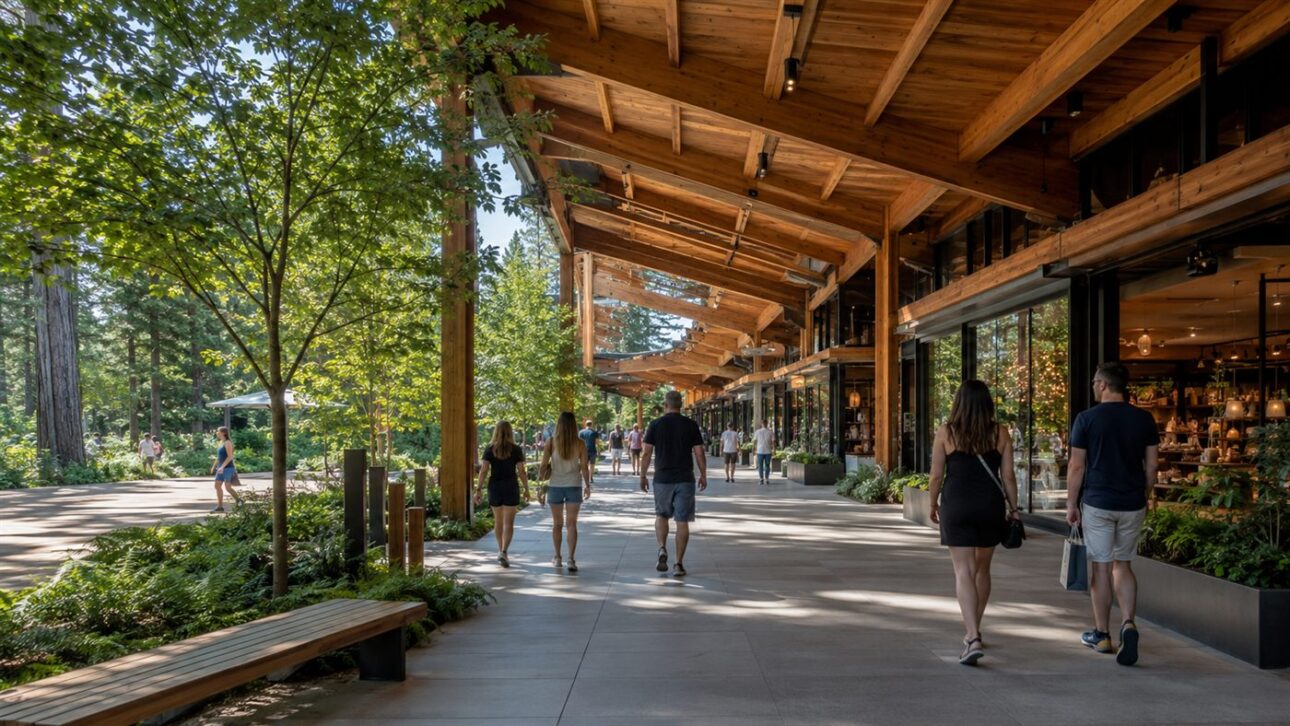
The project combines two types of pieces with different functions. CLT, which stands for cross-laminated timber, forms large panels used as slabs and structural walls, planes that close and support the building.
Meanwhile, glulam, laminated glued timber, forms beams and pillars, the linear elements that span the spaces and hold the loads. Together, almost 700 cubic meters of CLT and more than 600 of glulam form the complete skeleton of the project. It’s the duo that replaces, respectively, the concrete slab and the steel beam.
Using both together, on a large scale, shows technical maturity. It’s not about a wooden decoration over a concrete structure, but a building whose backbone is entirely made of wood.
900 tons less carbon
The environmental account is what makes the choice so powerful. According to Grandes Construções, using wood instead of concrete and steel avoided the emission of more than 900 tons of carbon into the atmosphere, considering what was not emitted and the carbon stored in the wood itself.
This happens for two reasons. Producing cement and steel releases a lot of CO2, so not using them already cuts emissions. Additionally, the tree captured carbon while it grew, and this carbon remains trapped in the structure throughout the building’s life. The building becomes a standing carbon stock, not a source of emission.
In times of climate goals, a material that builds quickly and also sequesters carbon is almost too good to be true, but it is exactly what renewable wood delivers.
A shopping mall that became a showcase
Located next to the Itapetinga State Park, the 46,000 square meter development was designed to integrate commerce and nature, with wood reinforcing this green identity. The Open Mall is an open, ventilated shopping format, more like a plaza than a closed box.
The choice of wood there is not just technical, it is also a message. A shopping center that displays its own wooden structure communicates sustainability without needing a speech, and becomes an attraction in itself. Architecture and environmental purpose go hand in hand.
The project, signed by a specialized architecture firm, proves that wood is not an aesthetic limitation, but rather project freedom with contemporary appeal.
Why this matters for Brazil
Brazil has a huge and underexplored advantage in this story: plenty of planted forests. The country is a leader in eucalyptus and pine productivity, the ideal raw material for engineered wood, which gives it the potential to lead this construction on the continent.
Each project like Praça Pitiguari creates demand, a production chain, and confidence in the material, pushing the sector forward. If Brazil transforms its forestry strength into construction, it can decarbonize works and generate income in the countryside at the same time. The material manufacturer even plans to double its production in response to growing demand.
Replacing part of the national concrete with reforested wood would be a silent revolution, uniting agribusiness, industry, and climate goals in one product.
The challenges of wood in Brazilian construction
Not everything is simple. The construction culture in Brazil is strongly linked to concrete, and changing this requires training engineers, architects, and workers, as well as overcoming the distrust of clients and the real estate market.
There is also the challenge of scale and cost: the engineered wood chain is still young in the country, and gaining competitiveness requires more factories and volume. The technology has already proven that it works; it just needs to become routine, not the exception.
Even so, Praça Pitiguari sends a clear and counterintuitive message: it is possible to build an entire shopping mall out of wood, faster, lighter, and capturing carbon. If the largest project of its kind in Latin America is already standing in the interior of São Paulo, how long until wood stops being a novelty and becomes the new normal in construction?