





 Portuguese
  English
  Spanish
  3 min of reading
  0 comments


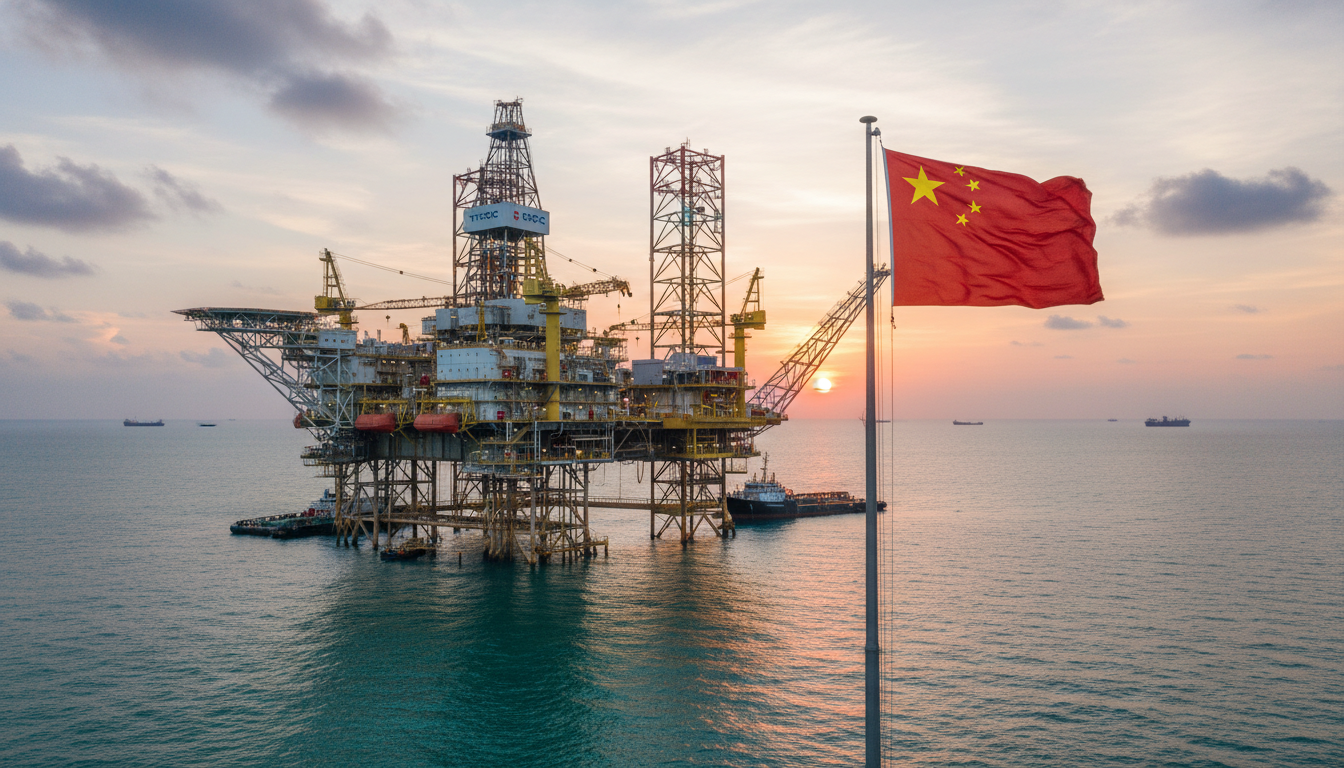
CNOOC announced the discovery of the Huizhou 19-6 field in the South China Sea, with proven reserves exceeding 100 million tons of oil equivalent, 170 km from Shenzhen, in ultra-deep clastic rock layers at 5,415 meters that had never been explored before
On March 31, 2025, China National Offshore Oil Corporation (CNOOC) confirmed a discovery that could reshape the Asian energy map. The Huizhou 19-6 field, located in the eastern South China Sea about 170 km from Shenzhen, contains proven reserves exceeding 100 million tons of oil equivalent. Thus, it is the first large-scale clastic oil field found by China in ultra-deep deep-play layers.
Zhou Xinhuai, CEO of CNOOC, stated: “This is the second consecutive discovery, in two years, of fields with more than 100 million tons in reserves in the eastern South China Sea.” Therefore, China is unlocking a new oil frontier in waters that previously seemed depleted.
The numbers of the Huizhou 19-6 field that surprised geologists

- Reserves: +100 million tons of oil equivalent
- Location: ~170 km from Shenzhen, Guangdong
- Water depth: 100 meters (average)
- Reservoir depth: 5,415 meters (ultra-deep)
- Rock type: large-scale integrated clastic (1st of its kind in offshore China)
- Production test: 413 barrels of oil + 68 thousand m³ of natural gas per day
Xu Changgui, Chief Geologist of CNOOC, stated: “The discovery confirms the existence of the largest clastic oil field in China, highlighting the high exploration potential of resources in high-temperature and high-pressure basins along the country’s coast.”
-
A 2.4-meter drone created in Denmark could change sea rescues by locating castaways with more than 80% success, landing on ships in seconds, and delivering life vests before cold and exhaustion reduce survival chances.

-
Starlink stops selling antennas to consumers in the United States, Canada, and Mexico, and starts charging a monthly rental fee for the equipment in a new strategy for satellite internet.
-
With solar panels on one in three houses, Australia accelerates the home battery race, connecting more than 1,000 units per day and showing how families can store rooftop energy to avoid expensive electricity peaks at night.
-
SpaceX created an artificial flood to protect the largest rocket ever developed by the company.





Why finding oil in ultra-deep clastic rock is so difficult

Ultra-deep clastic layers combine three challenges that make exploration extremely complex: low rock permeability, high temperatures, and elevated pressures. Consequently, few companies in the world have the technical capacity to drill and produce under these conditions. The Huizhou 19-6 field is the first time that China has been able to confirm significant reserves in this type of formation in an offshore environment.
The discovery adds to other recent successes of CNOOC in the eastern South China Sea, including Huizhou 26-6 North, Panyu 10-6, Kaiping 18-1, and Xijiang 24-2. Furthermore, the Kaiping 18-1 field had already been the first discovery of 100 million tons in deep waters in the region.
Chinese energy security and disputes in the South China Sea

The Huizhou 19-6 field is located in China’s Exclusive Economic Zone, outside the areas directly disputed with the Philippines, Vietnam, Malaysia, and other countries. However, the South China Sea as a whole is one of the most geopolitically tense points on the planet, and any expansion of exploration in the region has strategic implications.
For Chinese energy security, the discovery is significant. China seeks to reduce dependence on oil imports, which may peak in 2026 with a slowdown in transportation demand. Still, the Huizhou 19-6 field does not have a defined timeline for the start of commercial production, and the challenges of low permeability may delay exploration. On the other hand, each field that CNOOC confirms in the eastern South China Sea strengthens the narrative of self-sufficiency that Beijing has pursued for decades.





-

1 person reacted to this.