






 Portuguese
  Spanish
  3 min of reading
  0 comments


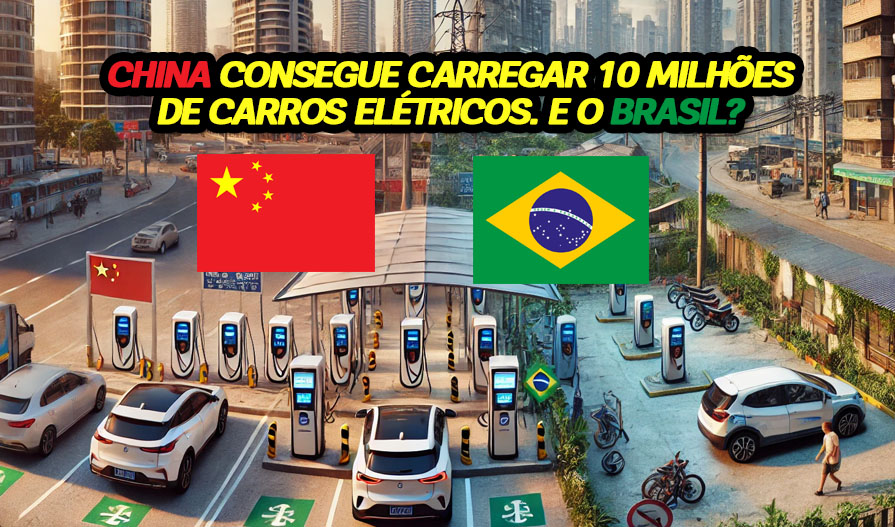
Imagine Living in a Country Where Charging Your Electric Car Is As Simple As Stopping at Any Corner. This Is the Scenario That China Is Building, and Every Month, the Numbers Impress Even More.
At the end of July 2024, the Asian country announced a surprising milestone: over 10.6 million electric vehicle charging stations are in operation. According to the National Energy Administration of China, these numbers represent a growth of 53% compared to the previous year.
Of the total, 3.2 million are public stations, while the remaining 7.4 million are private. The country does not stop there: ultra-fast charging stations are being installed on highways and rural areas, with plans to add another 3,000 charging points and 5,000 parking spaces on highways by the end of 2024, according to the National Development and Reform Commission (NDRC).
China now holds the largest charging service network in the world, an infrastructure capable of meeting the needs of over 24 million electric vehicles already circulating in the country.
-
Uber Faces Shareholder Scrutiny as Board Accused of Ignoring Safety, Compliance, and Harassment Warnings Amid Over 3,500 U.S. Lawsuits

-
Ferrari’s First Electric Car Divides Fans, Priced at $630,000, Amid Concerns Over Limited Editions; Brand Clarifies It’s Not Just for Future Perks
-
BYD Dolphin Mini: The Electric Car That Defies Depreciation, Losing Only 3.58% in a Year and Becoming the Best-Selling Retail Model Under $22,000

-
Electric Car JAC E-JS4 Loses $19,000 in Value in One Year, Leading Record Depreciation of Used Cars in Brazil Due to Expensive Battery and New Models


“The total charging and sharing power has exceeded 160 million kW, meeting the demands of our electric vehicles,” highlighted Zou Peng, executive secretary-general of the Alliance for the Promotion of Electric Vehicle Charging Infrastructure in China (EVCIPA).
Brazil Is Still Crawling in Charging Infrastructure
While China rapidly advances, Brazil still faces major challenges in expanding its charging network. Although the Brazilian Electric Vehicle Association (Abve) has estimated that the number of charging stations in the country is expected to more than double by the end of 2025, reaching the mark of 10,000, the current landscape is challenging: only 4,600 charging points are in operation as of August 2024.
This growth, while significant, still reflects the limitations of the Brazilian market. The concentration of charging stations in the South and Southeast regions — with nearly one-third of them located only in the State of São Paulo — reveals the disparity between the more developed areas and other regions of the country.
About 70% of charging stations are concentrated in these two regions, which restricts access to electric vehicles to the wealthier areas, as highlighted by Pedro Rodrigues, director and partner of the Brazilian Infrastructure Center (Cbie).
The infrastructure necessary to support a significant increase in charging stations is a constant concern. Rodrigues explains that regions outside the South-Southeast axis lack robust enough energy transmission systems to sustain a larger number of charging stations.
“The cities in the Southeast and South mostly have better infrastructure, but in the North and Northeast, the fragility of the transmission systems is a major obstacle to expansion,” he stated.
Decelerated Expansion and Challenges Ahead
The expansion of infrastructure in Brazil is far from homogeneous. In February 2024, Raízen, a fuel distributor, and electric vehicle manufacturer BYD signed an agreement to install 600 new charging points in eight capitals across the country. This effort, while significant, is still short of what is necessary to democratize access to electric vehicles in Brazil.
The high cost of electric vehicles also contributes to this inequality, limiting the market to the economically stronger regions. With prices still unaffordable for most of the population, the expansion of charging stations becomes a risky bet in many areas of the country.
In light of this scenario, the question remains: will Brazil be able to keep pace with China’s rapid expansion of electric vehicle infrastructure, or will we continue to lag behind in global innovation?





Be the first to react!