Portuguese
  Spanish


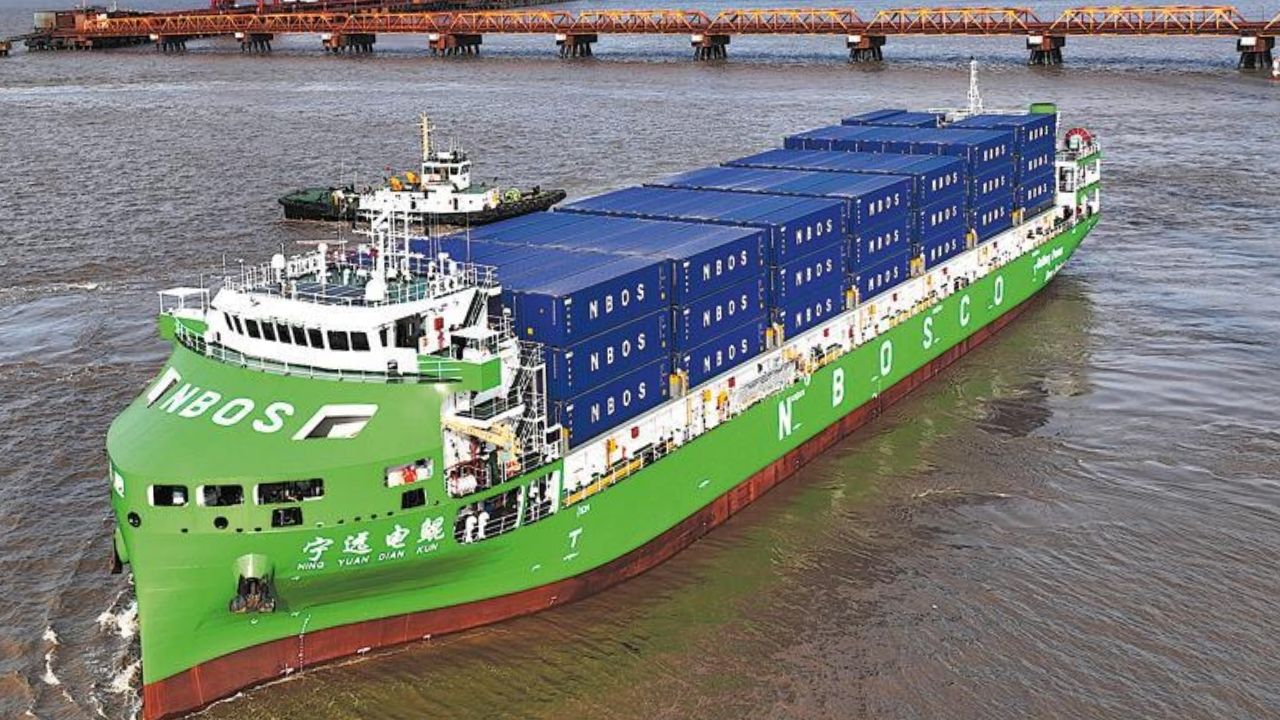


The ship Ning Yuan Dian Kun was delivered in Ningbo after tests and will operate between Ningbo and Jiaxing, in China, with 10 container-format energy units, electric propulsion, autonomous navigation, silent operation, and a promise to cut 1,462 tons of carbon annually in Chinese coastal cargo transportation.
The Ning Yuan Dian Kun ship has placed China in a new stage of coastal maritime transport by setting sail as the world’s largest intelligent and fully electric container ship. The vessel was delivered in Ningbo, in Zhejiang province, after completing tests and will continue operation on the route between Ningbo and Jiaxing.
According to information from ChinaDaily, with a capacity of over 740 TEUs, energy supply of about 19,600 kWh, and electric propulsion, the cargo ship was presented as a symbol of a transition in Chinese navigation to quieter, smarter, and lower-emission operations. The project also promises to cut 1,462 tons of carbon per year.
Electric ship marks a new phase of Chinese coastal transport
The Ning Yuan Dian Kun was developed to serve a specific coastal route in Zhejiang, between the ports of Ningbo-Zhoushan and Jiaxing. The proposal is not just to replace fuel with electric energy, but to showcase an operational model for zero-emission container maritime transport during the voyage.
-
Artist’s 15-Meter Lighthouse in the Mojave Desert, 160 km from the Sea, Intrigues Visitors with 19 km Range After Years of Bureaucracy

-
Bluetti AC70 Solar-Powered Station: Powers Fridge and Wi-Fi During Blackouts, Delivers 1,000W, 3,000 Charge Cycles, Priced at $900

-
Enormous Black Hole Phoenix A* Challenges Scientific Understanding with Mass of 100 Billion Suns, Surpassing Famous TON 618 in One of the Largest Known Galaxy Clusters
-
Say Goodbye to Storing Wine in a Regular Fridge: Midea’s Climate-Controlled Cellar Holds 34 Bottles, Maintains 5-18°C, and Uses Only Half a kWh Daily


The vessel was described by project experts as an example of the complete development of zero-carbon ships, combining purely electric propulsion, autonomous navigation, and high operational efficiency.
The delivery of the ship also reinforces China’s strategy to expand clean technologies in segments that traditionally depend on fuel engines. In coastal transport, this change can have a direct impact on short and frequent routes, where recharging and energy planning are more viable.
According to the technical managers, the model indicates that container transport in Chinese coastal waters is entering a phase marked by operational intelligence, efficiency, and emission reduction.
Vessel has 740 TEUs and 19,600 kWh of energy

The ship is 127.8 meters long and 21.6 meters wide, dimensions designed for coastal operation between cities in Zhejiang. Its capacity exceeds 740 twenty-foot equivalent units, known as TEUs.
The energy comes from 10 container-shaped power units, with a total supply capacity of about 19,600 kWh. This arrangement allows the energy source to be adapted to the container ship’s own logistics universe, using modules compatible with the ship’s operation.
The vessel was developed and designed by the Shanghai Merchant Ship Design and Research Institute, known as SDARI. The electric propulsion system was provided by the Shanghai Marine Equipment Research Institute, SMERI.
The two institutions are subsidiaries of China State Shipbuilding Corp, a state group linked to the Chinese naval industry. The project, therefore, combines research, shipbuilding, and integration of electrical systems into a real operational platform.
Electric propulsion changes noise, response, and crew routine
One of the most noticeable impacts of the vessel is the noise. Captain Wang Ting highlighted that, compared to fuel-powered ships, the most evident change in a fully electric cargo ship is the absence of the typical engine room noise.
The journey becomes almost silent, creating a quieter working environment for the crew. Without the constant roar of the main engine, operators can better focus on maneuvers and navigation routines.
The response of the electric motors also changes the way of driving. The torque of electric propulsion is linear and immediate, allowing smooth acceleration and deceleration, with high response and virtually no delay.
At the same time, the new system requires learning. The crew needs to monitor energy consumption, manage available power, and plan the ship’s speed more rationally during the route.
Synchronous motors reduce emissions and eliminate local pollutants
The Ning Yuan Dian Kun uses two synchronous permanent magnet propulsion motors. The technology is associated with the estimated annual reduction of 1,462 tons of carbon emissions.
In addition to the reduction of CO₂, the project also promises to eliminate emissions of sulfur oxides, nitrogen oxides, and fine particles during operation. This represents a significant difference in ports and coastal areas, where air quality is pressured by maritime traffic.
According to Ma Hongmeng, senior engineer at SDARI and responsible for the smart ship, the vessel seeks to achieve zero pollution throughout the entire transportation process, from navigation to docking, loading, and unloading.
The statement refers to the direct operation of the ship, based on electric propulsion. The source of the energy used for recharging remains an important point to assess the total impact of the energy chain.
Autonomous navigation requires a new type of monitoring
The vessel was also presented as smart, with features linked to autonomous navigation and efficient operation. Therefore, maritime authorities have set up a dedicated team to monitor the complete cycle of the ship.
The Ningbo Maritime Safety Administration reported that, as it is a new generation of smart vessel, there will be continuous tracking and precise evaluations from the design, construction, and navigation to the control of operational risks.
This monitoring is essential because electric and smart ships present different challenges from traditional cargo ships. It is not enough to evaluate the hull, engine, and route; it is also necessary to understand digital systems, autonomy, energy, and operational safety.
The operation of the Ning Yuan Dian Kun can help form technical standards for other larger electric vessels, especially on high-demand coastal routes.
China attempts to create a replicable zero-carbon transport model
Ningbo Ocean Shipping Co, the company for which the ship was custom-made, already operates 32 green and energy-efficient vessels, which represent 57% of its own fleet.
The company’s president, Chen Xiaofeng, stated that the goal is to use the Ning Yuan Dian Kun to make advances in key areas and build the country’s first fully electric maritime ship demonstrative model.
The intention is to expand pure electric technology from inland waterways to maritime transport, creating a complete, replicable technical and operational system aimed at zero-carbon transport.
This point is important because the ship does not function just as an isolated vessel. It also serves as a showcase for a chain of technology, operation, training, and energy management that can be applied to other routes.
Route between Ningbo and Jiaxing becomes a real laboratory
The choice of the route between Ningbo and Jiaxing is strategic. Both cities are located in Zhejiang, in eastern China, a region with strong port, industrial, and logistics activity.
In coastal routes, operational predictability can favor the use of electric ships. Shorter distances, known docking points, and regular cycles help in energy planning and recharging.
This makes coastal transport a more realistic field for testing large-capacity electric vessels. Instead of starting with long ocean crossings, the project advances in a controlled and commercially relevant environment.
If performance is confirmed in daily operation, the Ning Yuan Dian Kun can pave the way for new electric vessels in other Chinese coastal corridors.
Ship challenges the era of fuel-powered cargo ships
The advancement of the Ning Yuan Dian Kun does not mean that traditional cargo ships will disappear quickly. Global maritime transport still heavily relies on fossil fuels, especially on long-distance international routes.
But the Chinese ship shows a concrete alternative for a specific segment: coastal container transport. In this niche, electrification can reduce noise, local emissions, and fuel consumption in frequent operations.
The main challenge will be to prove scale, reliability, cost, and energy availability. The system needs to work not only in tests but in commercial routine, with cargo, weather, delays, maneuvers, and real logistical pressure.
Even so, the delivery of the vessel marks an important step for the Chinese naval industry and for the debate on how to decarbonize part of maritime transport.
Largest intelligent electric container ship opens new naval dispute
The Ning Yuan Dian Kun places China in a prominent position in the race for larger electric ships. With over 740 TEUs, 19,600 kWh of energy, and intelligent operation, the cargo ship shows that electrification is starting to move from smaller vessels to relevant commercial routes.
The project combines naval technology, energy management, autonomous navigation, and environmental goals. The promise to cut 1,462 tons of carbon per year makes the ship a symbol of the Chinese maritime transition.
It will still be necessary to monitor its real operation, costs, and replication on other routes. But the message is clear: the future of coastal transport may not depend solely on fuel engines.
And you, do you think electric ships like this can change global maritime transport, or will this technology still be limited to short and controlled routes? Share your opinion.