Portuguese
  Spanish


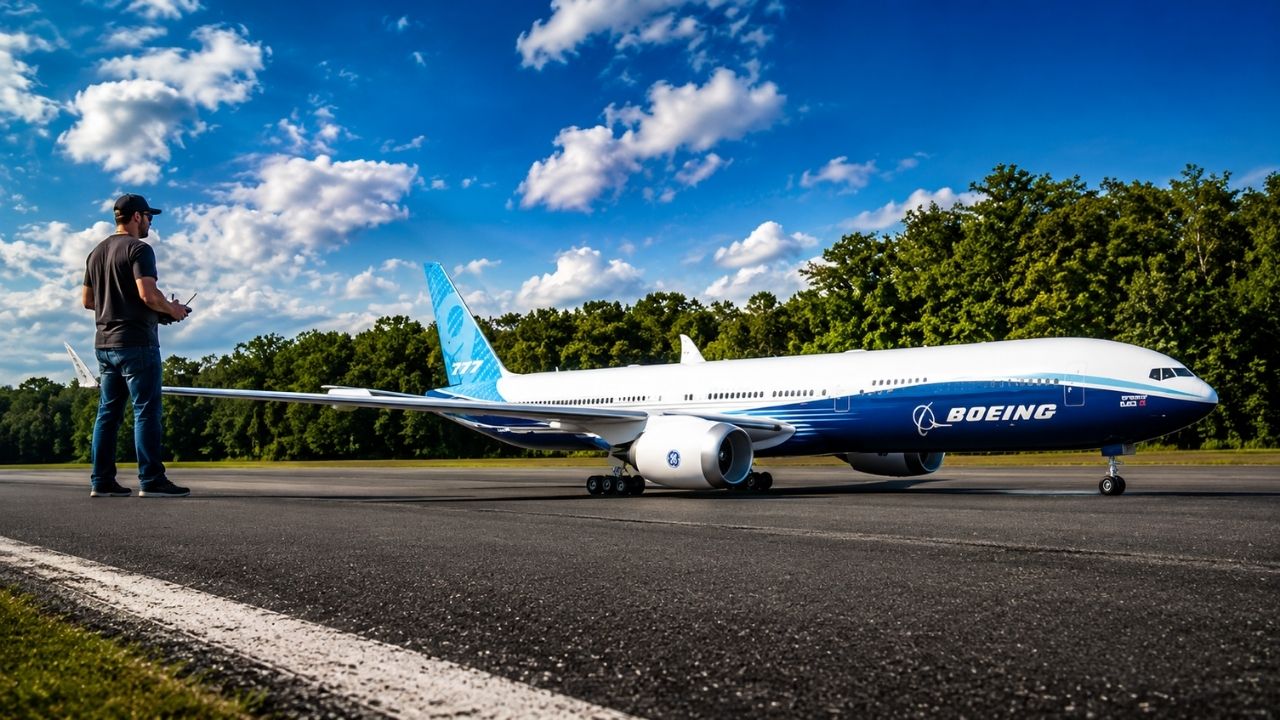


Boeing 777 in giant model aircraft received Boeing paint, cut-out windows, detailed engines, and functional lighting, but tests revealed landing gear failures, tire loss, and battery adjustments until the team found balance, corrected the center of gravity, and completed a landing considered perfect on the radio-controlled field.
The giant-scale Boeing 777 returned to testing almost two months after the inaugural flight, now with final paint in Boeing’s visual pattern, cut-out windows, installed lights, and detailed engines. The model aircraft was prepared by Mike and his team to fly in a radio-controlled aviation field, in front of the project’s creators.
In a video published on the Ramy RC channel, what seemed like just a visual display turned into a sequence of technical adjustments. During the flights, the model faced a landing gear problem, lost a tire, showed heavy nose behavior, and needed the batteries repositioned until achieving a clean landing.
Boeing 777 impresses with finish even before taking off

The Boeing 777 in scale drew attention right at the final presentation. The house livery style paint from Boeing gave the model aircraft an appearance very close to a real aircraft, with visual details that reinforced the realism proposal.
-
Thailand Converts 8 Tons of PET Bottles into 3,500 School Backpacks, Showcasing Circular Economy with Over 40 Factories Involved

-
Mysterious Bats Spotted in Paris’s Père Lachaise Cemetery, Drawing Tourists to the “Vampire Cemetery”

-
From Selling Street Food to Leading a $300 Million Construction Firm: The Journey of a Brazilian Entrepreneur

-
Abandoned Penthouse in Houston Reveals Million-Dollar Suite with 24-Karat Gold, Tiffany Crystals, and Opulence Even Elvis Might Have Snubbed




The windows were not just painted: they appear cut out in the fuselage. This detail enhances the sense of scale and differentiates the project from simpler models, where much of the finish remains only in the external paint.
The engines also received special attention, including logos and finish on the spinners. Functional lighting was installed to complete the look, creating a model aircraft with strong presence both on the ground and in the air.
Even so, one detail still bothered the team: the tires. According to the report, the model needed thicker tires, approximately 70 mm in width, but the team couldn’t find a ready-made option on the market and had to fly with temporary parts.
First flight with final look exposes problem in landing gear

When the Boeing 777 took to the air with the final paint, the look impressed, but the test quickly revealed that not everything was resolved. During the flight, the team noticed that the landing gear exhibited irregular behavior.
The problem appeared when the retraction command did not work as expected. The landing gear got stuck, requiring new attempts to activate it in the air. After a few cycles, the team managed to lower the assembly again to prepare for landing.
The situation showed how a model of this size depends on precision in small details. An interference in the mechanism, a poorly positioned part, or an inadequate tire can completely alter the safety of the operation.
The subsequent landing confirmed the difficulty. The model lost a tire and could not execute the flare as expected, a movement where the nose rises smoothly before touching the ground. The team assessed that the model was nose-heavy and needed correction.
Lost tire showed the limit of temporary parts

The lost tire on the Boeing 777 was not treated as an isolated detail. The team itself had already expressed concern about the tires before the flight, because the available parts did not have the ideal width to maintain appearance and function at the correct scale.
In large models, the landing gear is not just a visual accessory. It needs to absorb impact, maintain stability during taxiing, and work in conjunction with the aircraft’s total weight, especially in faster landings.
The loss of the tire reinforced that the project still needed more suitable parts. The team commented that it would be necessary to find or manufacture better tires to replace the improvised ones.
Even with the problem, the flight did not end in disaster. The model aircraft returned to the ground, allowed inspection, and paved the way for adjustments. This type of test is precisely the moment when hidden failures appear before a more stable operation.
Battery adjustment changed behavior in the air

Besides the landing gear, the Boeing 777 also required corrections in the center of gravity. The team explained that the paint and finish added weight to the tail, which led to moving the batteries forward.
The problem is that this repositioning seems to have gone beyond the ideal. With the batteries too far forward, the model aircraft became nose-heavy, making the flare difficult and causing the pilot to feel that the model did not lift the nose as it should during the approach.
After the first landing, the team decided to move part of the batteries back again. The change improved the behavior but still required care. The goal was to find a balance that would allow landing with a slightly high nose, without a sudden drop at the end.
This adjustment shows the complexity of a project of this size. In a giant model aircraft, centimeters in the position of the batteries can alter stability, approach speed, and response to commands.
After adjustments, the perfect landing finally came
After correcting some of the problems, the Boeing 777 returned to the air for new tests. The model presented a more stable flight, better-controlled speed, and more predictable response during the final approach.
The difference was mainly noticeable during the landing. With the center of gravity better adjusted, the pilot was able to execute the flare with more control, reducing the sensation that the model aircraft was “falling” at the last moment.
The final landing was celebrated by the team, who considered the landing perfect after previous attempts. The model touched the ground smoothly, ending the test sequence with a positive result.
In total, three flights were conducted, according to the final report. The first two presented minor problems with the landing gear, but the team managed to correct the failures and conclude the test with a successful demonstration.
Model Aircraft Shows That Realistic Finish Does Not Eliminate Technical Precision
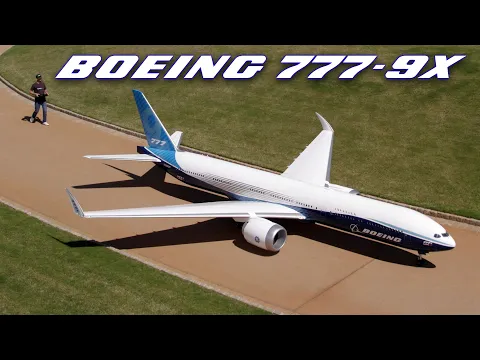

The case of the Boeing 777 clearly shows that a high-level model aircraft does not rely solely on a beautiful paint job. The final finish can transform the appearance, but it also changes weight, balance, and flight behavior.
Every detail needs to align with the model’s engineering. Lights, windows, engines, paint, batteries, tires, and landing gear are part of a unique system. When one of these elements changes, the entire set may require a new adjustment.
The beauty of the project lies precisely in this combination of visual and technical aspects. The model aircraft looks like a faithful reproduction of a real aircraft, but it still needs to face the same basic principles of flight, weight, drag, stability, and landing.
In the end, the test reinforced the importance of patience. The first flight with the final look was not perfect, but it revealed what needed to be corrected. After adjustments, the model managed to deliver the image the team had been aiming for from the start.
The reward came in the end, with a landing considered perfect after the adjustments. The project shows that, in high-level model aircraft, impressive appearance only works when the technical part keeps up. Do you find it more interesting to see the perfect final result or to follow the problems and corrections that happen behind the scenes of a project like this?