Portuguese
  Spanish


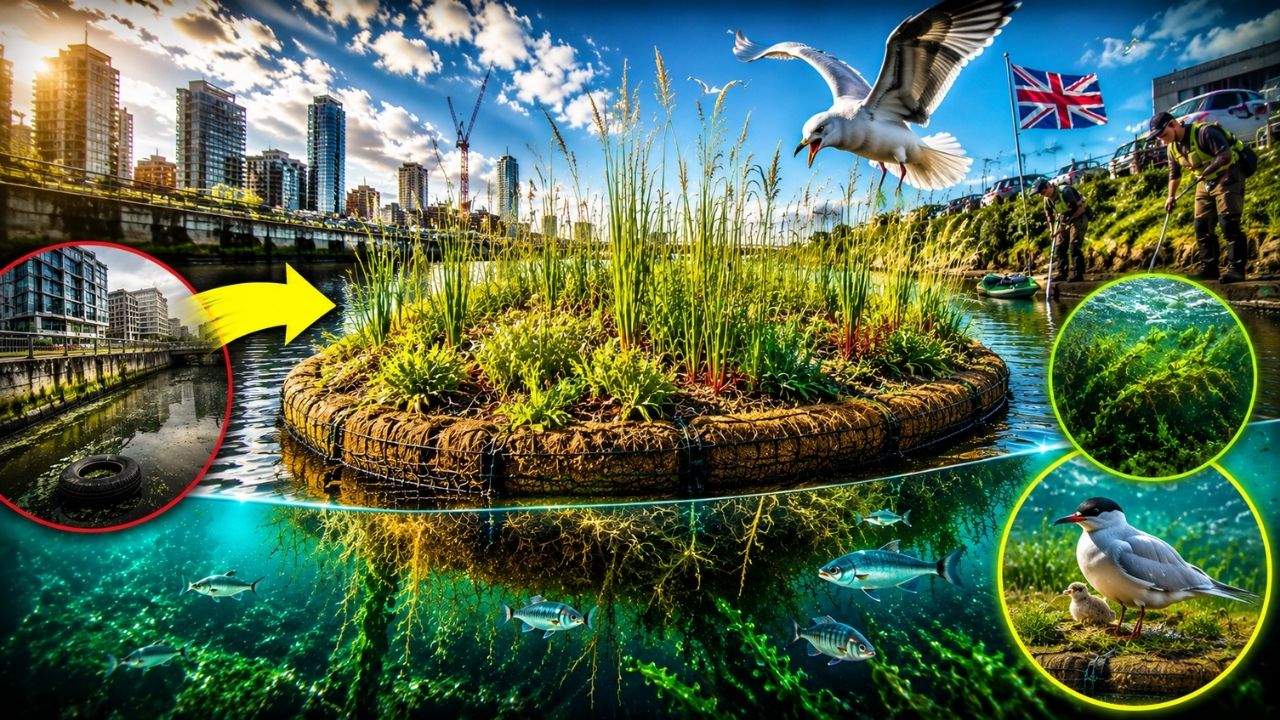

Project led by the University of Portsmouth installs floating marsh with salt marsh vegetation in Portsmouth to assess water cleaning, species return, and coastal resilience, after marine habitats lost more than 85% of vegetation in the UK in 50 years, in areas pressured by concrete, seawalls, and urbanization.
A floating marsh is being tested in the UK to recover lost environmental functions in coastal areas taken over by concrete. The project is led by the University of Portsmouth, in partnership with Southern Water, in Portsmouth, and was announced in April 2026 as a coastal restoration experiment.
According to a publication by the University of Portsmouth, the initiative uses floating pontoons designed to support salt marsh vegetation in coastal waters. The proposal is to assess whether this system can improve water quality, create refuge for marine species, and return biodiversity to environments where natural habitats have been reduced by constructions, seawalls, and urbanization.
UK tests floating marsh in areas where coastal vegetation has disappeared

The project arises in a scenario of significant loss of coastal ecosystems. Researchers point out that more than 85% of aquatic and marine vegetation, including salt marshes, seagrasses, and algae, have disappeared in the UK over the last 50 years.
-
EcoFlow’s Portable Fridge Offers 43 Hours Off-Grid, Reaches -25°C, App-Controlled, Solar-Powered for Camping and RV Adventures

-
Vietnamese Inventor Overcomes Debt and Develops Agricultural Robot Sold in 15 Countries
-
3,000 Sheep Maintain 900 MW Solar Farm Transforming Texas Fields into Energy for Data Centers

-
Distant Galaxy Shaped Like a Giant Jellyfish Sheds Gas, Forming New Stars as It Moves Through Hot Cosmic Gas



This disappearance affects not only the landscape but also important ecological functions. Without coastal vegetation, shallow marine areas lose shelter for fish, natural water filtration, and spaces used by different organisms for feeding and reproduction.
Pontoons with marine plants attempt to recreate a habitat that concrete eliminated
The floating marsh functions as a structure installed over the water, with pontoons capable of supporting typical salt marsh plants. Instead of trying to immediately reconstruct a natural area fixed to the ground, researchers are testing a living platform capable of occupying spaces where the original habitat was lost.
The idea is especially relevant for coastal zones modified by rigid infrastructure, such as flood defenses, seawalls, and urbanized areas. In these locations, the coastline continues to exist physically, but often loses the vegetation that supported marine life.
Floating marsh system is still rare in marine environment

According to the researchers involved, the use of marine species in such a floating system is still uncommon. The technique has been tested only a few times before, making scientific monitoring a central part of the project.
The floating marsh is not presented as a complete substitute for a natural coastal ecosystem. The proposal is to verify if it can function as a complementary solution, especially in areas where traditional restoration faces limits due to urbanization or the presence of concrete structures.
Water quality will be monitored before and after installation
The floating wetlands were created at Southcoast Wake Park, in Portsmouth, as part of a long-term research program. Scientists will monitor the environment before and after installation to measure changes in water, biodiversity, and ecological resilience.
Among the objectives is to observe if the plants can absorb nutrients and pollutants present in the aquatic environment. This type of monitoring is crucial because it allows separating expectation from real results, showing if the system delivers measurable benefits over time.
Biodiversity will be measured with environmental DNA
The team will also use environmental DNA sequencing, known as eDNA, to track changes in biodiversity. This technique allows for the identification of traces left by organisms in the environment, including bacteria, fungi, fish, and invertebrates.
With this, researchers will be able to assess whether the floating marsh attracts new forms of life or alters the ecological composition of the area. The method also helps identify the origin of bacterial communities, information relevant to studies related to water quality, mollusk protection, and bathing conditions.
Project aims for scalable solution for the British coastline

Southern Water sees the initiative as a potential nature-based solution for protected areas in the future. If the results are positive, floating wetland technologies could be evaluated in other marine environments and also in freshwater areas.
The interest in scale arises because the loss of coastal habitat is not an isolated problem in Portsmouth. The United Kingdom faces combined challenges of coastal urbanization, nutrient pollution, pressure on ecosystems, and climate change, factors that increase the need for adaptable alternatives.
Floating marsh also enters the economic debate of coastal restoration


The restoration of coastal habitats involves not only environmental conservation. Researchers highlight that coastal ecosystem services are estimated at £211 billion for the UK economy, which includes benefits related to natural protection, biodiversity, water quality, and long-term resilience.
In this context, the floating marsh appears as an attempt to unite ecological engineering and coastal management. The central question is whether living structures, installed in areas altered by concrete, can restore some of the functions that the coastline lost without requiring major interventions in the terrain.
Experiment may indicate a new path for coastal cities
The test in Portsmouth will be observed over time, because coastal systems change with tides, weather events, pollution, and human pressure. Even if the initial results are positive, the effectiveness will depend on the permanence of the plants, the response of the fauna, and the system’s maintenance capacity.
The experience also shows a shift in thinking about coastal infrastructure. Instead of relying solely on concrete to control risks, such projects aim to include vegetation, biodiversity, and natural filtration as part of the solution.
Now the question remains: should solutions like floating marshes be adopted in more coastal areas dominated by concrete, or is it still too early to bet on this type of environmental technology on a large scale? Leave your opinion in the comments.